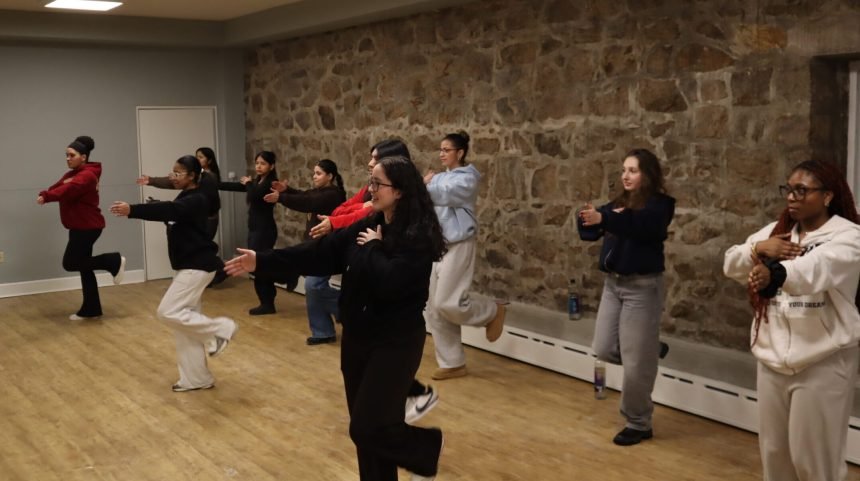
Mu Sigma Upsilon partnered with Tumbao — Lehigh’s Latin dance team — for a cultural dance swap featuring traditional African and Latin dance on Tuesday.
Mu Sigma Upsilon is the first multicultural sorority in the nation, and the ‘Mu’ stands for multicultural. Lehigh’s Yemaya chapter was founded in 2012. The groups gathered in the Umoja dance studio and took turns teaching their respective dance styles.
Tumbao dance captain, Indira Alvarado, ‘26, led the group through a blend of salsa and reggaeton to a remix of Daddy Yankee’s “Lo Que Pasó, Pasó” and Joe Arroyo’s “Rebellión.”
Alvarado said dance has always been an important part of her family and upbringing.
Growing up, she took classes in a variety of dance styles, including ballet, jazz, contemporary and hip-hop. She began Latin dance classes in salsa, merengue and bachata when she was 13.
“Having those classes when I was a little bit older helped solidify the stuff I bring now to Tumbao,” Alvarado said.
She said the team enjoys combining traditional and modern dance, which they also express through their costuming.
Tumbao’s style is colorful and last semester, the team performed at Fusion in a 1990s-inspired sweat set and jersey costume.
T’Anna Gooden, ‘29, said she loved Tumabo’s performance at Fusion.
“They were really well put together and had a good stage presence,” she said.
Gooden said she isn’t a member of either group, but attended the event because her friend, Kaylin Velasquez, ‘28, was teaching. She said she also wanted to learn more about Tumbao and Mu Sigma Upsilon’s Yemaya chapter.
Gooden has a background in contemporary, hip-hop and commercial dance but had never tried Latin dance before the event. She said the speed of the music made the salsa more difficult, but after practicing slowly, she began to understand the rhythm.
“I think the way that (Alvarado) taught without any counts was very helpful,” Gooden said. “It helped me tap into that natural flow (Tumbao) has with salsa.”
Velasquez said shifting from a precise dance style to a more fluid one was difficult at first but enjoyable.
“I haven’t got that flow in me,” Velasquez said. “When (Alvarado) told us to body roll, I said ‘Oh?’”
Gooden said she eventually memorized the steps, and by the end of the session, she performed the routine at full speed alongside Velasquez.
Velasquez said the experience allowed her to tap into her Puerto Rican identity and that she’s open to joining Tumbao next year.
Velasquez choreographed a traditional African step dance for Yemaya to teach the class. Traditional African step dances typically include clapping, body slapping, vocalizations and stomping, along with sharp and precise movements. Often, there’s no music.
“It was cool to dance without any music playing, because we’re so used to (dancing) based off of that,” Alvarado said. “I’m someone who’s very inclined by the lyrics and the beats and the music.”
Stepping became popular in fraternities and sororities in the mid 20th-century but has since expanded to Latino and Asian American fraternities, as well as American high schools.
Velasquez said she began stepping in elementary and middle school and often incorporated African drumming into her dancing.
When choreographing, Velasquez said she prioritizes how the group sounds stomping together, because it has to look good to sound good.
Yemaya promotes belonging and self-improvement through events such as Ladies informational night, where members learn how to become “sophisticated,” and Hair Crush, which celebrates all hair types.
Despite not having an established dance team, Yemaya has performed at Dancefest and the Cultural Greek Council’s bi-annual Yardfest.
This year, Tumbao will be featured in Dancefest and International Bazaar, along with other Lehigh cultural events. The team also hosts independent dance socials for students and faculty, including salsa and bachata nights.
Yemaya collaborates with dance teams at other universities and will travel to the University of Delaware in April to compete in the Blueprint 15.0 Stroll Competition, a three-round dance competition with a $500 cash prize.
Alvarado said the dance swap was an opportunity to step into others’ shoes and learn the traditions of her peers’ cultures. She said it’s important for cultural groups at Lehigh to connect with each other, even when there’s no cultural crossover among members.
“It was fun, especially learning something new that I don’t do and getting into my Hispanic culture,” Velasquez said.