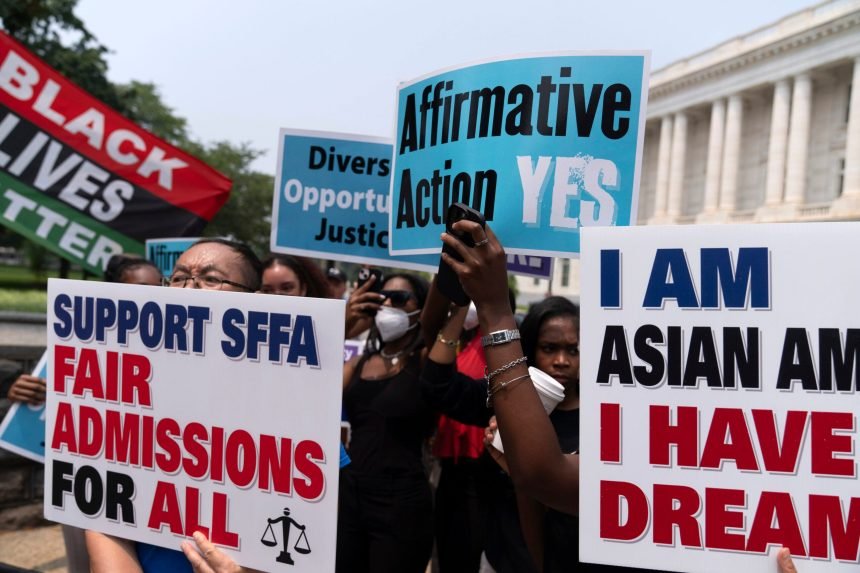
When the U.S. Supreme Court struck down affirmative action in 2023, it banned race considerations in college admissions.
That first started to make an impact for the 2024-25 academic year, and the enrollment numbers from that time shows a shift in the racial makeup of universities.
The nonprofit organization Class Action, which works to promote equity in education, analyzed the admission data from over 3,000 schools and found that highly selective colleges like Harvard and Yale enrolled fewer Black and Hispanic students than before the Supreme Court decision.
News with a little more humanity
WPR’s “Wisconsin Today” newsletter keeps you connected to the state you love without feeling overwhelmed. No paywall. No agenda. No corporate filter.
Class Action senior fellow James Murphy told WPR’s “Wisconsin Today” that the change had a cascading effect that pushed highly qualified students of color toward less-selective public universities instead, like the Universities of Wisconsin.
“It’s a reminder that college admissions is a complex ecosystem,” Murphy said. “It’s not just what happens at one institution.”
For example, a high achieving student of color was less likely in 2024 to get into a school like the University of Chicago, which has an acceptance rate below 5 percent.
That student might instead opt to enroll at a school like UW-Milwaukee, which saw increases in its admissions of Black and Hispanic students after affirmative action was struck down.
But that student’s decision to go to a UW school would take away the spot of a different student, who might get pushed out and attend a community college or technical school instead.
Murphy said each individual college has a wide range of factors that influence the demographics of its enrollment which extend far beyond the Supreme Court ban on race considerations.
In Wisconsin, schools that saw the biggest percentage increase in Black and Hispanic students from 2023 to 2024 included UW-Eau Claire, UW-Milwaukee and UW-Stevens Point. Others like UW-La Crosse, UW-Oshkosh and UW-Parkside saw minimal changes.
UW-Madison saw its percentage of Black and Hispanic students decrease following the Supreme Court decision.
Taylor Odle, an educational policy professor at UW-Madison, believes researchers like him will need more years of enrollment data to understand the full magnitude of these trends and what’s driving them.
He told “Wisconsin Today” that affirmative action wasn’t widespread in Wisconsin college admissions because even the state’s most-selective flagship university, UW-Madison, has a much higher acceptance rate than the Ivy League schools that are seeing more significant demographic shifts.
“Colleges across Wisconsin are thinking about ways of attracting a variety of students, not only racially or ethnically minoritized students but focused on socioeconomically disadvantaged students,” Odle said. “Finding those high achieving Black, Hispanic and other students across the state will be critical for every institution in Wisconsin, not just the public flagship, so that students have a robust and vibrant campus experience where they are exposed to people from different walks of life.”
He pointed to the expansion of the Wisconsin Tuition Promise program which helps students from low- and moderate-income families.
UW-Madison dissolved its Division of Diversity, Equity and Education Achievement last year after pressure from the Trump administration, although the school reorganized some of those efforts into a new office for first generation college students.
Odle thinks it will be important to monitor not just how many students of color enroll at Wisconsin universities as freshmen but how they complete college, earn their degree and transition into the workforce.