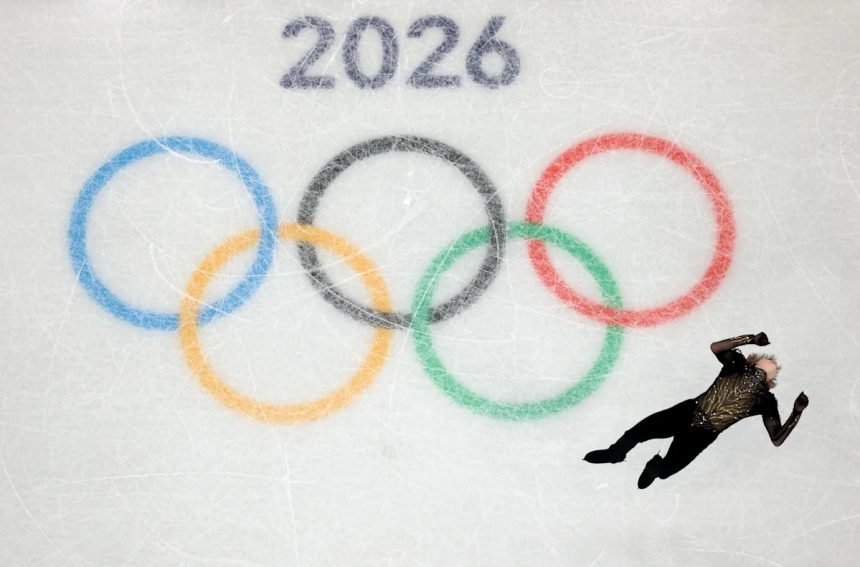
MILAN — Ilia Malinin had just landed a backflip, a trick that fires up a crowd like few other elements in skating. He landed, and looked into the crowd, and there was Novak Djokovic, the tennis GOAT, celebrating as loud as everyone else in the arena.
“He was standing there, hands on his head,” an exhausted, exuberant Malinin said, a gold medal around his neck. “I was like, Oh, my God, you know,? That’s incredible. That’s like a one in a lifetime moment, just seeing a famous tennis player watching my performance. I’m absolutely blown away.”
Advertisement
It was that kind of night for the Americans, a night when everything needed to go exactly right for the United States to defend its team figure skating gold. And everything did, with no margin for error. Amber Glenn’s Olympic debut, a barrage of quads from Ilia Malinin, and the finest-ever skate from pairs duo Ellie Kam and Danny O’Shea all combined to give the United States the gold medal over Japan. Italy claimed bronze in a remarkably close competition.
The United States came into the evening with a five-point lead on Japan, but that lead quickly narrowed after the pairs program. Kam and O’Shea, ranked fifth among pairs after the short program, skated the routine of their lives, exulting in joy on the ice afterward.
USA’s Ilia Malinin competes in the figure skating men’s singles free skating team event during the Milano Cortina 2026 Winter Olympic Games at Milano Ice Skating Arena in Milan on February 8, 2026. (WANG Zhao / AFP via Getty Images)
(WANG ZHAO via Getty Images)
“It felt like a performance of a lifetime,” Kam said afterward, still almost vibrating with joy. “It’s certainly our personal best, and to put it out on a stage like this as a team, it feels amazing.”
Advertisement
But even that performance was only good enough to earn a 135.36 and move the pair up into fourth place. A magnificent performance from Japan’s Ruku Miura and Ryuichi Khara earned a 155.55, won the pairs free skate event for Japan, and closed the gap with the United States to just two points with two events remaining.
Thus, the battle for the gold medal effectively became a math problem between the United States and Japan. That meant Team USA’s Amber Glenn, in her Olympic debut, needed to keep pace with Japan’s Kaori Sakamoto, a two-time Olympian and two-time medalist.
Glenn, one of the fastest and strongest skaters in the Olympics, began her routine with a difficult triple-axel that she barely landed, finishing with a tiny skid. Concern evident on her face, she missed an early combination and closed out a routine that was more powerful than precise. And when she completed her routine, she remained briefly on her knees, shaking her head in frustration.
“I just physically didn’t feel great. My legs were feeling heavy, I was tired, I just didn’t feel my best,” a visibly weary Glenn said after her skate. “I’ve been practicing here incredibly, I’ve been feeling really good, and I think I just had some fatigue. I need to really manage that going into the individual event.”
Advertisement
Glenn grimaced as she was given a score of 138.62, knowing that the math wasn’t in her favor. She fell to third place after Sakamoto’s brilliant skate of 148.62, and the competition came down to the men’s competition with Japan and the United States tied at 59 points apiece. Further down the standings, Italy stood at 52 points, Georgia at 50 and Canada at 47.
After Italy’s Matteo Rizzo skated a strong program to keep the other two nations at bay and clinch a bronze medal for Italy, the ice belonged to Malinin. The Quad God skated onto the ice with a planned program that included seven quad jumps, including a never-before-done-in-the-Olympics quad axel. He started fourth of the five men’s skaters, a result of finishing in second in Saturday’s short program.
Malinin’s short program on Saturday night was uncharacteristically awkward. Sunday’ night’s free skate, by contrast, began with a perfectly executed quad flip. But his planned quad axel turned into a triple axel, and he threw in one of his traditional backflips for some more style. Again, it wasn’t quite up to his standards, scoring 200.03, but would it be enough against Japan’s Shun Sato?
Advertisement
Barely. Sato skated the routine of his life, but ended up just a few points short of Malinin, finishing with a 194.86 that kept the audience on edge right until the score was announced. Once the United States claimed gold, the celebrations began in the American box, and in the stands, and on the medal stand, and then on into the Milan night.