Newly released federal college data show that Hispanic freshman enrollment at Mississippi’s two largest public universities rose sharply in fall 2024, the fastest-growing among flagship colleges in the Southeast since the Supreme Court banned race-based college admissions in a landmark ruling in June 2023.
The University of Mississippi saw a 44 percent increase of its Hispanic freshman headcount between 2023 and 2024, while Mississippi State University’s increased by just over 40 percent, according to a new analysis of federal data by Class Action, a grassroots higher-education advocacy organization. The University of Southern Mississippi, the state’s third-largest college, saw its new Hispanic student numbers fall by nearly 13 percent.
“While this particular study is early and there is much more research to be done on this issue, one thing remains true: Mississippi’s public universities offer a quality education and welcome quality students,” said John Sewell, director of communications for the Mississippi Institutions of Higher Learning, the governing body of the state’s eight public universities. “We are aware of the nationwide enrollment trends following the Supreme Court decision, including the trend of declining enrollment of highly qualified students of color at more selective institutions.”
The trend aligns with broader national findings in the Class Action analysis, which examined Integrated Postsecondary Education Data System data for more than 3,000 colleges and universities, covering roughly three million freshmen. The report found that Black and Hispanic enrollment declined sharply at the nation’s 50 most selective colleges following the Supreme Court decision, while enrollment increased at many public flagship universities. Overall, freshman enrollment of underrepresented minority groups rose 8 percent at public flagships nationwide, according to the data.
Researchers say the shifts reflect what is known as a cascade effect, in which students who once would have enrolled at elite institutions instead attend less selective universities after being rejected under race-neutral admissions rules.
“These really talented Black and Hispanic students who were, in the past, treating the University of Mississippi as their safety school or the University of Michigan as their safety school, because they probably have a better-than-average chance of getting into Wesleyan or Williams or Amherst—suddenly those students aren’t getting into those places,” James Murphy, a senior fellow at Class Action, told inside Higher Ed, a Washington, D.C.-based online news publication. “So, they’re not going to say, ‘well, geez, no college for me.’ They’re going to the schools that they were almost certainly getting into in the past, [but] they just weren’t enrolling in because they were getting into ‘better’ schools.”
Those shifts occurred alongside substantial movement in Black enrollment. At the University of Mississippi, a campus with a long and complicated racial history, Black freshman enrollment increased by 49.7 percent, one of the largest jumps nationally. Mississippi State University saw a 4.8 percent increase, while Black enrollment at the University of Southern Mississippi declined 10.3 percent.
“When Edward Blum brought his case against Harvard and UNC, did he ever think that Black enrollment would grow by almost 50 percent at the University of Mississippi?” Murphy noted in the report. “College admissions is a complicated game, and it is certainly not a single-player one.”
The University of Mississippi did not respond to questions from The Mississippi Independent about its vast enrollment increase of students of color.
While Mississippi’s public flagship universities appear to have gained substantial numbers of new students of color, the report also found that Black enrollment declined nationally at historically Black colleges and universities (HBCUs), a trend that doesn’t include Mississippi, where HBCUs saw a miniscule increase in Black freshman. The report cautioned that the overall data reflect only one admissions cycle and that longer-term patterns remain uncertain.
The report’s authors also warned of potential long-term consequences. As Black and Hispanic students enroll in smaller numbers at institutions with the highest graduation rates and post-graduation earnings, the reshuffling of enrollment may reinforce existing socioeconomic inequalities rather than eliminate them.
For Mississippi, a state facing persistent challenges around educational attainment and workforce participation, the surge in Hispanic enrollment, alongside sharp increases in Black enrollment at certain campuses, raises an open question: whether the changes represent a lasting realignment in who attends the state’s public universities, or a temporary aftershock of a Supreme Court decision whose full effects are still unfolding.
“Post-SFFA enrollment outcomes are a reminder that college admissions operate in an ecosystem where what happens at one institution shapes and is shaped by what happens at many others,” noted the report. “This fact is an important one to remember and explain to laypeople and policymakers in the coming years, assuming that bad actors will continue to push simplistic narratives about college admissions based on limited data points.”
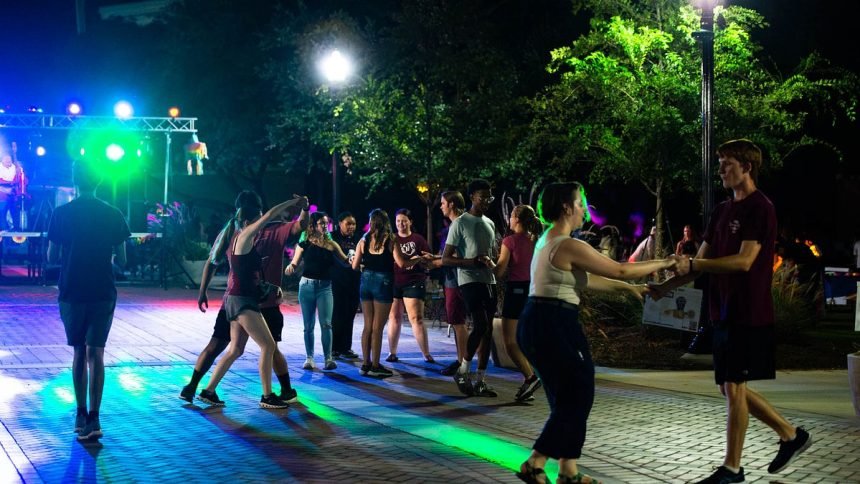
Image: MSU students and friends dance at YMCA Plaza during “Salsa in the Streets,” an annual Hispanic Heritage Month celebration sponsored by the MSU Ballroom Dance Club, Holmes Cultural Diversity Center, Latino Student Association, and Society of Hispanic Professional Engineers (credit Cameron Mazingo/Mississippi State University)