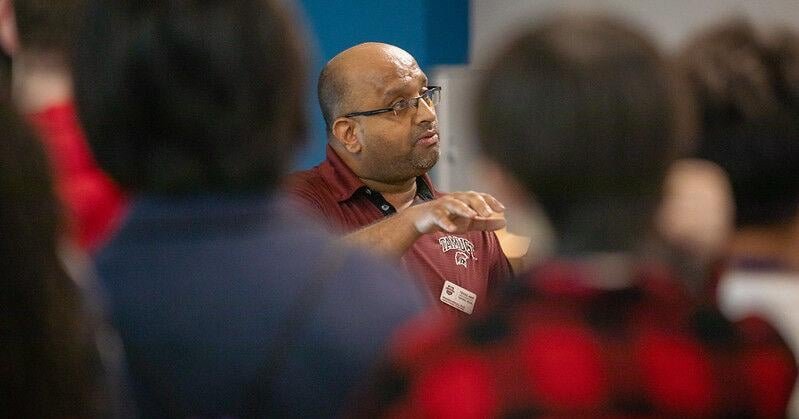
When Texas A&M University-Central Texas Assistant Professor of engineering, Praveen Malali, 41, is in his mechanical engineering technology lab, he is very much — pardon the pun — in his element.
There, on the fourth floor of Warrior Hall, an impressive inventory of pump systems, flow meters, AC trainers, heat exchangers, heat conduction experiments, and free and forced convection devices are, like Malali, in constant motion. And, as much as he loves working with them, he loves working with his engineering technology students even more.
The program, he says, began in earnest in 2020 when then Texas A&M University System Chancellor John Sharp awarded $1 million to A&M-Central Texas, purchasing a state-of-the-art scanning electron microscope and — quite literally — the manpower necessary to develop the program, appointing Research Fellow Taylor Harvey.
Their first cohort was small, but mighty: three or four original undergraduate students, he says. But they knew that it would grow, and they were right. In the last six years, he says, enrollment in engineering has quadrupled, and, even better, he has plenty of in-class opportunities to put that lab equipment to good use.
Malali knows the function of every single item in his lab. Because, well, he has been eating and sleeping physics in general and engineering in particular for more than 30 years. The pump systems, he says, show his students how to control pressure and flow and to see how pumps create movement in everything from water systems to industrial plants.
Flow meters measure how fast liquids move through a system. AC trainers visualize vapor compression cycles and the mechanics behind it. Heat exchangers transfer heat between two fluids without mixing them. Heat conduction reveals why some materials insulate and others conduct. Free and forced convection devices detail heat-transfer processes. They must master the principles of advanced algebra, calculus, science, and physics. And then engineering.
If it sounds intimidating, it is because it can be. And this is where the gift of a talented and learning-centered professor makes all the difference. It is all there, he says. In the whir of a pump or the rise of a temperature gauge, they discover the quiet mathematics behind every tool on the lab bench.
A flow meter isn’t just a dial; it’s algebra in motion — area, velocity, and volume braided together. The AC trainer turns thermodynamics into a story, tracing loops of pressure and temperature across charts that only make sense once students have wrestled with gas laws and thermodynamic cycles.
Heat exchangers demand more: geometry for surface area, calculus for how heat slides from one fluid to another, differential equations for how that transfer changes along the metal’s length. Even a simple conduction plate is a lesson in gradients — why heat slips through copper faster than foam — all hidden in the slope of a graph.
And when convection takes over, free or forced, students meet the dimensionless world of Reynolds and Nusselt numbers, those quiet ratios that decide whether air drifts or roars. In every device, the math is there, humming beneath the steel, waiting for students to see it.
All of this, and it starts to make sense that there are 16 weeks to a semester. Even more sense that the person responsible for guiding and encouraging this knowledge has, himself, been at it for more than three decades. It is not tedious for him; it is a celebration of inquiry and innovation – every single class and every single lab. Malali has it all committed to memory. No pauses, no hiccups. Just a steady stream of knowing how some of the most complex engineering physics in the world … well, works.
It is no surprise that he is well-credentialed. As is every other university faculty member. But in this particular field of study, only six in every thousand people have earned his level of education: a doctorate in mechanical engineering from a renowned research institution, rich in research and innovation, Old Dominion University.
Think of it: mastery over things that would confound most people. Nothing major, he winks in jest. Just the fundamental principles of the universe. And demonstrated knowledge like this is rare.
Where, though does this kind of genius come? Not to mention the grit it takes to pursue a discipline that some degree programs actually consider it a badge of honor not to find anyone worthy of graduation. Malali, however, is not cut from that cloth. Neither is he the type of person who would sit comfortably with the ‘genius’ word used anywhere in his vicinity.
The work of real geniuses, he says, echoed throughout his family’s home for as long as he can remember.
“I remember being in the eighth grade,” he said, his deep coal-colored eyes sparkling with nostalgia. “Even before then, I knew the names Heisenberg and Einstein from listening to his father’s tutoring sessions with his own students. Every lesson he taught, every word he said, captivated me. And I never lost that sense of wonder and curiosity.”
His childhood, he says, was part traditional and part exceptional, emphasizing family, education, sports, and science. He did things other kids did. Played cricket. Bat and ball. Although for most in the U.S., he laughs, cricket is an anathema. Maybe he just has a knack for understanding things that near impossible.
“My father, Dattatry, was then, and still is, a wonderful father, and an incredibly gifted and learned man,” Malali adds. “My brother, Pramod, and I were never discouraged from pursuing our passions and we owe it all to him and his inspiration.
And if Malali dislikes the ‘genius’ label, it might be harder for him to dismiss the other ‘g-word’: geek. In the days long before artificial intelligence or, for that matter, laptops or home computers, Malali — then a pre-teen — sat with a stack of hard paper, cardboard, paperclips, and imagination, developing a memory device to commit to memory the layers of properties of elementary particles.
Still, he enjoyed the simple things. Grew up loving board games and hopscotch, of all things. He was pretty darn good at that, he laughs, reliably beating cousins with his agility. And then, he paused for a moment, remembering his mother’s cooking.
There, in his childhood home, where the chalk dust from his father’s private lessons hung in the air so did the smell of fragrant yogurt rice and dosa. Aromatic mustard seeds, curry leaves, and smoky chiles accompanied by black gram – crepes of fermented batter. Combined, his parents nurtured both the mind and body, he nods reverently, as his mother’s name, Padma, now passed away for a decade, lingers on his lips with a warm smile.
As an undergraduate student, Malali was where he never imagined he might be: in front a class, explaining superfluidity. He competed in a lecture competition of more than 80 peers. Their task? Discuss Brownian Motion. Again, no problem. He placed third.
Talking about the research that brought about the discovery of the atom. Random, chaotic movement of microscopic particles the size of pollen or dust – suspended in a fluid. The particles zig zag, he explained, because they are constantly being bombarded by the fast-moving particles of the fluid even though those molecules are invisible.
As he speaks, his enthusiasm for his students and his ability to tame the theoretical into the practical is impossible to miss. He is happiest, he says, when his students apply their learning, and, if possible, do something to make contributions to their field of study or the university community.
Just last year, when the bulbs inside the bollard lights on campus kept getting damaged – and replacement bulbs were thousands of dollars, his colleagues in the facilities office knew just where to go. Right there in the university’s maker space, using 3D print technology, Malali’s students designed, built, and perfected a conduit that allowed less expensive bulbs to be used.
When the lab doors close and the hum of the equipment fades, what remains is the thing Malali has been building all along—not machines, not experiments, but minds. Minds shaped by curiosity, steadied by discipline, and lifted by the rare joy of understanding something difficult and beautiful.
His students may forget the formula for Nusselt numbers someday, but they won’t forget the professor who taught them to see the hidden lines that make the universe make sense. And because of that, the future of mechanical engineering technology at A&M–Central Texas isn’t just growing. It’s accelerating.