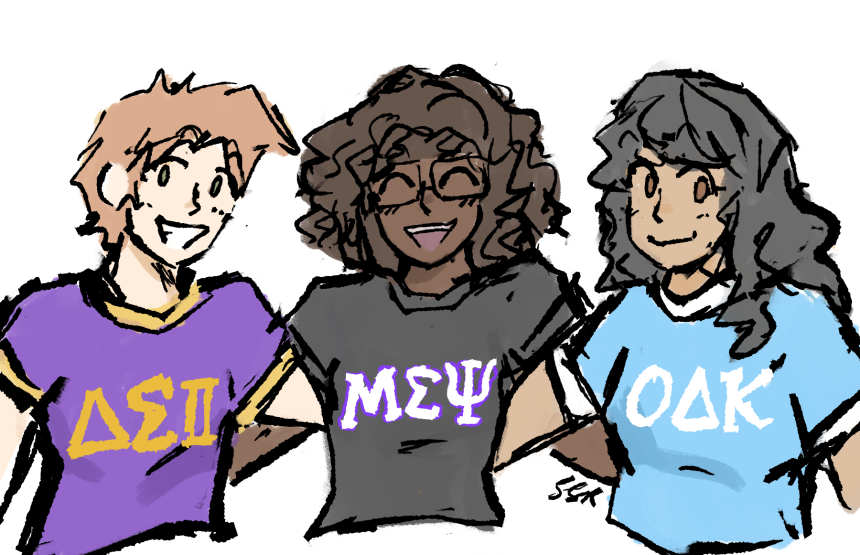
“Fraternity” typically conjures images of drunk boys partying, not professional business meetings or intellectual chats about politics. These four fraternities, though, do just that. Trinity is home to several professional fraternities and honor societies that combine co-ed brotherhood and professional development across a variety of academic disciplines. For members of these organizations, they bridge the gap between academia and friendship.
Delta Sigma Pi (DSP) is one of the two business fraternities at Trinity. Eva Tatum, junior environmental studies and business double-major, is the president of Trinity’s DSP chapter. A fraternity devoted to connecting business majors, Tatum initially joined DSP because she wanted to find a like-minded community and good business connections.
The fraternity only accepts business majors to ensure the organization is strongly connected with the business department, but when asked about her favorite part of DSP, Tatum answered quickly: “the brotherhood.”
“The amount of trust that we have in each other is really what I find so special,” Tatum said. “I love being able to walk into literally any class that I am in and say, ‘That’s my brother. I know that person.’”
The world’s largest business fraternity, Alpha Kappa Psi (AKPsi), also has a chapter on Trinity’s campus. Kiara Fernando, senior human resource management major, is the president. She joined to have an organization on her resumé, but quickly discovered it was a space for collaboration and support, she said. There’s a sense of community throughout the entire organization, according to Fernando.
“My favorite part is when I am able to help someone prepare for an interview, then they tell me [afterward], ‘I ended up getting an offer,’” Fernando said. “That’s the best feeling I think: to actually see people go on and be successful because of the help and training they got through it.”
Unlike DSP, AKPsi accepts majors from all disciplines. This, Fernando said, is an asset. “We’re more focused on being able to build a network, leadership skill development – things that everyone needs,” Fernando said. “I think that’s a huge benefit, because it opens us up to a lot more industries.”
Brotherhood is at the forefront of non-business organizations, too. Mu Sigma Psi (Mu Sig) is Trinity’s professional music fraternity, and though it helps Trinity musicians network in their industries, Jake Cipolla, senior music and education major and president of Mu Sig, said that it’s the community that makes the fraternity feel like a real brotherhood.
When asked what his favorite part of Mu Sigma Psi was, much like Tatum, Cipolla said: “the people.” Cipolla explained that for him, Mu Sigma Psi is a place to have fun with likeminded people.
“Everyone goes above and beyond,” Cipolla said. “I like the community.”
There are organizations devoted to professional development outside of the fraternity realm, too. Pi Sigma Alpha, Trinity’s political science honor society, fills the same niche. Pi Sigma Alpha President Jay Salter, senior political science major, said that the organization connects the educational and social lives of political science students.
During his first two years at Trinity, Jay said that he struggled to find his group in the student body. To help ease other political science students with finding a sense of community, he and a small group of students re-established the Trinity chapter of Pi Sigma Alpha in 2024. Salter said he was proud of the honor society’s role in building community in the department.
“I got really lucky. I met a few other people taking the international law class, and we set up study groups and things, and really got to know each other through that,” Salter said. “So what we wanted to do was try to cultivate that on a department-wide level.”
Jarvis Clark, director of student engagement, reiterated the importance of building community through professional fraternities. These groups are important for teaching lessons not typically taught in formal education, he said.
“It is something to do outside of the classroom that gives you a sense of belonging because it connects you to other students, and connects you to something that’s not always 100% tied to what you’re learning in the classroom,” Clark said.
While the professional fraternities differ, all the presidents emphasized how much they enjoy spending time with fellow members. “We all just genuinely like each other,” Alpha Kappa Psi President Fernando said.
Whether your calling is playing music, running a business or getting political, Trinity’s professional fraternities help students find connections beyond the classroom – and brotherhood, professionally.