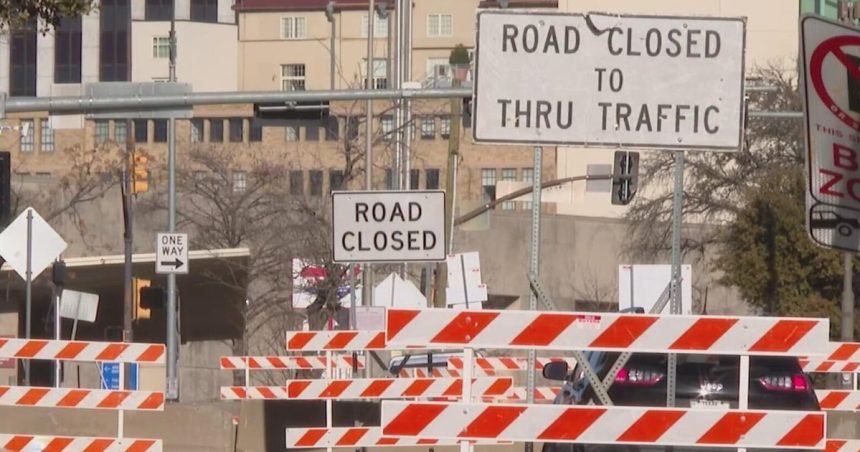
Small businesses along South Akard Street say the removal of a key bridge connecting Downtown Dallas to the Cedars neighborhood is already driving customers away, with no return of direct access expected until 2028.
Since the Akard Street bridge over Interstate 30 was taken down in mid-January, business owners say foot traffic and visibility have dropped sharply, turning once-busy streets noticeably quiet.
“I have seen less traffic, for sure,” one business owner said.
The bridge had long served as a direct connection between downtown and the Cedars. Its removal has forced drivers and pedestrians to reroute, a change that owners say goes far beyond inconvenience.
“They told me it comes back in 2028. The minute I heard that, two years, that’s a whole lifetime for a small business like us,” said Val Jean-Bart, owner of Val’s Blue Label.
Jean-Bart moved his cheesecake business to the Cedars just a few years ago. He said he learned the bridge was being removed only as the project was already underway. Now, he is rethinking how to keep customers coming.
“Now we have to rethink, on how we keep people engaged, and how do we bring people here and safely with less hassle,” he said.
Other nearby businesses say they are dealing with similar challenges. At Hotel Lorenzo, managing partner Justin Burton said confusing detours and signage are creating frustration for visitors.
“As you approach, the turn lane is closed, and then you have a right turn only sign, and then a no right turn sign,” Burton said.
Business owners say patience alone is not enough. Jean-Bart has sent a letter to city leaders and the Texas Department of Transportation asking for clearer signage, adjustments to bike lanes, additional parking options and better overall traffic flow.
“We’re not asking for a lot. Just basic city coordination with DOT,” he said.
Jean-Bart said a meeting is planned with Dallas City Council member Jesse Moreno and transportation officials, and he hopes those conversations lead to short-term solutions while the long-term project continues.
Until then, he said, local businesses are relying on community support to stay afloat.
“We need you now more than ever.”