Closed home sales rose last month in Mesa year over year as both average and median sale prices nudged slightly down from January 2025.
This 3,330-square-foot home on North Stone Point Circle in Mesa sold this month for $1.14 million. Built in 2002, the five-bedroom, three-bath house boasted a “light-filled floor plan” with numerous amenities.
The total of 73 homes sold last month represented a 9.2% increase over the January 2025 total, according to data from Phoenix Realtors, the Valley’s largest association of real estate professionals.

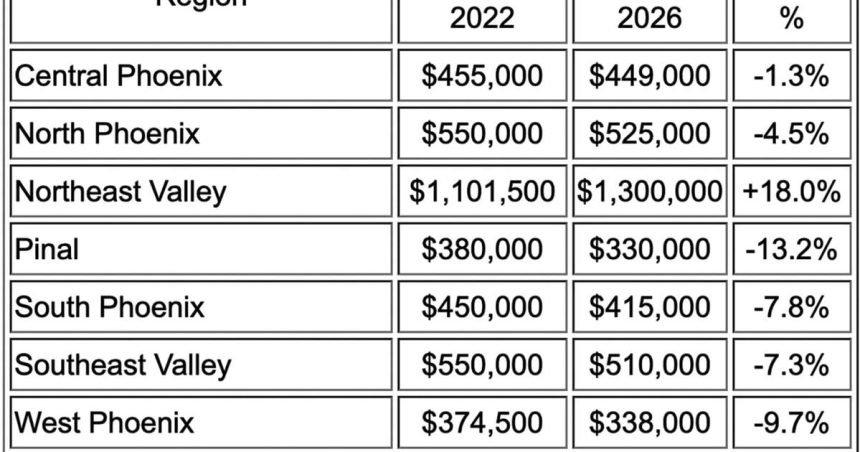
The Cromford Report said that the median price of homes selling in the first quarter of this year is significantly down in most parts of the Valley from where they were four years ago except in the Northeast Valley, where the Taiwan semiconductor plant and other related industrial development are creating jobs at a pace that is stimulating the housing market there.
The median sales price dipped 2.1% year over year to $475,000 while the average sale price of $549,262 was 1.4% lower than that of January 2025, according to Phoenix Realtors.

This chart shows how dramatically the Valley housing market has changed in three years, with seven- and eight-figure home sales capturing a larger part of the overall market. (Courtesy of the Cromford Report)
While sellers received 97.7% of their asking price last month – almost the same as January 2025 – they waited longer to close the deal.
Average days on the market rose by 7.4% to 73.
Both new listings and pending sales last month dropped year over year, although the total inventory of homes for sale remained virtually the same as it was in January 2025 with 1,166 houses on the market.
Pending sales plummeted by nearly 32% year over year while new listings slipped by 7.9%.
Phoenix Realtors said the trend across the Valley last month “shows the market settling into its typical winter slowdown.”
Valley-wide, closed sales increased year over year last month by less than a percent while pending sales plummeted 31% and new listings were down by 6%.
“When you look at the long-term trending numbers, January is always a slow month for residential real estate,” said Phoenix Realtors Board President Sammy Glassman, noting the market had “hit a trough ahead of the peak sales in February and through spring.”
Phoenix Realtors added, however, that January figures across the metro region “align with expected trends from the past five years” and that the median sale price of $475,000 last month was 3.1% lower than January 2025.
Glassman added Valley sales activity “was slightly lower than national sales, which increased 1.3% over the previous year.”
A leading analyst of the Metro Phoenix housing market said rising inventory and sluggish sales are quickly making the Valley a buyers’ market.
The Cromford Report two weeks ago said that out of 18 submarkets in the Valley it closely monitors, “we have only two cities moving in favor of sellers.
“The trend in favor of buyers is getting significantly stronger,” it added, noting Scottsdale, Fountain Hills and Goodyear moved into buyers’ territory by double digits while Chandler showed the slowest movement away from a sellers’ market.
“For the market to be still moving in favor of buyers after the Super Bowl is unfortunately a signal of weakness,” it said. “In a good season we normally see enough demand by mid-February for the number of active listings to reach a peak and start to decline.”
It noted 2025 “was not a good season and active listings did not peak until the end of April” and added, “It looks like 2026 is following a similar path to last year despite affordability improving due to much lower interest rates than a year ago.”
While “demand is up a little from a year ago,” the Cromford Report said it is “not as much as expected, given interest rates are a lot lower than this time last year.
“The typical 30-year fixed rate is currently around 6.2% while a year ago it was just over 7%,” it said. “The total number of listings under contract is up a modest 2.2% from Feb 1, 2025. This is better than a decline, obviously, but it hardly represents enthusiastic buying.”
Noting the sharp decline in sales last month, the Cromford Report called the number of closings “underwhelming…considering that mortgage expenses are considerably lower.”
It conceded that the trend toward a buyers’ market “could easily turn around if demand picked up and if active listings reach an early peak and start falling as more of them go under contract.”
But it added, “Whether this happens or not is still a tough call.
Overall, the market is stable and demand is better than a year ago,” it said. “However, it is not better by enough to compensate for the extra supply that sellers have to compete with. There is still downward pressure on prices in the low and middle ranges, especially in areas with excessive supply.”
The Cromford Report also advised that the median sale price “is more representative of the bulk of the market (excluding luxury homes) and it went down 1.8% over the last month.”
And it said demand and sales activity remained higher in seven-figure home price ranges.
Realtor.com economists echoed the Cromford Report, stating last week, “More active listings and more new homes being put up for sale are both contributing to the market tilting in favor of buyers.
“All of the homes on the market are sitting longer,” it added, stating that the lengthening time homes are staying on the market “goes beyond normal seasonal cooling, indicating a fundamental shift in buyer urgency.”