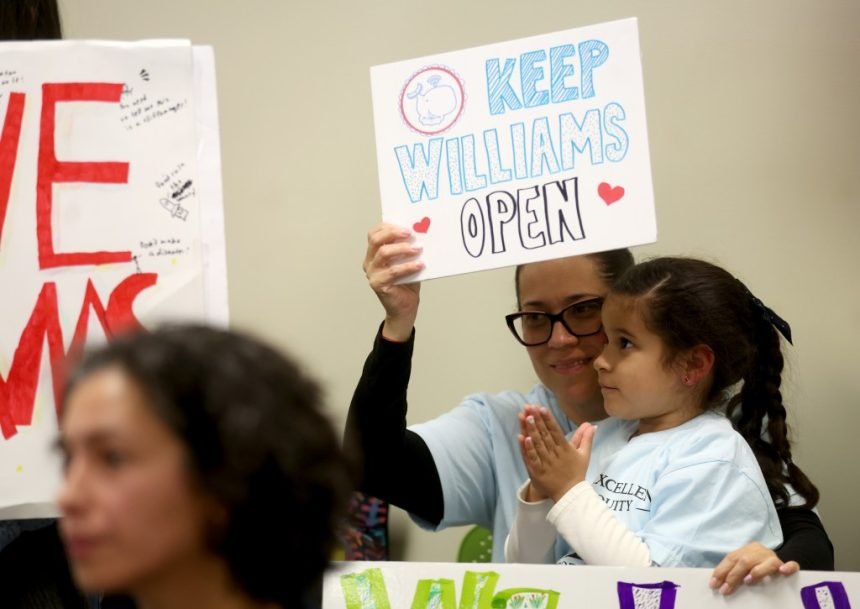
Angela Perez and her daughter Violet, 7, attend a meeting at the San Jose Unified School District headquarters in San Jose, Calif., on Tuesday, Feb. 10, 2026. Under the district’s “Schools of Tomorrow” initiative to tackle declining enrollment, up to nine elementary schools could close by the beginning of the 2026-27 school year. (Jane Tyska/Bay Area News Group)
San Jose Unified School District’s proposed school closures echo elements of a 2022 Oakland Unified plan that state officials later said would have disproportionately affected Black and low-income students.
More schools attended by minority students, English language learners and low-income students face closure or consolidation under the plan San Jose officials announced earlier this month, while campuses with larger white student populations are largely spared.
Of the schools currently listed for closure, 10 enroll a higher share of Hispanic or Latino students than the districtwide average of 55%. Six exceed the district’s 2% Black enrollment average, and 11 enroll more English learners than the district average of 24%.
By contrast, while 10 schools districtwide enroll a higher-than-average share of white students, only three of those schools are on the potential closure list.
Brenda Gonzales, a parent of an 8-year-old at Lowell Elementary in downtown San Jose, said the campuses under consideration are heavily concentrated in downtown and east San Jose.
“It feels like we’re being pushed out of our area,” Gonzales said. “We feel a bit hopeless and like this is discrimination towards our school.”
Education advocates say that’s because the district’s methodology relies heavily on enrollment size and facility conditions — criteria they argue can disadvantage schools in historically underinvested communities.
San Jose Unified did not respond to a request for comment.
Like many districts in the Bay Area, San Jose Unified faces declining enrollment. The district has lost nearly 20% of its students since 2017 and now serves about 25,000 students. The current proposal would close or consolidate up to nine of the district’s 27 elementary schools. The school board is expected to vote on the plan by March 12.
District officials have said they evaluated elementary schools based on transportation needs, total enrollment, staffing and facilities, among other factors. The district also said it reviewed 22 equity-related metrics to assess whether there might be disproportionate impacts on certain student groups.
But the district’s equity review focused on potential impacts to special education students, English learners, foster youth and low-income students eligible for free meals — not on racial demographics.
San Jose officials have said “ideal schools” should have enough staff and students to offer three classes per grade level, and that schools in better physical condition on average are remaining open.
In Oakland, state officials warned that relying heavily on enrollment and facility conditions without analyzing historical inequities could result in a disproportionate impact on vulnerable student groups.
In 2022, facing shrinking enrollment and a $50 million budget deficit, Oakland Unified voted to close seven elementary schools and merge at least two others. After a complaint from the Northern California chapter of the American Civil Liberties Union, the California Department of Justice investigated.
State officials found the Oakland plan would have had a statistically significant disproportionate impact on Black and low-income elementary students, as well as some students with disabilities. Oakland had relied on metrics including enrollment trends, location, facility condition and program demand to determine which schools to close.
In a letter to the district, Attorney General Rob Bonta wrote that closure criteria must be examined in historical context to ensure they do not penalize communities that have experienced decades of underinvestment.
Brandie Bowen-Bremond, policy director at the racial advocacy nonprofit Coleman Advocates for Children and Youth, said similar concerns surfaced in San Francisco when many campuses selected for closure had long faced systemic underinvestment.
“Schools that are suffering the most because of that are the first to go on the chopping block,” Bowen-Bremond said.
Districts across California often close schools that are under-enrolled, underutilized or costly to maintain, said Carrie Hahnel, a senior associate partner at the education policy nonprofit Bellwether.
Those schools frequently serve higher concentrations of minority and low-income students, she said, in neighborhoods shaped by decades of disinvestment and demographic shifts. As housing prices rise, Black and Hispanic families are often displaced by wealthier families who may opt for private or homeschooling, accelerating enrollment declines in public schools.
Still, Hahnel said consolidation can sometimes provide students access to more resources if done carefully. The key, she said, is ensuring decisions are not driven by metrics that reinforce historical inequities.
San Jose Unified has faced segregation concerns in the past.
In 1984, a federal court ordered the district to desegregate after a 1971 lawsuit found it had intentionally maintained racially segregated schools. The court described the district’s campuses as “ethnically imbalanced,” with mostly Latino students attending downtown schools and predominantly white students attending suburban campuses.
Families and advocates now say the current proposal risks repeating patterns that disproportionately affect Black and Latino students, focusing largely on downtown campuses while leaving many suburban schools in Almaden Valley untouched.
Sean Allen, president of the Silicon Valley chapter of the NAACP, said his organization receives complaints of racism and discrimination from 31 school districts in the county, and San Jose Unified ranks third for the most complaints.
Allen said displacing minority students from neighborhood schools and moving them into wealthier, predominantly white communities could increase the risk of bias incidents.
“We’re concerned about all of the children being displaced in those areas,” Allen said. “Pushing these kids into neighborhoods where there’s less diversity … are those communities going to be accepting of these children?”
Advocates also warn that school closures can disrupt students’ academic and social stability.
Rachel Jones, youth justice director at Coleman Advocates, said even temporary displacement can undermine a student’s sense of belonging.
“Some kids would be at risk going to other places because they’re in communities where there is this comfort and belonging sense and now you’re placing them in these unknowns,” Jones said. “And kids in unknowns are not good.”
The Schools of Tomorrow Implementation Committee is scheduled to meet again Tuesday. The district’s board is expected to vote on the closures by March 12.