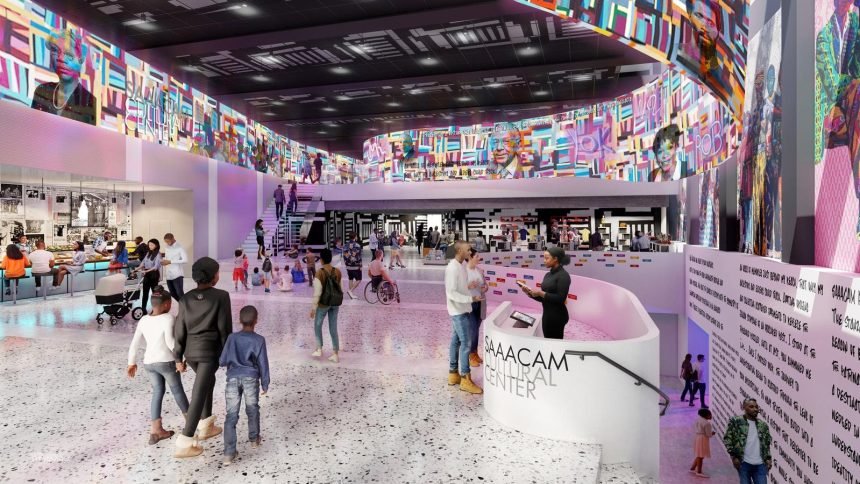
The San Antonio African American Community Archive Museum will open next year
SAAACAM
Millennials have a reputation problem in the workplace. They’re often framed as disengaged, skeptical, and disillusioned with traditional institutions. But that skepticism is not apathy—but actually discernment. And increasingly, it’s driving a quiet but consequential shift in how institutions are built, funded, and led.
Nowhere is that more visible than in the rise of independently funded cultural institutions that reject legacy power structures in favor of transparency, community accountability, and economic participation. One of the clearest examples is the San Antonio African American Community Archive and Museum (SAAACAM)—the city’s first African American museum—currently in the middle of a $102 million capital campaign that intentionally limits reliance on state and federal funding.
At the helm is executive director Deborah Jarmon, whose approach to leadership mirrors how many millennials now assess employers, institutions, and even careers: trust first, money second.
Slated to open in 2026, the San Antonio African American Community Archive Museum aims to be a cross-generational cultural and economic hub in the city.
SAAACAM
.
“You can’t fundraise unless you friend-raise,” Jarmon told me. “Trust has to come before dollars.”
Millennials Don’t Just Want Jobs—They Want Institutions They Can Believe In
Millennials now make up the largest segment of the U.S. workforce, but they’re also navigating declining trust in nearly every major public institution—from government to higher education to media. That erosion has reshaped how younger workers evaluate where they show up, how long they stay, and what they’re willing to build.
Museums, however, remain an outlier. According to research, museums still rank among the most trusted institutions across generations and political lines. But that trust is conditional—especially for younger professionals watching Black history programs, academic departments, and cultural initiatives come under political attack.
For millennials, the question is no longer “Is this institution prestigious?” but “Who controls it, and can it survive pressure?”
SAAACAM’s decision to minimize government dependency speaks directly to that concern. As Black history initiatives face defunding and rollback nationwide, institutional independence has become a form of job security, cultural protection, and long-term relevance.
“If we start deciding whose stories deserve to be told,” Jarmon said, “we lose a fair representation of who actually built this country.”
The New Fundraising Model Mirrors The New Workplace
SAAACAM’s funding strategy also reflects a broader shift in how millennials approach leadership and capital. Rather than relying solely on top-down philanthropy, the museum has focused on relationship-based fundraising—inviting donors into immersive educational experiences before ever asking for money.
That approach has resonated with professionals who are used to transactional workplaces and are hungry for meaning-driven engagement. Corporate leaders and foundation partners who participated in Black history riverboat tours and civil rights bus experiences later returned with unsolicited five-figure checks.
Education, not prestige, unlocked capital.
It’s the same dynamic playing out in the workplace: millennials are more willing to commit when they understand the why, not just the title or brand name.
Cultural Institutions As Employers—Not Just Exhibitors
When SAAACAM opens, it will employ at least 108 full- and part-time workers, excluding interns and contractors—making it a significant economic engine in San Antonio’s downtown corridor.
But its most millennial-aligned workplace impact is already happening before opening day.
After repeatedly encountering event venues with no Black chefs on preferred vendor lists, SAAACAM convened more than 20 Black chefs—ranging from food truck owners to Michelin-recognized talent—into a collective that now fields catering opportunities as a unified group.
The chefs share jobs, mentor younger talent, and negotiate collectively.
“We’re not even open yet,” Jarmon said. “And look how many people are already being impacted just by coming together.”
For millennials raised on collaboration, side hustles, and portfolio careers, this kind of ecosystem-building feels familiar—and increasingly expected.
Rewriting What Legacy Looks Like At Work
Perhaps most telling is how SAAACAM is redefining recognition and legacy. Donors at all levels—not just wealthy families—will see their names represented inside the museum. The model echoes grassroots political fundraising strategies that millennials watched succeed in real time.
“We want people to know your name can be on the wall,” Jarmon said. “Not just the usual ones”
That philosophy mirrors how younger professionals think about career legacy: less about climbing into elite rooms, more about reshaping who gets invited inside.
SAAACAM, Jarmon says, is aiming to model a future of work that many millennials are already demanding—institutions that can withstand political pressure, leadership rooted in transparency rather than hierarchy, and economic impact that extends beyond payroll and prestige.
For younger workers, credibility now functions as infrastructure. Trust determines whether people donate, apply, stay, or advocate. It shapes whether institutions feel worth building—or worth walking away from.
That shift helps explain why millennials aren’t disengaging from institutions altogether. They’re disengaging from unaccountable ones.
Instead of climbing traditional ladders, they’re redirecting their energy toward rebuilding systems that reflect their values—often outside of corporate America, and often without waiting for permission. Cultural institutions like SAAACAM sit at the center of that movement, not as relics of the past, but as test cases for what sustainable, values-driven leadership can look like now.
For employers, nonprofit leaders, and executives paying attention, the lesson is straightforward: trust is no longer a soft value or branding exercise. It’s the foundation on which modern institutions—and modern careers—are built.