
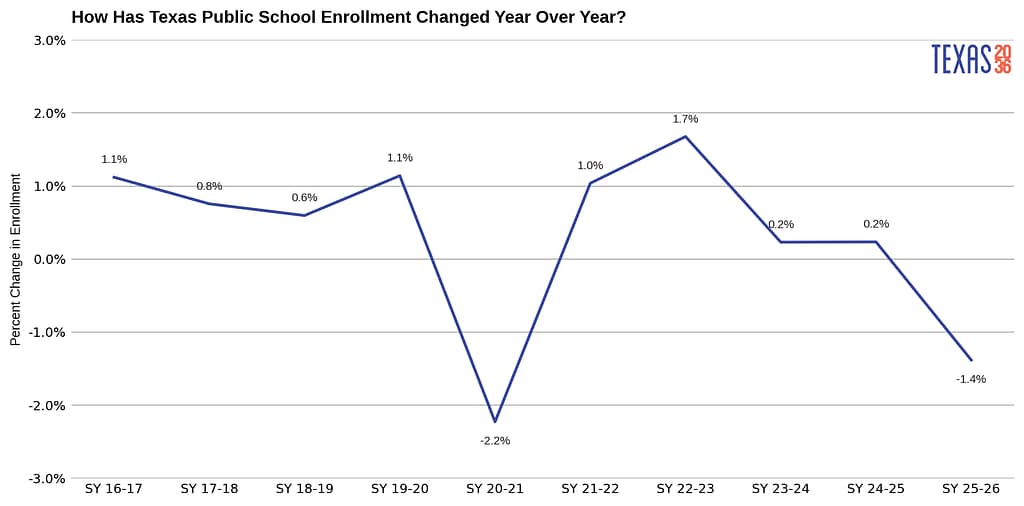
Enrollment in Texas public schools in the current school year (SY 25-26) dipped below 5.5 million students, representing a 1.4% decline in enrollment from the previous school year. This marks the first year-over-year enrollment decline since SY 20–21, when enrollment fell 2.2% during the COVID-19 pandemic. The SY 25-26 decrease is the second-largest drop in the state’s recent history, driven by declines in Hispanic and early grade student enrollment.
In the graph below, statewide enrollment in public schools is displayed for the last 10 school years.
While the graph above captures how many students contributed to changes in enrollment over time, the percentage change in enrollment is equally important. In the graph below, the percent change in statewide enrollment in public schools is displayed for the last 10 school years. Values below zero indicate that public school enrollment contracted in those years.
Public School Enrollment Declined Most among Hispanic Students
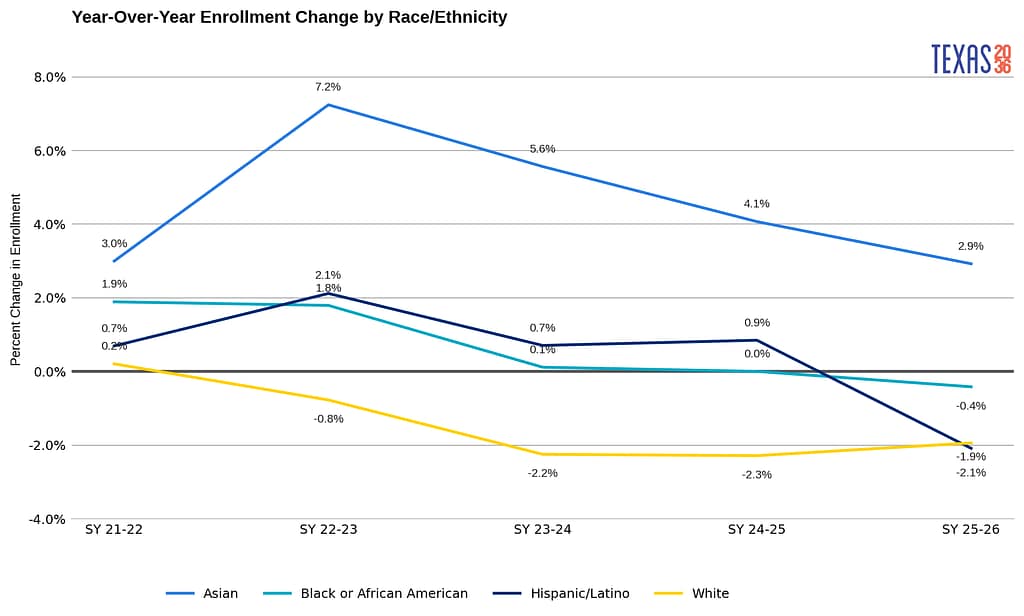
Between SY 24-25 and SY 25-26, overall public school enrollment declined by 76,613 students. In the same time period, the number of Hispanic students shrunk by 61,781, which represents 81% of the total student decline. This disproportionate impact on Hispanic students — Texas’ largest student group — signals a demographic shift that could reshape school district funding and resources for years to come.
In the graph below, for the four largest race/ethnic groups, the percent change in statewide enrollment for each group is displayed for the last 5 school years.
Public School Enrollment Declined Most in Elementary Grades
The racial and ethnic breakdown reveals only part of the picture. Breaking down data by grade-level shows which part of the K-12 system are seeing the largest enrollment declines. Between SY 24-25 and SY 25-26, elementary school enrollment (K-5) shrunk by 46,180 (2%), representing 60% of the overall student decline in statewide public school enrollment.
In the graph below, for each grade-span (Elementary School, Middle School, and High School), the percent change in statewide enrollment for each group is displayed for the last 5 school years.
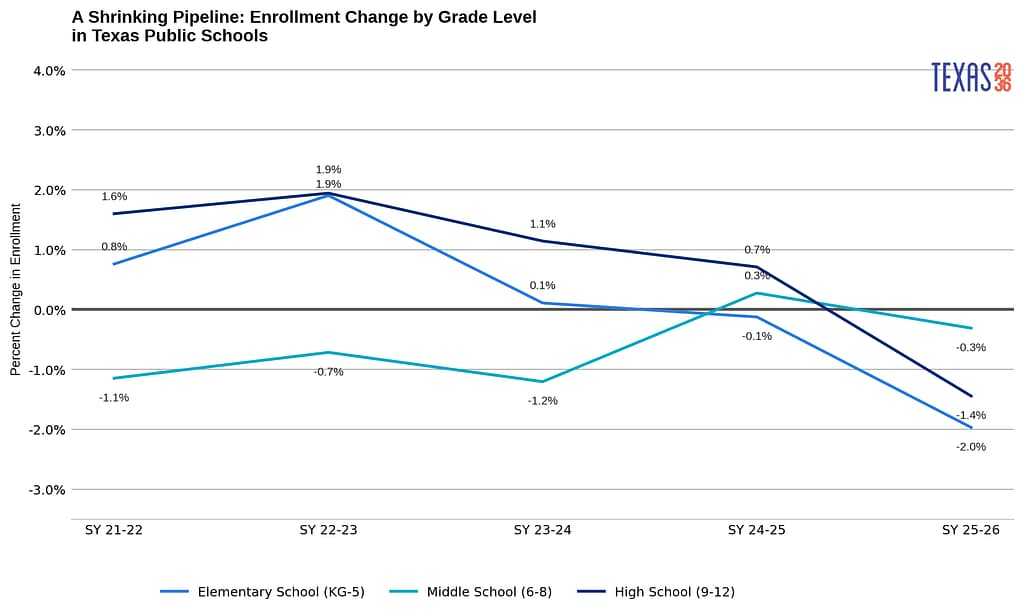
Declines at the elementary level are especially significant because they indicate fewer students entering the pipeline, with ripple effects on middle and high school enrollment in the years ahead.
Conclusion
Texas public school enrollment declined for the second time in the state’s recent history, driven largely by losses among Hispanic students and children in the earliest grades. These patterns point to a future of shrinking school population and growing pressures on districts to adapt.
Stay tuned for our upcoming report diving deeper into campus and district-level enrollment trends, where we’ll explore which communities across Texas are feeling the impact of these declines most acutely.