INDIANAPOLIS — It’s been said for years that NFL talent can be found at all levels of college football. But in this new era, NFL teams aren’t the only ones on the hunt.
The transfer portal may have been limited to a 15-day window this year, but preparing for it, as college football personnel department members will tell you, is a year-long job.
“We probably do 500 scouting reports,” said Texas Tech general manager James Blanchard, the lead architect of one of the best transfer portal classes in the country last year, “and man, probably 70% of them don’t even get in the portal.”
It’s part of the job. So is the understanding that a team’s coaching staff — a key cog in the player-acquisition process, too — can’t devote the same attention to transfer portal prospects who may not be interested in coming to their school, let alone those who don’t even enter the portal.
“That whole personnel department, they’re having to filter, filter, filter,” said J.R. Sandlin, the general manager at SMU.
The goal is to make the evaluation process as easy as possible for the coaching staff. In doing so, they might’ve made it easier for NFL teams, too.
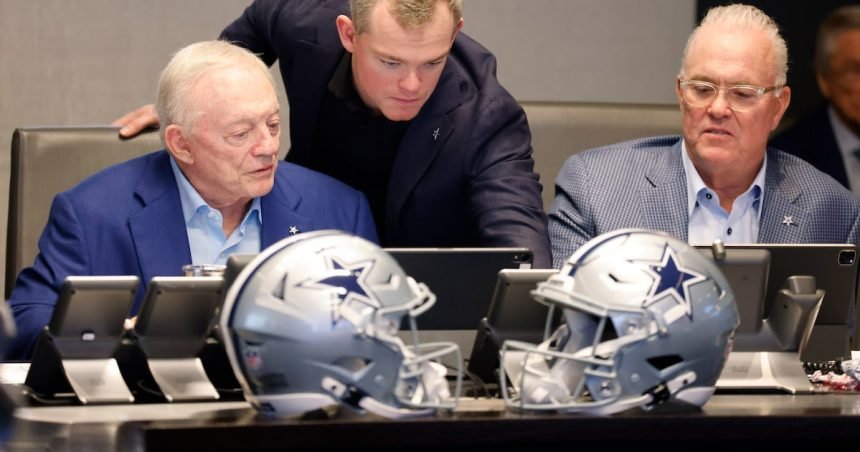
It was a small part of a lengthy end-of-the-year news conference for the Cowboys, but it was notable. Cowboys co-owner Stephen Jones, when talking about the upcoming NFL draft, said the team would focus mostly on scouting prospects from the Power Four conferences: the Atlantic Coast Conference, the Big Ten, the Big 12 and the Southeastern Conference.
In the transfer portal and NIL era, many players who might’ve been diamonds in the smaller-school-rough have already been discovered.
In 2022, for example, nearly 20% of the players invited to the NFL Scouting Combine came from non-Power Four conferences. Last year, fewer than 10% of combine invites were from those same schools. This year, that number dropped down to 5%. Eleven of the 133 players at the Senior Bowl in Mobile, Ala., were from non-power conferences.
“There’s no question that certainly the top talent is aggregating due to NIL and the transfer portal,” Jones said from the NFL Combine.
The path to the Power 4
Consider the journey of California cornerback Brent Austin.
Austin, a participant in last month’s Shrine Bowl in Frisco, has caught the eyes of NFL scouts. Before that, however, he was just trying to garner interest from any college.
“It was getting late, time’s ticking, and I still had no offers,” Austin recalled. Cal Poly, an FCS team, offered. Eventually, Curt Cignetti — now a national champion at Indiana — and James Madison became his only other offer. James Madison’s first year in Division I was also Austin’s first year. He didn’t even know where James Madison was before they offered.
Austin eventually played well enough to transfer to South Florida, a rise from the Sun Belt Conference to the American Athletic Conference. He impressed there, as well, allowing him to enter the portal for his final college season as one of the most highly recruited corners available.
College teams didn’t know him coming out of high school. This time, they were prepared. He took visits to Miami and Tennessee before choosing California. One of the closing pitches was a film presentation from an assistant coach. They had scouted him so well that they compiled a lowlight film rather than a highlight film, where they could show him where he could improve.
“That really stood out to me,” Austin said.
Instead of scaring Austin, it excited him. For the coaches at Cal, that might’ve also answered another element of the scouting process.
Texas Tech head coach Joey McGuire (left) and general manager James Blanchard (right).
Courtesy: Texas Tech Athletics
‘We just outworked y’all’
Colleges aren’t allowed to talk to players until they enter the portal, which means they have to make use of what they have. Highlights of a player, as Sandlin described, are a trailer for the movie, “which is the game film.” There, college scouts can create a deeper and more detailed evaluation of a potential portal entry. One thing Sandlin says SMU tries to ascertain about a player is their play character.
“Maybe it’s a championship game. Maybe it’s a rival. Maybe it’s a top-25 matchup. How do you play when the circumstances are more intense?” Sandlin questioned. “I feel like that’s that play character. We all talk about, ‘Character is revealed through adversity.’ This is kind of the same thing here.”
It all factors into the scouting process — something that’s supposed to be extensive.
The same can be said for Tech’s evaluation process, though Blanchard said it boils down to a simple idea: “We’re trying to find guys with NFL traits and qualities.”
Blanchard should know. He spent a year with the Carolina Panthers, where he watched film of opposing teams and evaluated and scouted potential free agents. He learned from Pat Stewart, who worked many years in scouting and player personnel for the New England Patriots, as well as the Philadelphia Eagles.
Blanchard took what he learned in Carolina and modeled his player personnel department at Texas Tech after it. He said they operate like a NFL team, so they know what to look for. It’s worked out. The Red Raiders won the Big 12 Championship this past season and made it to the College Football Playoff for the first time.
“People just think of us as Texas Tech … that we’re just throwing money around, hoping it works,” Blanchard said. “But it’s like, for a lot of these people, we just outworked y’all and we’re just better at this than y’all at this point in it.”

Stephen F. Austin defensive back Charles Demmings (07) runs a drill at the NFL football scouting combine in Indianapolis, Friday, Feb. 27, 2026. (AP Photo/Michael Conroy)
Michael Conroy / AP
The value of loyalty
Tech’s scouting success has also been on display at the college all-star games. The Red Raiders have seven players combined at the Shrine Bowl and Senior Bowl. Six of the seven were transfers. Four of those seven were transfers who played just one season for the Red Raiders. Two of those players, wide receiver Reggie Virgil (Miami of Ohio) and safety Cole Wisniewski (North Dakota State), transferred from non-power conference schools.
“There’s some extremely high-level football players in the FCS,” Wisniewski said.
Power conference teams agree, which is why many FCS and non-power conference prospects find their way rising in the college ranks.
There’s also value in learning why some players didn’t transfer.
Stephen F. Austin cornerback Charles Demmings was one of the 16 players invited to the NFL Combine who didn’t play for a power conference school. He was one of a handful that who played for a Football Championship School (FCS), which is one level below the Football Bowl Subdivision (FBS). He takes pride in that.
“It’s not just a story. It’s literally a testimony that you don’t know what’s on the other side of a committed yes,” said Demmings, who is ranked as the No. 139 prospect in the draft, according to Pro Football Focus. “You don’t know what plan God has for you. but if you give him the steering wheel you’ll end up right where you’re supposed to be.”
That doesn’t mean there weren’t other schools interested in Demmings. The 6-1 cornerback from Mesquite said he was approached by multiple colleges during his time at Stephen F. Austin to see if he would be interested in moving up the college football ladder. He pointed to Mississippi State, West Virginia and Rutgers as a few.
Instead of a pay raise and a rise in the college football world, Demmings wanted to stay where he started.
“I walked into SFA as a boy and I was leaving as a man,” Demmings said. “I was able to get my degree there. I was able to build a relationship with God there. I was able to meet men who not only had leadership qualities, but they molded it into other young players like myself. I wanted to continue that legacy, not let it be about money but how could I be of service to everyone coming after me.
“It was about what type of legacy can I leave? What type of person I am? What is my foundation? Because if you stand for nothing you’ll fall for anything. I wanted to show what I stood for.”
That shows something to NFL teams, too. Demmings said he met with the Cowboys at the Combine.
“You have those cases,” Jones said about players who stay, “and to me that speaks highly of the kid. That’s a plus when you see a kid who’s loyal to who gave him his chance.”
Find more Cowboys coverage from The Dallas Morning News here.