Dane County leaders want big names like Lana Del Rey, Brad Paisley and P!nk to add tour stops at the Alliant Energy Center in Madison one day.
But to get them, the county needs a significant investment into Alliant Energy Center’s aging campus. The only bid on the table is from Frank Productions, or FPC Live, whose parent company, Live Nation, is being sued by the state Department of Justice for over allegations of an illegal monopoly over live entertainment.
The county isn’t letting that multi-state lawsuit stop its plans to renovate the Veterans Memorial Coliseum and bring more life to the entertainment campus.
Frank Productions, also called FPC Live, was the only respondent that applied last November to renovate the Veterans Memorial Coliseum into a modern entertainment venue. Contract negotiations are currently underway.
County leaders haven’t shared much about their priorities for the contract, but according to FPC Live’s proposal, about $100 million is on the table toward the reconstruction of the coliseum built in 1967.
Dane County Executive Melissa Agard describes the project’s revenue strategy as a “public-private partnership,” and early terms hover around a 30-year agreement, according to the proposal.
County officials held a town hall at the Alliant Energy Center earlier this month, showcasing many moving parts of the redevelopment plan. A committee has been working over the past decade to imagine what a bustling entertainment hub the South Madison corridor off John Nolen Drive would look like, and the coliseum is the first of many major reconstruction projects on the campus.
At the town hall, Alliant Energy Center director Kevin Scheibler said he wants to get the campus back to what it was like in its heyday in the 1990s — booming with concerts and events year-round. Scheibler projects that this year the campus will host about 302 events in total, which is up from 273 last year and 244 the year before.
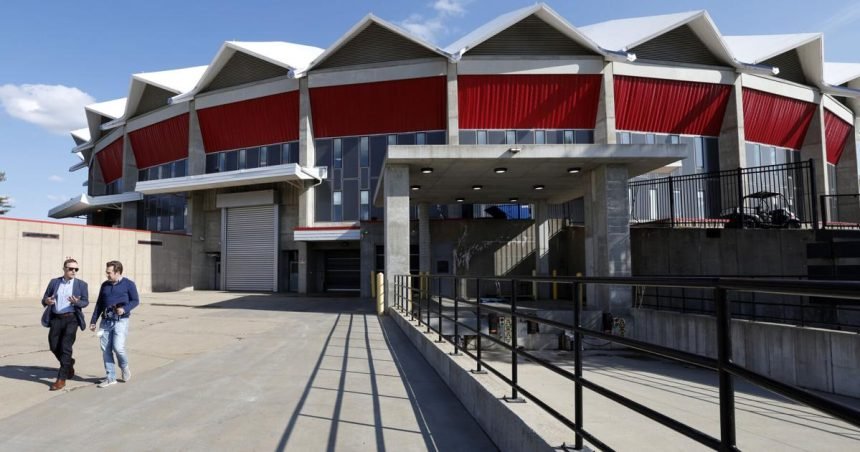
The Alliant Energy Center’s Veterans Memorial Coliseum was originally built in 1967 and has a capacity of around 10,000 people. Dane County Executive Melissa Agard says the venue should be renovated.
The campus annually hosts a variety of large-scale regional events, such as Brat Fest and the Midwest Horse Fair. Agard said the future redevelopments will hopefully “deliver meaningful and lasting economic and fiscal benefits to Dane County” and encourage more entertainment tourism to Madison. Last year, entertainment-wise, two of the 44 events at the Veterans Memorial Coliseum were comedians Nate Bargatze and Tom Segura.
In its vision to breathe life back into the 60-year-old building, FPC Live and Live Nation proposed hosting about 75 events a year, with the focus being on music and comedy-type concerts. The brand’s proposal would reduce the number of seats from around 10,000 to somewhere between 3,500 and 6,800 “while maintaining the look and feel of a sold-out show,” according to the proposal.

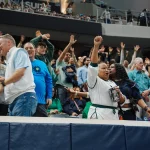
Vice President Kamala Harris gives remarks to a crowd of 13,000 during a 2024 campaign rally and concert at the Alliant Energy Center in Madison.
While the proposed reconstruction of the coliseum would feature a “flat floor” and flexible stagehouse, it would mean the space could no longer accommodate legacy events like the monster truck show, Midwest Horse Fair, or certain sporting events, according to early renderings shared with the public.
At the March 10 town hall, a number of people said they were excited about the project, though some were worried the Live Nation lawsuit would impact the county’s negotiations. In the antitrust lawsuit, two dozen states, including Wisconsin, allege Live Nation has monopolistic control over the music industry. But Agard and Scheibler said that doesn’t involve the county’s plans to reimagine the entire 164-acre campus over the next dozen years or so.
FPC has ‘a lot of power’
Two years ago, the federal Department of Justice, along with 30 other states, sued Live Nation for antitrust violations related to high prices for concert tickets through the company, Ticketmaster.
The settlement, in which Live Nation agreed to address ticket sale costs, reduce service fees and open its amphitheaters to all concert promoters, is “a separate deal” from the plan to renovate the coliseum, Agard said.
“Our understanding is it was a settlement and that we’re moving forward,” Scheibler said. “Businesses get sued all the time; we can’t prevent ourselves from working with people because of that.”
A trial was slated for earlier this month in a Mahattan federal court, but less than a week after jury members were selected, the federal justice department announced that a settlement agreement was reached between Live Nation and a handful of states (7), according to court documents.
Wisconsin Attorney General Josh Kaul said the state office is still full steam ahead with the suit. The state joined more than two dozen states filing for a mistrial, alleging Live Nation, which owns Ticketmaster, is an “unfair” monopoly. Other states include California, Illinois, Minnesota, New York, Michigan, Pennsylvania and the District of Columbia.
Staff from the state Department of Justice declined to comment further on the suit. FPC Live also didn’t respond to requests to comment for this story.
As part of the agreement, Live Nation has to continue operating under strict government oversight for eight years, with rules designed to ensure it doesn’t pressure or unfairly control venues. In a press release, Live Nation president and CEO Michael Rapino said Live Nation also plans to set aside $280 million to address states’ claims of unfair competition and divest from 13 of its amphitheaters, loosening half of those ticket sales.
People have expressed mixed feelings about FPC Live’s stake in local, taxpayer-funded entertainment, but there has been a consensus of pride in Frank Productions’ history in the Madison community.
One person at the town hall said Frank Productions has “a lot of power,” referring to the company’s dominance of the music entertainment scene in Madison, namely large venues like the Sylvee, Orpheum and High Noon Saloon. But the same person said there’s a “gem of goodness there” with FPC Live’s high level of customer service and expertise.
Local roots, national reach
The additional entertainment dollars that could come from the global reach of the Live Nation partnership offer potential for Dane County. Those in the business sector of Madison are eager for the opportunity to continue investing collaboratively.
At the town hall, Zach Brandon, the president of the Greater Madison Chamber of Commerce, expressed strong support for redeveloping the aging coliseum and the FPC Live partnership. He said the idea of a public-private partnership is “energizing” and said partnering with Live Nation would satisfy the desire for both local roots and a national reach in Dane County.
“We have the opportunity to set a model for a Dane County way of doing these types of projects,” Brandon said. “And we assume risk as taxpayers, but we also assume opportunity and upside as taxpayers, and that is a higher quality of life, it’s more in retention of people, it’s more tax base, it’s more tax revenue.”
Brandon cited the Coldplay tour stop at Camp Randall and Harry Styles’ listening party as recent examples of what kind of entertainment city Madison “aspires to be.”
“For me, the question isn’t, ‘Does the building need to be remodeled?’ The answer is unequivocally yes,” Brandon added.
Once contract negotiations are finalized, likely sometime within the next few months, the decision will rest with the County Board.
At the most recent County Board meeting on March 19, Scheibler formally presented the reconstruction plans to the supervisors alongside the county’s negotiation partner, Bryan Slater, vice president of CAA Icon. CAA Icon is a project management and entertainment business consultant that’s worked on major sports-center developments such as the Deer District in Milwaukee and Titletown in Green Bay.

Melissa Agard, Dane County executive, is pictured at the City-County Building in Madison.
Many County Board members expressed concern and confusion about their role in the negotiations, given that Alliant Energy Executives aren’t releasing many details to the public. It’s unclear whether board members will take up the issue before the contract is finalized and brought back to the full body, but many expressed the desire for a closed session to better understand how to communicate the taxpayers’ stake in the contract negotiations.
“I hope that they see the thought, they see the momentum in the years that have taken us to get to this point, and believe in the work that Kevin and I, and the others at the table are doing,” Agard said at the town hall. “But ultimately the County Board has the final say,” Agard.
County officials estimate $35 million in deferred maintenance costs to upgrade the HVAC, electrical service, plumbing, and new restrooms, among the new front and back-end operations for concert staff. Upgrading the sound and rigging system is another necessary renovation to get the building adequate for concerts, according to county purchasing documents.
Scheibler said if everything goes well, the coliseum could be open for business in 2029.