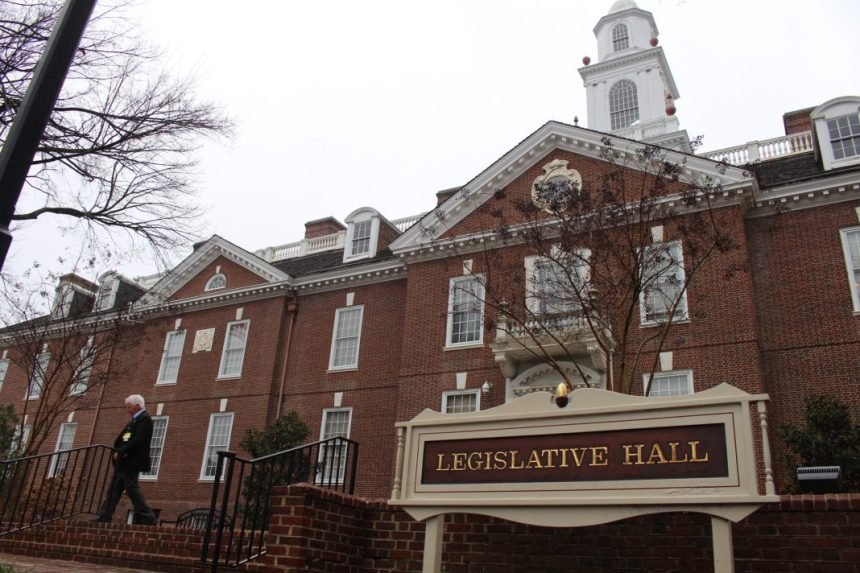
DOVER — A new bill would require union labor on major public construction projects funded by state dollars, prompting pointed opposition from Delaware’s construction community.
Sen. Jack Walsh (D-Newport) has filed Senate Bill 272 to require project labor agreements for school construction and renovation projects with a cost over $1 million. If the bill is passed into law, it would apply to public works projects advertised after Dec. 31. The agreement would be made with the Delaware Building and Construction Trades Council, which represents 4,000 members across 24 local unions, unless there was only one bid for the state contracts.
Walsh filed the bill one month after he filed an earlier version, which would require the agreements for union labor for all public works projects exceeding $5 million. But after intense resistance, he apparently amended the proposal to specific construction projects after what he called “robust discussion” in a press statement.
“Senate Bill 272 would establish Delaware’s first PLA-requirement law, which guarantees state-funded school construction and renovation projects are completed efficiently, on time, and by a highly-skilled workforce,” Walsh said in a press release. “While I appreciate the robust discussion that surrounded Senate Bill 241, this new legislation is about rightsizing our goals.”
Walsh could not be reached by the Delaware Business Times for comment.
Legislators have positioned project labor agreements as a way to ensure projects are completed efficiently with standardized wages, benefits and training while reducing the risk of labor disruptions.
But a coalition of business organizations argues that the proposed policy does not reflect how Delaware’s construction industry is structured.
Associated Builders and Contractors (ABC) Delaware has warned that gap could force contractors to look outside the state for labor in order to comply. The association represents more than 500 member organizations in industrial and commercial construction, including non-union members.
“We simply don’t have the union workforce to meet the demand,” ABC Delaware President Jennifer Cohan told the Delaware Business Times, adding that projects could ultimately rely on out-of-state workers which could dilute the economic benefit of public spending for Delaware residents.
Cohan estimated that about 90% of Delaware’s construction workforce operates in the non-union, or merit shop, sector, raising concerns about whether enough union labor exists locally to meet demand under a project labor agreement mandate.
ABC Delaware is joined by other organizations in opposition to the bill, such as Delaware State Chamber of Commerce, New Castle County Chamber of Commerce, Homebuilders Association of Delaware, Delaware Black Chamber of Commerce, La Esperanza of Delaware, La Plaza Delaware, Delaware Alliance of Latino Entrepreneurs, American Council of Engineering Companies of Delaware and Drive Delaware Forward.
Notably, the Delaware Hispanic Chamber of Commerce (DHCC) raised concerns about mandating union labor for state projects as it would limit opportunity for small companies owned by Latinos. Surveys cited by the National Association of Homebuilders show that Hispanic workers now make up nearly one-third of the U.S. construction labor force.
In Delaware, most of those Latino-owned construction firms operate as open-shop, non-union enterprises, according to the DHCC. Limiting the potential for state contracts to a union workforce would shut these businesses out for millions of dollars in work.
The Delaware Hispanic Chamber of Commerce (DHCC) raised similar concerns specifically around equity and access for small businesses as it relates to Latino-owned enterprises in the First State. The DHCC also pointed to the state’s Disparity Study completed in 2022, which showed that Hispanic-American firms received 2% of state construction contracting dollars, compared to a 5.39% market availability.
In an email, DHCC President and CEO Dr. Ronaldo Tello condemned the proposed regulation.
“We support fair conditions for every construction worker in Delaware. . . Our community deserves to understand how this legislation may affect the Latino entrepreneurs who have built businesses here, employ Delaware workers and contribute to our state’s economy,” Tello wrote.
Other factors are at play for construction businesses, as well, if the bill were to be signed into law. Citing national research, Cohan added that project labor agreements increase the cost of any given project by 10 to 30% due to less competition in the workforce and the work rules surrounding labor agreements.
“For example, union rules require three people to every job site, not just two. That would inevitably add costs in there and the wages might not even be seen in Delaware,” she said. “This new bill doesn’t make it better. In fact, it’s telling us who we can keep on payroll for these projects by stating that project labor agreements may . . . ‘permit contractors and subcontractors working on the public works project to retain a percentage of their current workforce.’”
SB 272 is now awaiting consideration in the Senate Labor Committee.