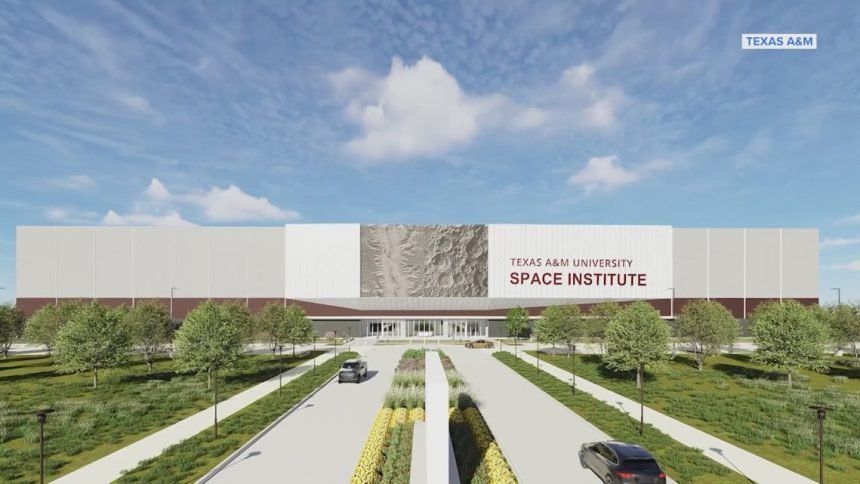
When complete, the space research center will have office space and labs, each one the size of Kyle Field at Texas A&M.
HOUSTON — A new 400,000 square foot building is set to open in fall 2026 and is a commitment to space research.
If you drive down Saturn Lane, you’ll see crews starting to put up the walls and the location surrounded by construction fences and poles as the building prep continues.
“It’s kind of probably NASA’s strongest commitment to the commercial space industry,” Jishnu Nair with the Houston Business Journal said.
Nair has closely followed the development of the Texas A&M University Space Institute.
“It is meant to be a one-stop shop for testing for vehicles that are set to go to the moon and Mars,” Nair said.
When complete, the space research center will have office space and labs, each one the size of Kyle Field at Texas A&M. The labs are designed to feel like the surface of the Moon and Mars.
“The crew will memorize every path and every obstacle,” Brett Fischer with Intuitive Machines said.
Intuitive Machines will have space at the facility to test their rovers.
“What we’re designing today is now the fit called the phase one LTV, uh, to get to the surface by 2028,” Fischer said.
A LTV is a lunar terrain vehicle, which is built to one day traverse the moon’s surface and collect samples. Fischer takes us to see some of their previous models, which were designed and developed right here in Houston!
“The A&M Texas Space Institute gives us an excellent test bed to test the machines, to test our lunar terrain vehicles and other aspects of living on the lunar surface, uh, for extended periods of time,” Fischer said.
Until the research center is complete, Fisher said they’ll continue to test their rovers as they have been in the past.
“We’ve been out to Arizona at Meteor Crater, testing our previous version of the LTV, and that terrain is similar in rugged nature,” Fischer said.
Those continued tests, soon to happen just down the street, are something Fischer calls critical for the future of space exploration.
“There’s a lot out there that we don’t know, and that’s really the nature of humankind to explore and to understand our surroundings. So, this is a big part of it,” Fischer said.
Intuitive Machines also has a simulator on-site. It simulates what it’s like to drive on the moon at a speedy three miles an hour.
Fischer said Apollo astronauts previously suggested having the vehicles go a maximum of six kilometers per hour due to the moon only having one-sixth of the gravity levels the Earth does. The astronauts said they could have gone up to 15 kilometers per hour, but even 10 km/hour can result in the vehicle leaving the surface.
Fischer said the primary mission of the vehicles is to extend crew ability to get to more sites of interest on the moon.
There’s hope that what’s learned at the Texas A&M University Space Institute can help to make additional space missions possible!
Got a news tip or story idea? Email us at newstips@khou.com or call 713-521-4310 and include the best way to reach you.