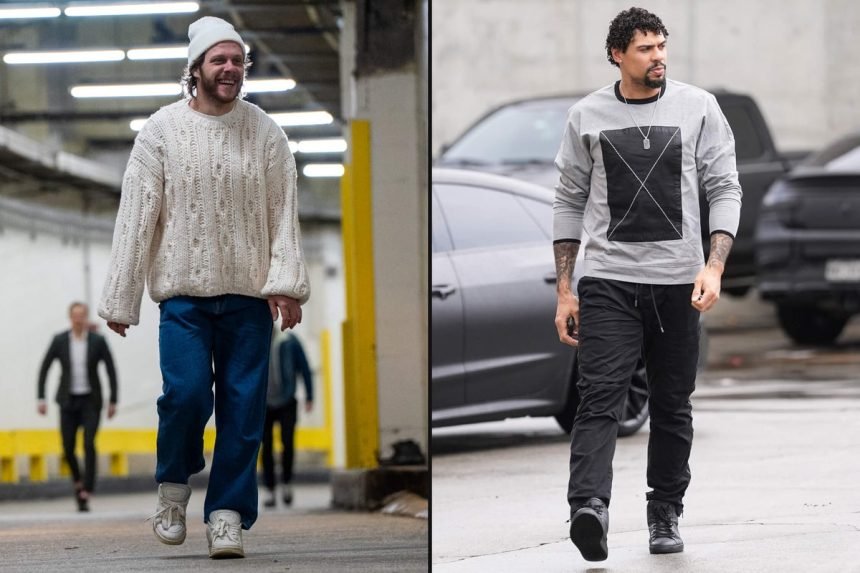
The origin story of Bonobos, the menswear company launched in 2007, can be written with one body part in mind.
“Our original mission,” says Kate Fulk, Bonobos’ senior vice president of merchandising, planning and wholesale, “was to solve what we called ‘khaki diaper butt.’”
Slim fit pants, according to Fulk, account for more than 50 percent of Bonobos’ sales. Butts are flattered, not merely covered.
But in the fashion industry, 19 years is an accommodating timeline for trends to wax and wane. So perhaps it is no surprise that what was old has become new, albeit with back-end neatness in mind. Men’s pants, regardless of brands and consumers, are opening up again. Skinny is not necessarily in.
“Let’s call it a more relaxed fit,” says Jesse Alpern, Bonobos vice president of design, “as a catch-all for styles that wouldn’t have been typically described as slim or skinny. It’s one of the more predominant trends in bottoms we’ve seen across the market for the past several years.”
This suits Ryan Reaves just fine.
The 39-year-old has been in the NHL long enough to follow the pants progression from baggy to tight to roomy once more. The 6-foot-2, 225-pounder has totaled 962 career games, most recently with the San Jose Sharks, partly because of his expertise at running people over and bashing them in the face. His job title demands a robust lower body.
Reaves is not alone. The hockey butt is real.
“Quads and booty,” Reaves, with a smile, says of just about everybody in the league.
You can understand, then, why many NHLers are delighted with the way pants style is evolving. The quad gods can breathe again.
He’s got legs
It wasn’t long ago that skinny pants were in. This did not make Jonathan Aspirot happy. The 6-foot, 212-pound Boston Bruins defenseman has always been more of a bulldog than greyhound.
“Big issue trying to fit into those,” says Aspirot, 26. “It would fit in the legs. But it wouldn’t around the waist. Just super big.”
Fellow Bruins defenseman Andrew Peeke is designed similarly. He is 6-3 and 214 pounds.
Peeke had completed his junior year at Notre Dame when he signed his entry-level contract with the Columbus Blue Jackets on April 1, 2019. The Lululemon gear he wore out in South Bend would not do if he wanted to fall in line for then-coach John Tortorella. The pro defenseman needed professional clothes.
Mary Ruth, Peeke’s mother, advised her son to go to Macy’s. He tried on multiple suits. Peeke called his mother back. He had a problem.
“You’ve got to help,” Peeke says. “I don’t know what I’m going to do. These things are going to rip.”
Peeke, 28, is a defense-first defenseman. The Blue Jackets drafted and signed him to lean on opponents. Down-low muscle, the kind that strains unforgiving pants, was required.
“Obviously, we need upper body. But it’s not the be-all and end-all if you’re not shredded. There’s different kinds of builds upper-body-wise,” Peeke says. “But the consistent thing is everyone has strong legs, strong butt, all that stuff. It’s just kind of the way hockey is.”
This is so even for naturally skinny players. Mason Lohrei is 6-5 and 218 pounds. Gaining weight used to be an issue. But even the 25-year-old Bruins defenseman had the typical hockey player’s dilemma.
“It was so hard to fit in pants,” Lohrei recalled of fashion in the slimmer era. “I’m tall and skinny. But my legs are a little thicker here. Never could find anything that didn’t look like leggings on me.”
The typical NHLer is not built like a marathon runner. The latter is lithe and lanky. The former is stout and stocky, all glutes and quadriceps from summers of lunges and step-ups and trap bar deadlifts and seasons of skating. Every NHLer is an anaerobic animal optimized for 45-second full-gas efforts.
It begins at the bottom.
“That,” Carolina Hurricanes strength and conditioning coach Bill Burniston says of a hockey player’s lower body, “is where you generate all your power from the ground up.”
Summer gains
Burniston’s charges prepare for each season by proceeding through four offseason phases: baseline, eccentric and isometric movements, strength, power.
Phase 1: The priority is good health. Even after some downtime, a player may need foundational work at the start of the offseason. Otherwise, he will not be ready for the stresses of later phases.
“We don’t want to train guys that have some type of deficit,” Burniston says. “We want to make sure we get them back to their baselines. Really, the first phase is more of general conditioning.”
Phase 2: Eccentric and isometric training, Burniston explained, is meant to strengthen tendons, ligaments and joints. This sets the table for Phase 3 and its large-muscle attention.
An eccentric exercise, such as a slowly lowered front squat, lengthens muscle under tension. An isometric exercise strengthens a muscle without changing its length.
“We’ll go into a split squat, and we’ll try to pull the bar up as hard as we can where it doesn’t move,” Burniston says of a typical isometric movement. “We’re moving against an immovable object into creating as much force as we can for maybe eight seconds.”
Phase 3: The players shift to heavier weights to promote strength. The players continue with eccentric and isometric movements. Burniston also likes to incorporate Copenhagens, which are movements that target the groin.
“We’re emphasizing glutes and quadriceps,” Burniston says. “We want to make sure our ankles are strong. We’ll work on some isometric work there, too.”
Phase 4: By now, the players have gone back on the ice while continuing their gym work. Speed becomes a centerpiece. During on-ice sessions, Burniston likes to use the 1080 Sprint, a device that provides resistance to underscore explosiveness.
“So we can do some resistive sprinting with our players on the ice,” Burniston says. “Which seems to be helping quite a bit.”
Throughout each phase, Burniston reminds his players to balance training with proper recovery and nutrition. They will not optimize their gym time if they don’t rest and fuel. Golf, fishing, barbecues and snoozing are encouraged, not just suggested.
“It’s not the hour you spend in the gym. It’s what you’re doing the other 23 hours,” Burniston says. “It’s how you conduct yourself away from the gym, away from the ice. It’s your sleep. It’s your nutrition. All those pieces play big parts in your success. If coming into the gym was the only thing you had to do to put on that kind of mass, a lot of people would be doing it. Because a lot of people spend time in the gym. But it’s the other things you’re doing that really make a difference.”
Aspirot considers himself an offseason workout fiend. He likes the Desmotec, a specialty line of equipment designed to optimize eccentric movements.
“We’re on the Desmos every day,” Aspirot says. “We’re training legs three out of five days a week.”
Strength, power and explosiveness are offseason priorities. But given the intensity, volume, precision and stimulus of an NHLer’s training, hypertrophy is practically a natural byproduct. Mikey Eyssimont is no exception.
The Bruins forward hits it hard during the summer. He likes heavy back squats, even though some players have gone away from them because of the strain on the back and hips.
By late summer, the 6-foot, 195-pound Eyssimont is at his largest. This will be an issue.
Eyssimont is getting married in August. The Bruins forward will be wearing a custom tuxedo. But he has to wait until the latest possible window for his fitting.
“I have a suit supplier that’s going to make me a new custom suit,” Eyssimont says. “But I can’t do that yet because my wedding’s at the end of the summer, which is when I’ll be my biggest and strongest. So if I size myself now for my tux, then it wouldn’t fit.”
No suit, no problem
Eyssimont has had good luck with Levi’s 505 and 550 jeans. But when he buys pants off the rack, he usually has to buy them with the waist one size larger.
“So it fits your butt,” Eyssimont explains. “Then you get them tailored to fit the waist.”
When Peeke arrived in Columbus, older teammates steered him toward Paige, a brand that makes stretchy jeans. They instructed him to buy suits from State & Liberty, which specializes in athletic builds.
Now, a player can get away without owning a suit at all. The players are free of the dress code that ruled the NHL. Not only that, the days of skintight jackets and pants are over.
“What is definitely not in,” Mitch Moxley, a Wirecutter writer covering men’s style, says, “are super-tight form-fitting pants and suits.”
According to Fulk, Europe was the locus of today’s relaxed progression. Widespread use and consumption of social media, Alpern noted, alerted customers to different shapes. Regular scrolling, swiping and liking nudged men to the point where they felt they had permission to experiment with roomier pants. Everyone was doing it.
“I think a lot of men are aware of context and occasion,” Alpern says. “They are oftentimes trying to ascertain how to show up in a smart way that they can feel confident, that they feel doesn’t break the norm of the working environment like an office place. Men enter an office space and tend to want to go with the flow to feel confident within that environment.”
There has also been a shift toward higher rises, which Bonobos incorporated into its classic fit, primarily because of aesthetic preferences: higher waist, room in the thighs, fuller legs.
At the same time, advances in materials and manufacturing technology have produced pants with four-way stretch. A pair of linen pants made with modern materials, for example, lets them stretch up and down and left and right. Older pants could only stretch in one direction.
“It allowed us to tweak our fits even further and further refine them, just because it provided an additional level of comfort that a two-way-stretched twill fabric wouldn’t have allowed,” Fulk says. “That also has become a preference. There’s fit optionality. But there’s also optionality in amount of stretch that any given fabric has.”
All of this — stretchier materials, roomier pants, striking of the dress code — qualifies as an NHLer’s renaissance.
“I buy a little loose,” Bruins forward David Pastrnak says. “Definitely back in the day, five, 10 years ago, what was in was really skinny jeans. That was hard. Now it’s way more comfortable.”