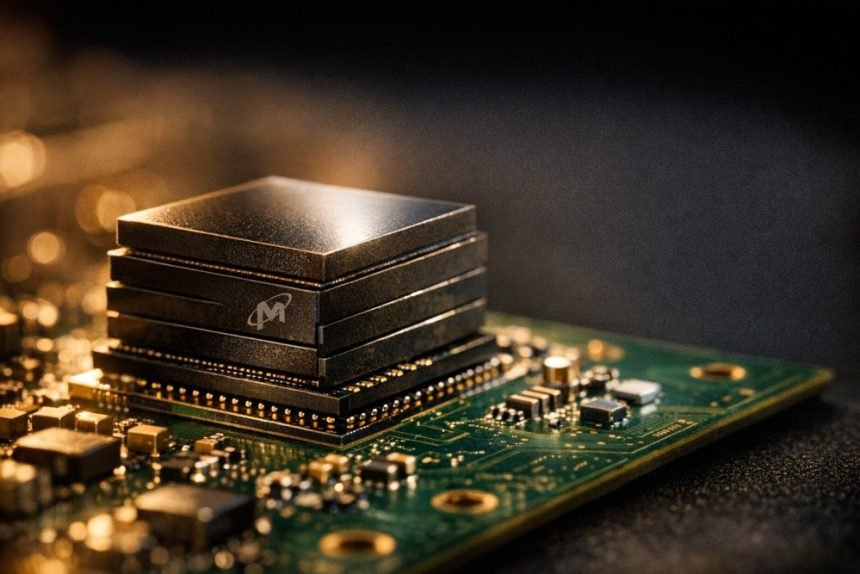
A focused MU stock analysis now has to weigh AI accelerator demand, tight DRAM supply, and renewed pricing power.
Micron Technology trades on NASDAQ as MU. It has moved from a commodity DRAM and NAND vendor into a credible supplier of High Bandwidth Memory used in AI training systems.
This piece covers Micron’s exposure, the drivers behind the rally, the risks investors underweight, and how to position the stock.
Micron’s Business Model And HBM Exposure
Micron is one of three vertically integrated memory makers globally. Its revenue splits between DRAM and NAND, with DRAM delivering most of the operating profit. Within DRAM, HBM is the fastest growing line.
HBM stacks DRAM dies vertically and connects them through silicon vias. The result is far higher bandwidth than standard DDR memory. AI accelerators from NVIDIA and AMD rely on HBM to feed massive parameter counts during training.
According to Yahoo Finance, Micron has sold out its 2025 HBM supply and is signing customers to long-term agreements that stretch well into 2026.
HBM also carries structurally higher margins than commodity DRAM. Every percentage point of HBM share within the DRAM mix improves blended gross margin. That is the real lever behind the recent rerating.
What Is Driving The 2026 Rally
The first driver is AI capital expenditure. Hyperscalers keep expanding training and inference clusters. Each new accelerator uses more HBM per chip than the last, raising memory content per server.
The second driver is supply discipline. After the 2022 to 2023 downturn, the three major memory makers cut wafer starts and delayed capacity additions. Inventories normalized and pricing recovered through 2025 into 2026.
The third driver is product mix. HBM wafers consume far more capacity per gigabit than standard DRAM. Shifting wafers toward HBM tightens supply of conventional DDR5, which lifts prices across the broader memory market.
According to 24/7 Wall St., MU has rallied roughly 68% YTD in 2026 as HBM demand outruns supply, with DRAM pricing in the early phase of a multi-year cycle. The current upcycle is unusual because AI demand is layering on top of a normal recovery.
Server bit demand growth has outrun supply additions this cycle. That supports premium pricing on advanced DDR5 modules used alongside HBM in SMCI server platforms and other AI systems.
Risks: Memory Cyclicality And Competition
The first risk is the cycle itself. Memory has always reverted. When pricing peaks, capacity expansions follow within twelve to eighteen months. Investors who ignore the cycle pay later.
The second risk is competition. SK Hynix is the dominant HBM supplier and holds the leading position with NVIDIA’s flagship parts. Samsung is the second largest player. Micron sits third but has been gaining qualifications.
If SK Hynix or Samsung accelerates capacity, Micron’s pricing power on HBM could compress sooner than the market expects. A qualification loss with a major hyperscaler can also reshape the outlook quickly.
The third risk is technology transition. Each HBM generation needs deeper bonding stacks and tighter process control. A yield stumble on next generation parts would shift share back toward whichever rival qualified first.
The fourth risk is geographic concentration. Most advanced packaging happens in Taiwan and Korea. Any disruption hits all three memory makers, but smaller players feel it more sharply.
How Investors Should Position MU For The Cycle
Memory stocks are not buy and hold compounders. They reward investors who size positions by where the cycle sits and trim into euphoria. A disciplined framework matters more than any single price target.
Active US stock investors holding MU should review position size against the rest of the AI exposure in their portfolio. If NVIDIA, AMD, and SMCI already deliver meaningful AI beta, adding outsized Micron risk concentrates the same theme.
Watch three signals through 2026. First, HBM share within Micron’s DRAM mix. Second, hyperscaler capex guidance. Third, the spread between contract and spot DRAM pricing, which often turns before earnings do.
Conclusion
Micron’s setup combines AI demand, tight supply, and rising HBM mix. That is a genuinely improved earnings backdrop. The cycle has not been repealed, and SK Hynix plus Samsung remain formidable competitors.
A balanced MU stock analysis treats the rally as a cyclical upswing on top of a structural mix shift. Investors who respect both drivers tend to keep more of their gains when the cycle eventually softens.
If you already hold MU through Gotrade, this is a good moment to review your watchlist and check portfolio weighting. With fractional shares and US stocks from US$1, you can reposition AI exposure without rebuilding the book. Open the app now!
FAQ
What does MU stand for and where does it trade?
MU is the NASDAQ ticker for Micron Technology. The company makes DRAM, NAND, and HBM memory for data centers, PCs, and mobile devices.
Why is HBM so important for Micron?
HBM carries higher margins than standard DRAM and is consumed heavily by AI accelerators. Rising HBM share within the mix improves blended gross margin and supports a higher earnings base.
Who are Micron’s main HBM competitors?
SK Hynix is the leading HBM supplier, Samsung is second, and Micron is third. All three are racing to qualify next generation HBM with hyperscalers and AI chip designers.
Is memory still a cyclical industry?
Yes. Memory pricing has always followed multi-year boom and bust cycles. AI demand softens but does not remove that pattern, so position sizing and timing remain important.
How can I buy MU on Gotrade?
You can buy MU as a fractional share on Gotrade, starting from US$1. That makes it easier to size memory exposure without buying a full share.