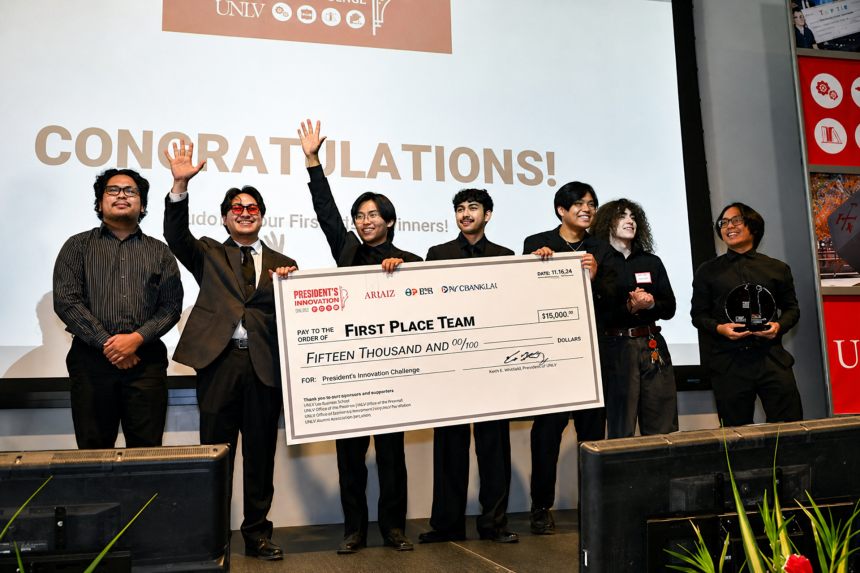
A window on the physics building, and one stubborn bird dropping, sparked the idea that would eventually earn Team Gagamba first place at this year’s President’s Innovation Challenge, held April 23 at the Thomas & Mack Center Strip View Pavilion.
Preparation for the competition took weeks of brainstorming, talking to industry professionals, revising ideas, and practicing well into the night. And as Team Gagamba remained on stage for the final round, they began to feel a bit nervous about the results after getting a look at their competition.
But then came the announcement from the judges.
Team Gagamba took home the grand prize for “Gagamba,” an autonomous drone designed to clean high-rise windows on the Las Vegas Strip. Their proposed project aims to reduce risks for human cleaning crews while helping building operators perform maintenance more safely and efficiently.
Finding Creative Solutions to Real-World Challenges
The President’s Innovation Challenge is a multidisciplinary team competition encouraging social and business entrepreneurship to help solve major challenges in Southern Nevada and beyond. This year, diverse teams of students combined their knowledge and expertise to explore the transformative power of artificial intelligence (AI).
Teams were asked to submit their boldest ideas and answer the timely question: How can AI be harnessed to reimagine the future of human-centric industries, and solve the most pressing challenges facing dynamic communities like Las Vegas?
In the end, six teams — including Team Gagamba — advanced to the final round, where they presented their proposals to a panel of judges for a chance at cash prizes to help launch their project.
This Year’s Top Innovators
The 2026 President’s Innovation Challenge winners:
- First place: Team Gagamba
- Second place: Team RebelBot
- Third place: Team BYK Labs
About Team Gagamba
Team Gagamba has proposed an autonomous drone platform designed for cleaning high-rise buildings, aided by AI.
After extensive research and speaking with industry professionals, the team found that high-access cleaning is expensive and unsafe for window cleaning workers, especially in a popular tourist destination like Las Vegas. The drone can detect contamination, map the windows, select a cleaning method, and verify results in real time.
Meet the members:
- Vaughn Guintu, Bachelor of Science in mechanical engineering
- Richies Huynh, Bachelor of Science in computer science
- Khristian Ordonio, Bachelor of Arts in political science
- Aarash Gohari, Bachelor of Science in computer science
- Nathaniel “Yul” Ordonio, Bachelor of Science in civil engineering
- Maddox Dolor, Bachelor of Science in civil engineering
- Narek “Tony” Tonoyan, Bachelor of Science in computer science
Here, Team Gagamba reflects on the competition, their proposal, and what comes next.
How did you hear about the competition, and how did your team come together?
Vaughn Guintu: Tony and I participated in last year’s PIC challenge with our NexSledge team, which we’re still actively working on. While we won the award for Technological Innovation, we wanted to come back and win first place. As for the rest of the team, it was mostly friends of friends. I think good team synergy is important, so knowing each other before the challenge helped the project overall.
What inspired your idea for the Gagamba drone?
Vaughn Guintu: I was walking with Aarash, and I was looking at the physics building. There was this big bird dropping on the window, and I thought, “What the heck? What kind of bird did that?” It was there for weeks, and I was thinking about how tedious it would be to have someone go up the building and clean it. And so, I thought, what if we had a drone that could clean it!
What was your team’s process as the competition unfolded?
Nathaniel Ordonio: It started with a graffiti removal drone. We did a lot of research into the financial side, the damages, and assisting police investigations regarding tagging. Then, after a few interviews with companies such as Servpro, MGM Grand, and other cleaning contractors, we learned more about what it means to clean as an industry. So we picked a spot in the middle of the cleaning spectrum, and we went with window washing because it was the most feasible option. There was high interest from Servpro and MGM Grand, and we received their feedback that window washing was one of the most common jobs they hired for.
Did a lot change with your proposal between when the competition started and where you ended up?
Vaughn Guintu: Initially, we wanted the drone to climb on the wall. The drone would go onto the wall, the rotors would spin a lot stronger, and attach to the wall. There’d also be wheels attached, so the whole modular system would be on the wall-mounted part. The issue with that is a simple physics problem. We determined that when you factor in the coefficient of friction, say it’s 0.5, it ends up that the amount of thrust that you need to go against the wall is twice what it is just hovering.
Maddox Dolor: Our first idea was to do graffiti removal, window cleaning, or mural painting. We initially didn’t want to do window cleaning because other companies had already done something similar to it in the past. Then, Glenn Nowak, one of the founders of AeroAI, suggested that we focus on one end. He told us that instead of prioritizing novelty, focus on a niche that could be the most impactful and profitable. That’s how we dialed in on window cleaning and analyzed how we can make this existing market even better.
What was it like working with your mentors?
Vaughn Guintu: [Associate professor-in-residence Anthony Ferrar] was pretty integral to NexSledge as a mentor last year. Actually, a lot of what he taught has carried over to this year. He is one of the best sales engineers, I’d say. He knows how to sell things, and I think that’s important when you’re pitching ideas in this competition. He has such a way with words.
Richies Huynh: Our mentors were very helpful throughout the process. They gave valuable feedback on the presentation. A lot of the time, we were thinking about how we could structure our pitch to the best of our ability, making it concise, clear, and convincing throughout the process. Their help with practicing and rehearsing leading up to the competition was tremendous, as was their ongoing support along the way.
What did you learn from this experience, either as an individual or working as a team?
Narek Tonoyan: I remember the very first meeting that Vaughn invited me to. He said: “We’re going to make this drone, and it’s going to combat graffiti tagging, and maybe we could also do biohazards as well, and maybe murals.” I was thinking, “Wow, this is kind of scattered, and I feel like there might not be a market.” But I did think [the drone] idea had potential, and I knew the people around me were fantastic, so we’re going to make something out of this. When you have faith in your team, and you really stick together, you work on it, good things always happen.
Richies Huynh: The people you surround yourself with and collaborate with are more important than what you’re working on. Regardless of what you’re working on, the people around you are going to make the project 100x better than it would have been with another group.
How were you feeling before, during, and after the final round?
Vaughn Guintu: I was messing up on the presentation that I had been practicing for the past week, and I thought, “Why am I forgetting my lines now? I’ve spoken in public before, and I’ve done this before.” For me, I’ve always wanted to build and work with drones. So while I was giving that final presentation, I realized, “Wow, I’m at my prime, I’m in flow state right now.” I was embodying Tony Stark. Then, after we won, I was elated because now we’ll have the funding and resources to pursue this project and make it a reality. We’re going to have Gagambas on every building on the Strip!
Narek Tonoyan: We practiced a lot the day before the final round. Everybody was nailing it. I said, “If we don’t win first, we’re at least going to be on the podium. Then, during the final round, I did get nervous seeing the competition. Everyone was good and had clearly rehearsed. I was like, “Wait, hold on. Let’s see how this develops.” Then, when we did win, I couldn’t believe it! We went to South Point Casino and celebrated with the garden buffet. It was just a sensational experience. It was unreal!
What’s next for your team now that you’ve won?
Vaughn Guintu: Over the next two years, we’re going to develop the drone and this whole project into something tangible. That’s going to involve working in the lab, being involved with undergraduate research, and getting more people involved. There’s also the business aspect. We’re going to go pitch it to Zero Labs, the Las Vegas incubator, and we’ll take another crack at Startup Vegas. We are all very motivated to make this project a reality.
What would you tell someone who is considering participating in next year’s competition?
Vaughn Guintu: Three of the last five PIC winners were in Rebel Start-Up. We may know the secret formula to help you get at least the top three. Consider joining Rebel Start-Up!
Richies Huynh: You learn so much from a business perspective that you wouldn’t necessarily learn inside a classroom. Like about market research and how to validate if an idea is good or not. PIC is a great launching point, especially if you want to start your own business or startup.
Nathaniel Ordonio: If you have an idea and you have a good group of friends, go for it. If anything, you get your name out there, and you have your idea presented to people who might help you in the future, even if you don’t qualify for a finalist position. Also, make sure you read the requirements closely. We made the mistake of thinking we could be a team of engineers. Since the challenge is interdisciplinary, we had to have someone swapped out from a different major. If you have a passion and you pay attention to what they’re asking for, you can improve Las Vegas and beyond by pursuing ideas that both you and your friends are passionate about!