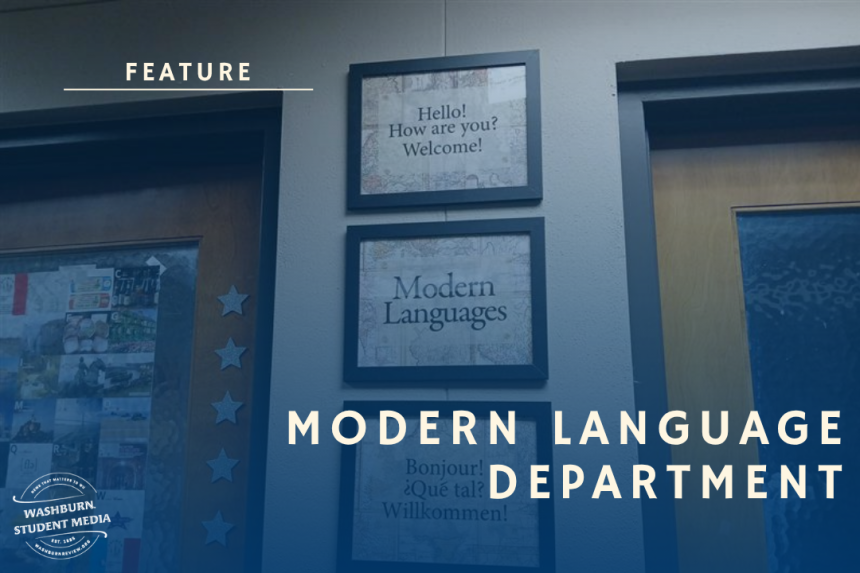
At Washburn University, the modern language department is located in Room 350 of Morgan Hall and offers students a variety of opportunities to engage in language learning and cultural experiences.
Miguel Gonzalez-Abellas, chair of the modern language department and professor of Spanish, said he is inspired to help people learn about his language and culture. Originally from Spain, Gonzalez-Abellas said he is passionate about sharing not only Spanish culture but also Latin American culture. After traveling through parts of Central and South America, he became eager to show the different perspectives and ways of life found in those regions.
Gonzalez-Abellas described what makes the modern language department unique.
“We’re the only department that actually speaks languages other than English, that we bring a lot of at least the linguistic and cultural diversity to campus and that’s important,” Gonzalez-Abellas said.
Gonzalez-Abellas described a nationwide decline in students studying foreign languages. He said enrollment in the department has remained about the same compared to last year, but the overall trend across the country continues to decrease. He added that he does not see an easy way to reverse the decline and pointed to a major difference between the United States and Europe in language education.
According to statistics he recently read, about 80 to 90% of students in Europe learn another language during high school or college, while only about 38% of students in the United States do the same. He said the gap reflects a challenge in American education.
Washburn Modern language department provides study abroad opportunities for students. Gonzalez-Abellas also described this opportunity.
“[It] not a requirement for our majors and minors, but we strongly encourage them to go study abroad,” Gonzalez-Abellas said. “We have a good scholarship program. So we try to make sure that studying abroad is not easy and there won’t be any financial constraints for students trying to do that. […] They can go on a short term program with a faculty member, faculty led program. They can just go for a summer, for like four or five weeks, or they can go for a full semester. It depends on, they need to consult with their advisor, and depending on it would be better for them.”
Helene Perriguey-Keene, lecturer in French and Spanish, described her teaching philosophy as encouraging students to travel, experience new cultures and broaden their perspectives. She said studying abroad helps students better understand their own language and culture while becoming more open-minded and tolerant. According to her, traveling and experiencing different parts of the world allows students to return with a deeper understanding of themselves and others.
Perriguey-Keene described how she helped students in language learning.
“I email a lot, and I’m trying not to be mommy, because that’s not the job of a teacher, but I have to make sure they’re okay,” Perriguey-Keene said. “First, I have people who are struggling mentally. Sometimes you need to find the right resource for them. It’s mainly about what you hope they interested in learning. Try to motivate them. So sometimes it’s a challenging class, because they need this class without wanting to be there. That’s, for me, the biggest challenge, because if you want to learn, hey, I’m here.”
Perriguey-Keene said they have a French club that gives students opportunities to engage with French language and culture through activities held every other week, including presentations, movies, museum visits and restaurant outings. She also organizes a French table where people gather to speak French for an hour. Since 2019, she and her colleague have taken students abroad to France, Guadeloupe, Quebec and Louisiana, while future trips are also being planned. She added that during her upcoming sabbatical, she plans to study French language and culture in Ireland and bring that experience back to her students.
Caroline Chiddix, junior elementary education and Spanish education major, said her experience studying Spanish in high school motivated her to pursue foreign languages. She said a supportive Spanish teacher inspired her interest in continuing language studies in college. Chiddix added that she hopes to become a teacher in the future and wants to work with bilingual students, which further encouraged her to study modern languages.
Chiddix shared her experience in learning Spanish.
“I would say being in the department has definitely helped everybody … Modern Language Department is really helpful, and they’re always willing to answer my questions when I have a lot of them,” Chiddix said. “They also were able to help me with opportunities for studying abroad, which I was able to do last semester.”
Chiddix said studying abroad in Santiago de Compostela, Spain, for 10 weeks was a life-changing experience. She chose the city because it was close to where her high school Spanish teacher was from. Chiddix said she decided to study abroad because she knew it was a once-in-a-lifetime opportunity, and the experience helped her grow academically while greatly improving her Spanish skills. She added that studying abroad opened her eyes to new perspectives and described it as one of the best decisions she has made at Washburn.
Chiddix had also described how the modern language department had helped her outside of classes.
“Yes, so outside of class, all the professors are always willing to answer your emails all the time, and I always have a lot of emails,” Chiddix said. “Even the head of the department, you’re able to meet with him frequently if you need to. Also, if I’m ever struggling with a concept in the classes, I can email the professor … They will always take time to set aside time for me to come to their office to help me. And they’ve done that many times.”
Chiddix is also a Spanish tutor who allows her to help students better understand the language outside the classroom. She said she holds office hours twice a week where students can ask questions, and she tries to explain concepts in different ways that may be easier for them to understand. Chiddix added that she provides students with examples and additional resources so they can continue practicing on their own outside of class.
Kelly McClendon, director of academic assessment and director intensive of English and senior lecturer in modern languages, said students learn languages most effectively in active and engaged environments where they regularly use the material they are studying. She explained that immersion plays an important role in language learning because students gain more experience by surrounding themselves with the language.
McClendon added that learning a foreign language in an English-speaking environment differs from the program she directs, where students are immersed in English while learning the language.
McClendon explained the balanced standardized assessment with creativity in language learning.
“Well, our outcomes are standardized across the courses and the levels,” McClendon said. “So if one teacher is teaching a section and the other teacher is teaching another section, we still have the same outcome. So we’re standardized, but we may use a different method of getting the students engaged with the material or assessing them. I may assess them a little differently, but I’m getting at the same question and the same skill.”
McClendon said language learning can be challenging for students because it requires constant practice and building foundational skills step by step. She explained that students must continue developing vocabulary, reading, writing and speaking skills in order to progress evenly in the language. McClendon added that instructors try to create engaging learning opportunities for students, but learning a language still requires significant effort and dedication.
McClendon described how she incorporated culture into her language classes.
“It’s very fun. That’s this really fun part and hopefully engaging for the students …,” McClendon said. “But I like to bring in the cultural United States, cultural holidays. So, I’ll may even bring my own treats that I’ve made at home that are traditional for my family, and then share them with my students. And then they share, but we do that a lot. And then, there’s so much cultural knowledge for them, so I try to get them, I try to make sure they know about plays here at Washburn, or concerts or what’s going on, so they can get involved.”
McClendon said many students taking language courses are majoring in other fields, with intensive English students often completing language requirements before continuing in different academic programs. She explained that faculty members also support the wider university community through faculty-led study abroad programs and services such as Spanish translation during new student orientation.
McClendon added that the department stays connected with the community through its work with international programs and international students.
The modern language department at Washburn University continues to provide students with opportunities to expand their cultural understanding through language learning, study abroad experiences and community engagement. Through the support of faculty members, cultural activities and immersive learning experiences, students are encouraged to develop communication skills, broaden their perspectives and connect with people from different backgrounds around the world.
Edited by Stuti Khadka