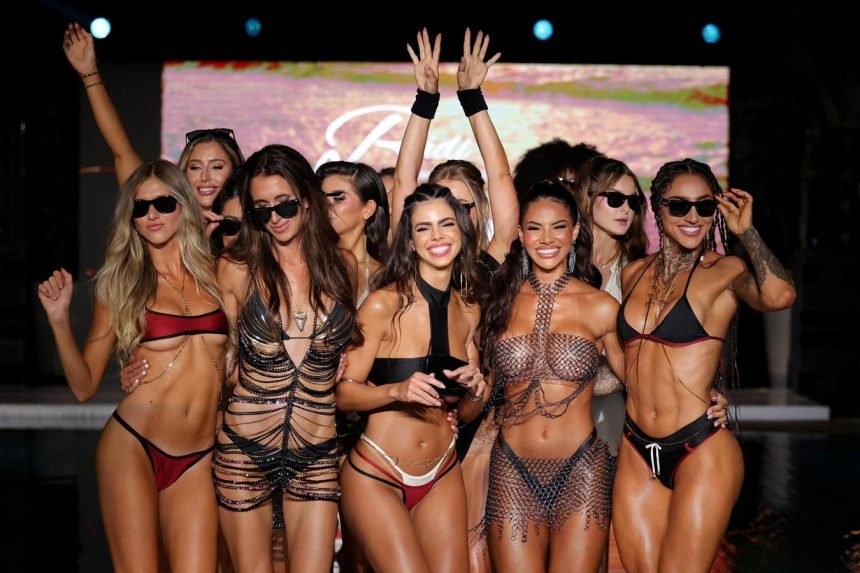
MIAMI BEACH, FLORIDA – JUNE 01: Models pose on the runway at the Lila Nikole Collection during Miami Swim Week: The Shows 2025 at Mondrian South Beach Hotel on June 01, 2025 in Miami Beach, Florida. (Photo by Rob Kim/Getty Images)
Getty Images
When Miami Swim Week – The Shows returns to the Mondrian South Beach on May 27th, the event will not merely stage another parade of bikinis against a backdrop of palm trees and runway photographers’ flashes. Under newly appointed interim-CEO Sean Rashid, the organization is attempting something considerably more ambitious: transforming a highly seasonal, postcard-ready spectacle into a year-round business platform for swimwear, resort-wear, wellness, and experiential luxury.
Sean Rashid, Interim-CEO of Miami Swim Week – The Shows
Courtesy of Miami Swim Week – The Shows
The current edition arrives at a moment when Miami itself is aggressively renegotiating its role in the US fashion industry landscape. Spanning more than 20 events across 10 venues and featuring over 50 designers from countries including France, Colombia, Brazil, Italy, Bulgaria, Turkey, Australia, and the United Kingdom, the largest gathering of its kind highlights a city positioning itself as a commercial gateway between North America, Latin America, and the global resort-wear economy.
Once viewed by Manhattan insiders as primarily a nightlife and tourism destination, Miami is building an independent economic identity as the third fashion capital in America after New York City and Los Angeles. “Paris has couture, Milan has luxury manufacturing, New York has commerce,” said Sean Rashid, CEO of Miami Swim Week – The Shows. “Miami has something different: resort, swim, wellness, Latin culture, hospitality, nightlife and global lifestyle – all in one city.”
MIAMI BEACH, FLORIDA – JUNE 01: Models walk the runway during the Closing Night of Miami Swim Week at Mondrian South Beach on June 01, 2025 in Miami Beach, Florida. (Photo by Sergi Alexander/Getty Images).
Getty Images
The Runway as an Investment Funnel
In an American fashion system still heavily centralized around NYC, Miami Swim Week has quietly become a case study in regional success. Unlike traditional fashion weeks that remain tethered to the singular, sacred alchemy of the runway image, Rashid speaks about Miami events in terms of experiential commerce. “The runway is no longer the end product,” he notes sharply. “It’s the beginning of a commercial funnel.”
MIAMI BEACH, FLORIDA – JUNE 01: (L-R) Simisola Lawal, Alina Sushchenko, Élodie Hintermann, and TheMrColeman attend the Closing Night of Miami Swim Week at Mondrian South Beach on June 01, 2025 in Miami Beach, Florida. (Photo by Sergi Alexander/Getty Images).
Getty Images
That philosophy is visible throughout the week’s sprawling programming. The event opens with a Neutrogena-sponsored model casting at The Goodtime Hotel, before dissolving into a week that blends runway shows with wellness activations, influencer networking, beauty lounges, and panels on fashion sustainability. Even the public-facing geography of the event is expanding. Among the largest public moments is the reopening celebration of Drexel Avenue on Lincoln Road, where organizers will stage a pedestrian block-party runway show featuring brands like Liliana Montoya Swim, Infamous Swim, and Cioccolato Couture, to name a few.
MIAMI, FLORIDA – MAY 31: Tallia Storm attends the HartiSWIM Runway Show at Miami Swim Week: The Shows 2025 at Mondrian South Beach on May 31, 2025 in Miami, Florida. (Photo by Rob Kim/Getty Images for HartiSWIM)
Getty Images for HartiSWIM
The production scale itself has escalated over the years. This year’s staging features a massive LED screen alongside immersive sound design and integrated DJ performances more commonly associated with edgy European runway productions. Rashid, whose own career has traversed fashion manufacturing appears particularly focused on spectacle as a part of his business strategy. “You have to captivate the audience,” he explains. “Runways can become boring if you don’t evolve the format. We want people to leave feeling like they experienced something, not just watched models walk.”
MIAMI BEACH, FLORIDA – MAY 31: Shatanay McCaskill. walks the runway with models wearing Everlast® during Miami Swim Week: The Shows on May 31, 2025 in Miami Beach, Florida. (Photo by Thomas Concordia/Getty Images for Miami Swim Week: The Shows)
Getty Images for Miami Swim Week: The Shows
From SoHo to South Beach
Born in India, Rashid entered the American fashion industry selling accessories in New York before designing leather collections that eventually landed in the windows of Saks Fifth Avenue and Bloomingdale’s during the late 1980s. Later, he founded a boutique modeling agency in SoHo that worked with legacy houses like Christian Dior and Dolce & Gabbana, while simultaneously moving into international entertainment promotion, orchestrating arena-scale concerts in Dubai for artists like 50 Cent and Justin Timberlake.
MIAMI BEACH, FLORIDA – MAY 28: Designer Ema Koja (C)walks the runway with models for Ema Savahl during Miami Swim Week: The Shows at Mondrian South Beach on May 28, 2025 in Miami Beach, Florida. (Photo by Thomas Concordia/Getty Images for Miami Swim Week: The Shows)
Getty Images for Miami Swim Week: The Shows
That unusual cross-disciplinary background helps explain why Rashid’s imprint on Miami Swim Week – The Shows often feels structurally closer to a lifestyle festival than a traditional fashion week. Nowhere his ambition is clearer than in the wellness expansion. The schedule includes “SwimFit” programming, packed with sound baths, aura readings, red-light therapy, cryotherapy, oxygen facials, and pilates. While some traditional fashion purists might dismiss such programming as trend-driven excess, Rashid argues that wellness is now inseparable from the modern resortwear and swimwear economy. “Swim has always been connected to the body,” he says. “But the wellness conversation has evolved. Now it’s about recovery, longevity, confidence, self-expression and how people actually thrive.”
MIAMI BEACH, FLORIDA – MAY 29: Ivana Delarose walks the runway for Delarose Sisters during Miami Swim Week: The Shows on May 29, 2025 in Miami Beach, Florida. (Photo by Thomas Concordia/Getty Images for Miami Swim Week: The Shows)
Getty Images for Miami Swim Week: The Shows
Miami is uniquely positioned to monetize this convergence. The city’s post-pandemic transformation into a magnet for tech entrepreneurs, wellness startups, crypto wealth, and luxury hospitality has created fertile ground for hybrid events that blur the lines between health optimization, fashion, and entertainment. “The real opportunity is disruption,” Rashid says. “Creating a fashion week that is more open, more experiential, more digital and more connected to how people live today.”
MIAMI BEACH, FLORIDA – MAY 29: Models walk the runway wearing Luxe Living Fashions during Miami Swim Week: The Shows on May 29, 2025 in Miami Beach, Florida. (Photo by Thomas Concordia/Getty Images for Miami Swim Week: The Shows)
Getty Images for Miami Swim Week: The Shows
The Architecture of a Regional Marketplace
Rashid’s ambition enters an increasingly crowded and fragmented landscape in Miami. Multiple competing swimwear events now coexist along South Beach. While globally, fashion weeks face existential questions regarding relevance, return on investment, and audience fatigue. “The American way is free competition,” he said with full confidence. “Competition makes you more creative. It pushes you to create more value for the people participating.” Still, Rashid acknowledges that longevity requires more than social media visibility. Throughout our conversation, he repeatedly returned to the idea that emerging designers need commercial infrastructure as much as runway exposure. “We want to help smaller designers connect with manufacturers, investors and retailers,” he says. “The goal is to create an impactful marketplace.”
MIAMI BEACH, FLORIDA – JUNE 01: Models walk the runway during the Closing Night of Miami Swim Week at Mondrian South Beach on June 01, 2025 in Miami Beach, Florida. (Photo by Sergi Alexander/Getty Images).
Getty Images
That focus may prove especially significant for Latin American designers using Miami as a testing ground for further U.S. expansion. Rashid points specifically to Colombia as a rapidly growing force in swimwear manufacturing and design, while noting rising interest from Argentina and Brazil as well. “We are very open to emerging designers,” he notes. “If we believe in the collection, we give them a chance.”
Decentralizing American Fashion
This openness has long differentiated Miami from the more gatekept fashion system of New York Fashion Week. But it also reflects the shifting economic realities of resortwear itself, a category that has become less seasonal and more integrated into everyday dressing, with spending on swimwear and resort wear seeing a massive surge, with the global swimwear market reaching $22.95 billion and resort wear $25.98 billion in 2025. Today, the category is no longer confined to cruise collections and luxury vacations; it increasingly intersects with activewear, nightlife, and influencer-driven lifestyle branding.
The current lineup stretches well beyond traditional women’s swimwear into men’s resort-wear, wellness fashion, experiential retail, and international collaborations, underscored by the closing “Italian Riviera Collective Show,” supported by the Italian Trade Agency.
MIAMI BEACH, FLORIDA – JUNE 01: Eliya Cioccolato (L) and Marie Sophie Baier (C) attend the Closing Night of Miami Swim Week at Mondrian South Beach on June 01, 2025 in Miami Beach, Florida. (Photo by Sergi Alexander/Getty Images).
Getty Images
Yet perhaps the most revealing part of our conversation involved Rashid’s critique of America’s broader fashion infrastructure. When asked whether organizations like the Council of Fashion Designers of America adequately support regional fashion ecosystems outside New York, Rashid was candid. “I think CFDA is very consumed with New York,” said Rashid. “America has many major cities with different cultures. Miami should not have to become New York to matter.”
MIAMI BEACH, FLORIDA – JUNE 01: Models walk the runway at the Lila Nikole Collection during Miami Swim Week: The Shows 2025 at Mondrian South Beach Hotel on June 01, 2025 in Miami Beach, Florida. (Photo by Rob Kim/Getty Images)
Getty Images
It is a sentiment increasingly echoed by fashion week organizers in cities from Portland to San Antonio to Honolulu: that the future of American fashion may depend less on Manhattan centralization and more on regional specialization. In Miami’s case, specialization is its ultimate leverage. The city already possesses what global fashion increasingly craves: tourism, multiculturalism, creator culture, and year-round, climate-driven resortwear fashion.
The challenge now is turning that cultural energy into a sustainable, institutional business architecture. For Rashid, that challenge is deeply personal. “Success is not just surviving the season,” he said near the end of our conversation. “It’s proving a new model.”