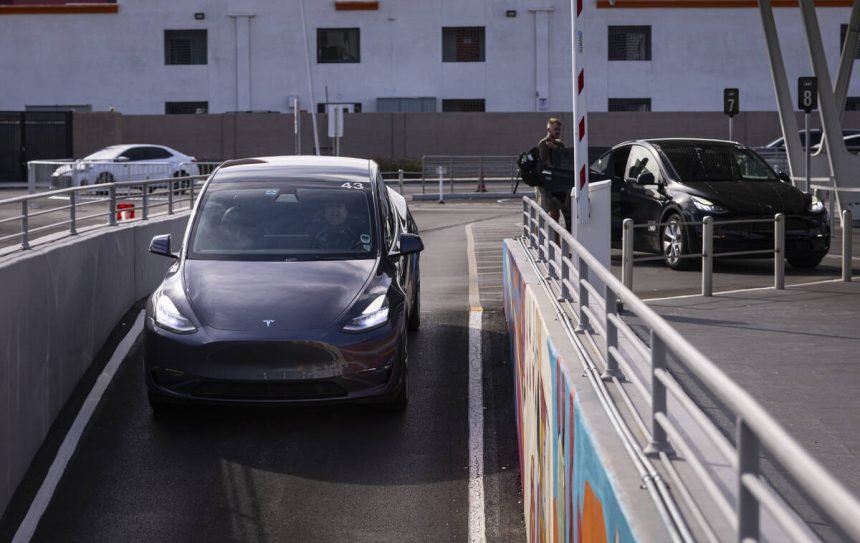
Clark County Commissioners approved the amendment of an ordinance that further regulates the Elon Musk-owned Boring Co.’s Vegas Loop on Tuesday.
The amended ordinance focuses on the design, construction, commissioning, operation and maintenance of Vegas Loop’s tunnels as the company plans further expansion of its mainly underground people mover system.
It details required safety and operational measures for each phase of the Vegas Loop project, including how long tunnel portions can be between exits. It also requires the installation of sensors, cameras, fire suppression and ventilation systems for security and fire safety.
Having those guidelines in place will prove helpful as the Boring Co. and county officials work to speed the permitting process for building out the Vegas Loop system. Boring Co. President Steve Davis told the Review-Journal in January that it can take up to six months to receive needed building permits for constructing the Vegas Loop.
With each loop tunnel segment built the same way, just in different locations, Davis’ hope is to land a process similar to another Musk-owned company, SpaceX, which received regulatory approvals from the Federal Aviation Administration and other agencies to conduct rocket launches more frequently in the U.S., since the launch process is essentially the same each time.
Fire response vehicles
The ordinance also requires Boring Co. to provide and maintain specialized fire response vehicles for the Clark County Fire Department that can operate in the Vegas Loop’s underground tunnels.
“The tunnels are a size that doesn’t fit your typical fire response down there, and we’re first to get there,” said Clark County Commissioner Marylin Kirkpatrick. “I thought, two years ago, that we were supposed to have a fire response vehicle that could go down there. My understanding is that it’s not quite finished yet and that they’re (Boring Co.) waiting on us (county).”
Clark County Fire Chief Billy Samuels is responsible for approving the features and functions of the fire response vehicle, before one is produced, according to the ordinance.
“We owe the Boring Co. a spec vehicle for feedback on that, so that is currently on us,” Samuels said. “The current vehicles that we have, they’re just side-by-sides and they are inadequate for the performance. The vehicles that we are spec’ing out would meet those needs. It has the power we need.”
Initially the response vehicles were meant to be bi-directional, but Samuels said that no longer makes sense. Samuels said he is working with others to nail down what needs to be included in the vehicles and hopes to have those details into the county and Boring Co. by the end of the week.
“I think we’re fairly confident in what we have been working on — way more than we have in the past,” Samuels said. “I think we can get this across the finish line.”
As part of the ordinance, one fire response vehicle will be required per every 1,250-foot segment of the loop system without a direct at-grade exit and one spare vehicle to have on standby.
Future build-out
Plans call for the Vegas Loop to eventually include 68 miles of tunnels and 104 stations across the Strip, downtown Las Vegas, Chinatown and other areas including Allegiant Stadium, the Las Vegas Convention Center and near Harry Reid International Airport.
The Vegas Loop’s current operations include multiple stations at the Las Vegas Convention Center and at nearby resorts including Encore, Fontainebleau, Resorts World and Westgate. The system uses Tesla vehicles in a point-to-point system, allowing passengers to be transported from their pickup to their drop-off without stops in between.
A 2.2-mile dual tunnel running underneath Paradise Road between Westgate and a Boring Co.-owned site on Paradise, across from the Thomas & Mack Center at UNLV, should be in operation in some fashion by November’s Las Vegas Grand Prix, Boring Co. officials said.
‘Ready to explode’
Clark County Commissioner Jim Gibson said the ordinance lays out the expectations of the county and Boring Co. and that he is excited for what it means for the further expansion of the project.
“These permits are many in number and there is a whole lot of work that has yet to be done,” Gibson said. “But we have agreed in principle to stations at Harry Reid International Airport, which is a monumental thing. We’ve been working at UNLV on easements and defining the route from UNLV, there will be a station there, as I understand it. The work now is ready… to explode in the sense that we are ready to really move forward and the adoption helps us get to that place.”
Contact Mick Akers at makers@reviewjournal.com or 702-387-2920. Follow @mickakers on X.