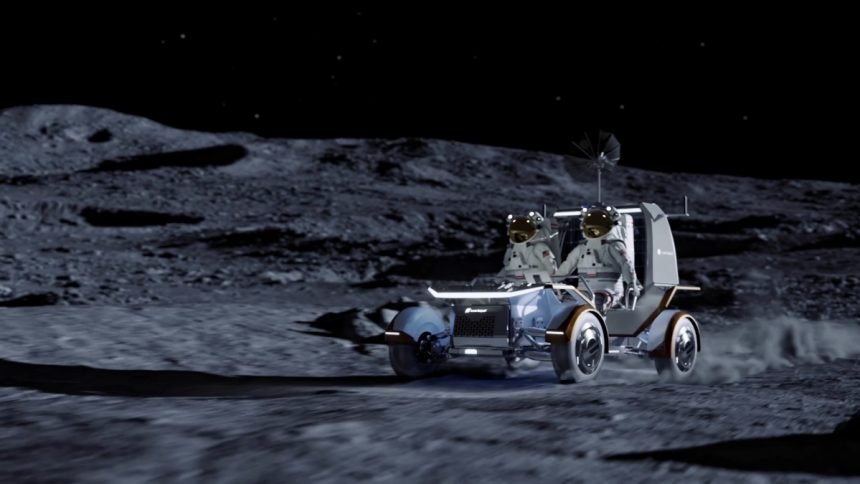
GM technology will help power Lunar Outpost’s Pegasus for NASA’s Artemis missions
2026-05-26
NASA has selected Lunar Outpost for its Lunar Terrain Vehicle Services program, Pegasus, and GM is part of the team developing the vehicle for future Artemis missions to the Moon.
Pegasus is designed to support operations at the Moon’s south pole, where rugged terrain, darkness and extreme temperatures create significant mobility challenges.
GM is adapting production-car battery technology for a lunar environment characterized by extreme temperature swings. Long-term reliability and fault tolerance are critical here. The company is also contributing to suspension and chassis work to help Pegasus navigate cratered terrain, steep slopes and low-gravity conditions.
The work builds on GM’s long history in space exploration. GM contributed key systems to the original Apollo-era lunar rover, including the wheels, suspension, steering and drivetrain.
“GM’s electrification technology was built to perform in some of Earth’s toughest driving conditions, and adapting it for the Moon with space-rated batteries is an extraordinary technical challenge,” said Stephen duMont, president, GM Defense. “Helping astronauts once again travel safely across the lunar surface will be a proud moment for our team and our country.”
Pegasus is being developed by Lunar Outpost in partnership with GM, The Goodyear Tire & Rubber Company and Leidos.
Pegasus gives Artemis Astronauts safe, reliable, and highly capable mobility to explore and build the first elements of a permanent Moon Base.
NASA has selected Lunar Outpost’s Pegasus for a crewed High Achievability Task Order under its Lunar Terrain Vehicle Services (LTVS) contract, and GM is part of the team developing the vehicle for future Artemis missions to the Moon. Astronauts will drive Pegasus on the Moon in 2028.
Pegasus is designed to support operations at the Moon’s South Pole, where rugged terrain, darkness and extreme temperatures pose significant mobility challenges.
GM is producing battery technology for a lunar environment characterized by extreme temperature swings. Long-term reliability and fault tolerance are critical here.
The work builds on GM’s long history in space exploration. GM contributed key systems to the original Apollo-era lunar rover, including the wheels, suspension, steering and drivetrain.
“GM’s electrification technology was built to perform in some of Earth’s toughest driving conditions, and adapting it for the Moon with space-rated batteries is an extraordinary technical challenge,” said Stephen duMont, president, GM Defense. “Helping astronauts once again travel safely across the lunar surface will be a proud moment for our team and our country.”
Pegasus is being developed by Lunar Outpost in partnership with GM, The Goodyear Tire & Rubber Company and Leidos.