Published on
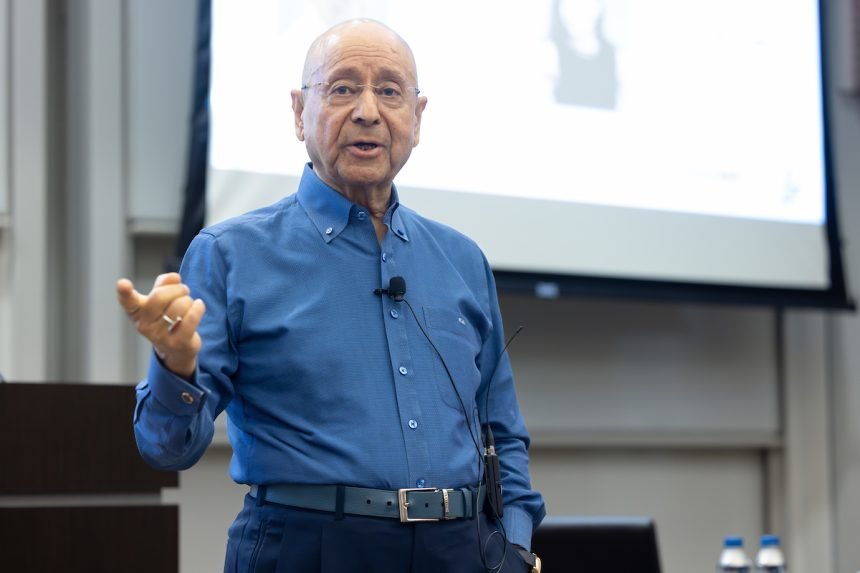
Rattan L. Khosa speaks to the students at SeedCon 2025.
As part of the NVC@30 celebration, Rattan L. Khosa, ’79, reflected on his entrepreneurial journey, his connection to Booth, and why helping aspiring founders take the leap into entrepreneurship has become so meaningful to him.
When University of Chicago Booth School of Business alumnus Rattan L. Khosa first came to the United States from India in 1969, he was leaving behind a comfortable life and taking a significant risk in pursuit of opportunity.
After graduating first in his civil engineering program, he struggled to find the right professional opportunity despite being at the top of his class. That ultimately led him to pursue a research fellowship in the United States.
“It was a huge risk,” Khosa said. “I could have stayed and lived a very comfortable life, but I wanted something more.”
Persistence at Booth
By the time Khosa considered pursuing an MBA, he already held a bachelor of science degree, a bachelor’s degree in civil engineering, and a master’s degree in structural engineering, and he had built a successful career.
Still, colleagues encouraged him to pursue business school. Getting into Booth, however, took persistence.
“I applied and got rejected twice,” Khosa recalled. “The third time, I sent a letter and got a call asking me to interview.”
The concern was not his qualifications, but whether he could balance the program with his career responsibilities.
He was accepted, but between work, travel, family responsibilities, and the demands of the program, Khosa’s grades slipped. He eventually decided to temporarily step away to regroup.
Even after returning, he remembers sitting at breakfast with his wife and considering leaving the program entirely because he felt he was not giving enough attention to his family, despite needing only six more courses. But with encouragement from his family, he stayed the course.
“What I got out of it, despite all the challenges, was realizing I could do it,” Khosa said. “That gave me confidence that I could do anything.”
Building AMSYSCO
Khosa secured a job following graduation, but over time he grew unsure about its long-term success. He faced three choices: find another position in the United States, return to India, or start a company of his own.

Encouraged by his father, he chose the entrepreneurial path. With $44,000 and no outside financing, Khosa founded AMSYSCO, a post-tensioning company that would eventually become one of the industry leaders, from his basement.
“At the time, everyone thought I was crazy,” Khosa said.
Despite the skepticism, AMSYSCO grew into a successful company that has remained profitable every year since its founding.
Khosa realized how much his Booth experience had shaped the way he approached challenges.
“In engineering, you look for formulas,” he said. “In business, you figure out how to make things work.”
“I also learned how to solve problems under pressure,” Khosa continued. “When I didn’t have money in business, I figured it out the same way.”
Expanding Entrepreneurship at Booth and the Polsky Center
Khosa first became more deeply involved with the University after receiving an invitation from entrepreneur and philanthropist Michael Polsky to join an entrepreneurship advisory board.
“I’m big on reaching out, meeting people, and helping where I can,” Khosa said. “If I can help the school in any way, why not?”
Over time, he became increasingly engaged with entrepreneurship programming at Booth and the Polsky Center. One area he was especially passionate about was entrepreneurial sales.
Khosa spent years pushing for a class on the topic before Booth ultimately became one of the first business schools to establish an entrepreneurial sales course. Today, similar programs have become common across the country, and entrepreneurial sales is one of the most popular classes at Booth.
Khosa has also remained highly engaged with students, frequently speaking in classes, bringing students to AMSYSCO’s offices, and mentoring aspiring entrepreneurs.
“I like students to see things in real life, not just read about them,” he said.
Khosa’s connection to the Edward L. Kaplan, ’71, New Venture Challenge (NVC) was especially meaningful because of his own struggles raising money as an entrepreneur.
“When I started my business, I failed to raise money,” Khosa said. “I was desperate trying to figure out how to make it work.”
In 2018, Khosa approached Booth and Polsky Center leadership about becoming more involved in entrepreneurship support.
Working alongside leaders including Starr Marcello, MBA ’04, deputy dean for MBA programs and clinical professor of entrepreneurship, and Steven N. Kaplan, Neubauer Family Distinguished Service Professor of Entrepreneurship and Finance and Kessenich E.P. Faculty Director of the Polsky Center, those conversations eventually led to the establishment of the Rattan L. Khosa Student Entrepreneurship Program.
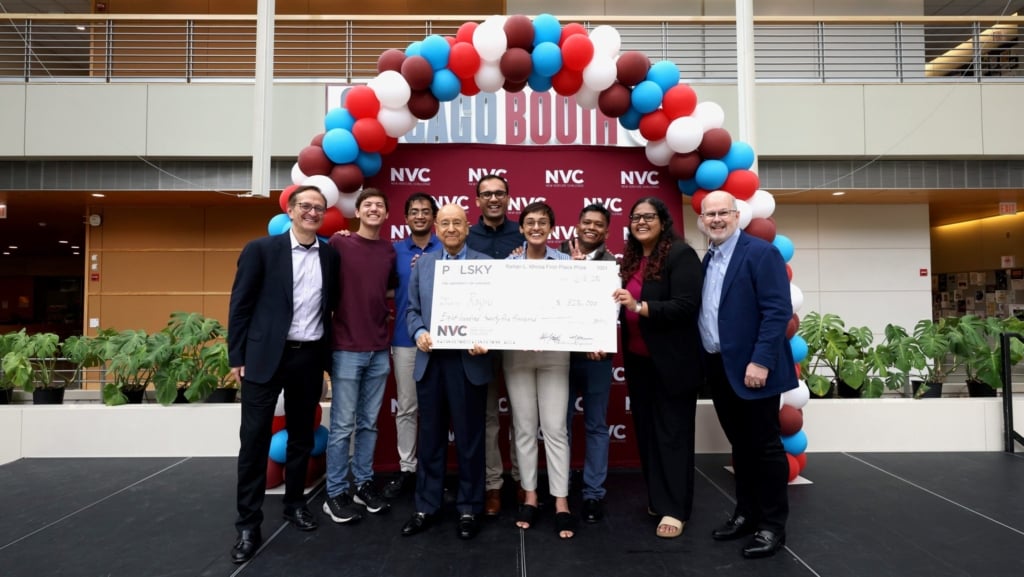
Khosa with 2025 NVC winner Rayni.
“When the idea was presented to me, I thought about how many people fail because they can’t raise seed money,” Khosa said. “If I can make a difference in that space — making seed money available — what a great idea.”
Khosa believes providing founders with early validation and funding can dramatically change their trajectory.
“The Rattan L. Khosa First-Place Prize was a game changer because it increased the amount of early funding available to students,” Khosa said. “The original prizes were maybe $25,000 or $30,000. Once the program expanded, judges and supporters became more involved, and the awards grew significantly.”
“And once a team wins the prize, it opens the door for them to raise more money,” he continued. “That becomes a stepping stone.”
That growth was demonstrated at the 2025 NVC Finals, where Rayni received the Rattan L. Khosa First-Place Prize totaling $835,000, including $610,000 contributed by judges representing investment firms.
Continuing to Invest in Future Founders
Khosa remains closely connected to the NVC and attends the finals each year, spending the day listening to teams present their ventures. He believes the NVC gives students a rare opportunity.
“What better option than getting seed money while you’re in school?” he said. “You get an MBA, but you also get the chance to launch a business.”
Even after decades of entrepreneurial success, Khosa vividly remembers the uncertainty and risk he faced when starting his own company.
“I know what it means to take a risk and need help early on,” said Khosa. “I provide my support so students have a better opportunity to pursue their ideas.”