- Salt Lake City raised the sales tax rate 18 months ago to help fund the downtown renovation project.
- Revenue from the tax increase and a Delta Center ticket fee are flowing into city coffers.
- A new polls shows Utahns split over higher tax rate for the sports, entertainment, culture and convention district.
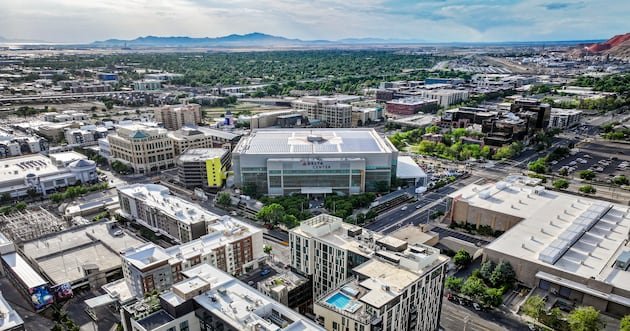
Not much is happening on the ground yet for the massive downtown Salt Lake City redevelopment project. But money for the planned sports, entertainment, culture and convention district is starting to flow.
The city imposed a 0.5% sales tax increase nearly 18 months ago to raise money for the revitalization endeavor. To date, it has collected nearly $66 million.
Salt Lake City and Smith Entertainment Group, the owner of the Utah Jazz and Utah Hockey Club (now Utah Mammoth), signed a participation agreement in 2024 to redevelop a three-block area in the heart of the city.
SEG has said it intends to put $3 billion into the project. The proposal includes reconfiguring the Delta Center entrance to face east, pedestrian plazas, a residential tower and a hotel and providing retail and restaurant space between 300 West and North Temple. Parts of the Salt Lake County-operated Salt Palace Convention Center would be torn down and remodeled but city, county and company officials committed to keep adjacent Abravanel Hall, home of the Utah Symphony, intact.
The tax hike — going to 8.25% from 7.75% — is anticipated to generate $1.2 billion over the 30-year life of the participation agreement, $900 million of which would go to SEG. So far, the collection rate puts the city on pace to collect that anticipated amount.
The increase does not apply to groceries or big-ticket items such as cars. The company estimates it will spend $525 million to remodel the 35-year-old Delta Center and $375 million on the other district improvements.
The downtown makeover isn’t expected to be complete until just before the 2034 Olympics in Salt Lake City.
Laying the groundwork
The second phase of the Delta Center interior remodel to better accommodate basketball and hockey started right after the Mammoth were eliminated from the NHL playoffs earlier this month.
Demolition and reconstruction of buildings in the district won’t begin until SEG takes possession of the western wing of the Salt Palace Convention Center in February 2027.
“As I understand it, they intend to begin demolition work immediately,” said Blake Thomas, senior advisor on real estate and capital projects in the Salt Lake City mayor’s office.
Salt Lake County intends to share details about the convention center renovation in the next few weeks.
“We’re excited about the Salt Palace renovation plans and that investment in Salt Lake City, and that a connected paseo throughout the district to help with activation and connectivity of downtown,” Thomas said.
The participation agreement between Salt Lake City and SEG includes a community benefit fund from fees the company attached to ticket sales for basketball, hockey and other events that started in July 2025. The money is earmarked for affordable and family-sized housing, a Japantown streetscape project and public art, the latter two getting $5 million each.
The city recently received its first payment from SEG for that fund totaling just over $1 million, Thomas said.
What Utahns think about the tax increase

A new Deseret News/Hinckley Institute of Politics poll showed Utahns are split on whether they favor or oppose the sales tax increase. The survey found 44% support the increase, while 48% oppose it and 9% don’t know.
Support for the higher tax rate has gone up and opposition has dropped since the Deseret News/Hinckley Institute polled Utahns on the same question in August 2024. The earlier survey showed 54% opposed the sales tax increase, while 38% favored it and 8% didn’t know.
Broken down by age group, the new survey found 52% of 18- to 34-year-olds favor the increase, compared to 38% among those 65 and older.
City dwellers expressed strong support for the tax hike, with 60% of people in urban areas in favor, compared to 35% each among suburban and rural Utahns.
Also, 50% of self-identified Republicans in the survey support the increase, while only 32% of self-identified Democrats shared that opinion.
Morning Consult conducted the poll of 802 Utah registered voters May 15-18. It has a margin of error of plus or minus 3 percentage points.

Creating a vibrant downtown scene
While much of the work on the redevelopment project is not yet visible, activity around the Delta Center picked up, having both the Jazz and Mammoth downtown.
“I think one of the key parts of the district is when the Mammoth came to town and grew sports nights from 41 to 82 nights. The playoffs are kind of gravy to that where that’s even more economic benefit to the city and downtown,” Thomas said.
Natalie Gochnour, an economist and director of the Kem C. Gardner Policy Institute, earlier said that 75% to 80% of the sales tax is paid by businesses and nonresidents of Salt Lake City.
She estimated that Salt Lake City households would on average pay about $120 to $150 a year in additional sales tax. But, she said, the amount really depends on how much people consume. Some might pay $1,000 more, while others only $20, she said.
Salt Lake City residents, she said, benefit for $3 out of every $4 that are invested from the sales tax increase.
“And what do they get for it?” Gochnour said. “They get a vibrant, growing, thriving, dynamic city that has upward mobility.”