(RNS) — I have devoted my career to soccer. I teach a college course on Soccer & Global Politics. I’ve conducted research in 35 countries on the social dimensions of the people’s game. I truly believe soccer is the closest thing that the secular world has to a universal religion.
This summer, eight World Cup matches will be held in Atlanta, where I live, yet I am not going to any of the games. As much as it pains me, I’ve decided to boycott the 2026 Men’s World Cup in Canada, Mexico and the United States.
I am not a fervent FIFA critic, and I am looking forward to going to Brazil for the 2027 FIFA Women’s World Cup. But I cannot in good conscience attend matches, watch matches on television or collect Panini stickers of the players this summer.
Here is why.
First, the world was promised it could come to these games — that is false.
On May 2, 2018, President Donald Trump wrote a letter to FIFA proclaiming that “all eligible athletes, officials and fans from all countries around the world would be able to enter the United States without discrimination.” FIFA President Gianni Infantino recently echoed that, saying, “America will welcome the world. Everyone who wants to come here to enjoy, to have fun and to celebrate the game will be able to do that.”
In fact, fans from Haiti and Iran are banned from entering the United States, and those from Algeria, Cape Verde, the Ivory Coast, Senegal and Tunisia have been de facto excluded by Kafkaesque, constantly changing, on-again-off-again impediments, including a $15,000-per-person bond program that was canceled too late for fans to make plans to attend the tournament.
According to a filing by U.S. Customs and Border Protection, fans from 42 countries, including the UK, France, Germany and South Korea, are subject to five-year social media searches and may be arbitrarily denied entry into the United States. Human rights organizations warn these U.S. policies could also result in risks for racial profiling and arrest.
And for those allowed in, what exactly will they be asked to celebrate?
President Donald Trump puts on his FIFA Peace Prize medal awarded to him by FIFA President Gianni Infantino, right, before the draw for the 2026 soccer World Cup at the Kennedy Center in Washington, Friday, Dec. 5, 2025. (AP Photo/Julia Demaree Nikhinson)
Early on, the Trump administration made threats to move venues from blue to red cities, and FIFA made a calculated decision to win over the president through constant adulation and sycophancy. This led to the surreal creation of the FIFA Peace Prize, which was awarded to President Trump at the FIFA 2026 World Cup group-stage draw in December 2025 at the Kennedy Center.
At the 2025 FIFA Club World Cup — the tournament FIFA uses to test facilities ahead of the World Cup itself — President Trump kept the original championship trophy, forcing the winner, Chelsea, to accept a replica. He also pilfered a medal reserved for the winning players. He awkwardly hovered over the awards ceremony, photo-bombing the champions’ photo and drawing side-eyes from Chelsea star Cole Palmer.
This scene was reminiscent of another ugly moment in the sport. In 1934, when the second FIFA World Cup was held in Italy, the phrase “Mussolini is always right” was plastered across walls throughout the country. The World Cup — known as ‘Mussolini’s World Cup’ — was a propaganda tool for glorifying Mussolini and for making Italy great again. He personally handed the championship trophy to the captain of the victorious Italians, and he delighted in the cheers and fascist salutes from the Italian players and fans.
I would like to think that if I were a soccer fan in Italy in 1934, I would have passed on that World Cup, too.

President Donald Trump holds the FIFA World Cup trophy during an announcement in the Oval Office of the White House, Friday, Aug. 22, 2025, in Washington. (AP Photo/Jacquelyn Martin)
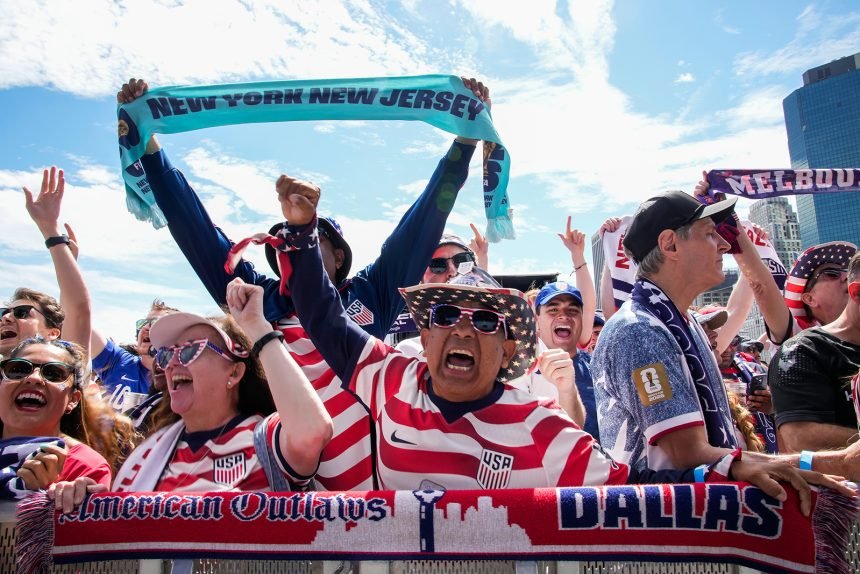
Ugly politics is not the only issue. FIFA is committing a red-card offense by treating fans as mere spectators to be exploited, rather than as partners and participants in creating the atmosphere and spectacle that characterize soccer competitions. Soccer fans are the twelfth player, bringing the chants, the imagery and the passion. Without the fans, especially the Argentines and Moroccans, the 2022 World Cup would have felt like the Disneyland World Cup.
The bright orange Dutch flash mobs, the Japanese Samurai Blue Ultras that entertain and clean up their section after the match, the choreographed celebrations of the Brazilians and the vibrant body painting of the Senegalese are as integral to the World Cup as the players.
FIFA is manipulating and deceiving fans by releasing batches of tickets in an opaque manner to create a sense of scarcity that artificially inflates ticket prices. While FIFA does have a responsibility to generate funds for its operations from the World Cup every four years, which in part are invested in grassroots initiatives around the world to develop the game, this needs to be balanced with an awareness that the most passionate fans of South Korea, Colombia or Germany are stakeholders and irreplaceable performers in the matches that are televised around the world. The matches played in empty stadiums during the COVID pandemic confirmed that truth: Televised games without enthusiastic fans are dreary affairs.
Many of the most enthusiastic fans are working class and effectively excluded by the sky-high prices in 2026 for tickets, parking, transportation and concessions. After an outcry from fans, FIFA created a new category with around 1,000 tickets for each of the 104 matches at $60 each to be allocated to the confederations for distribution to hard-core fans. That is not nearly enough.
Soccer is the people’s game, with a universal language and shared vernacular that cuts through class distinctions and unites people in a community of fervor for the game and faith in one’s team. The Infantino-Trump partnership is debasing it and the 2026 FIFA Men’s World Cup.

Kirk Bowman at the 2024 UEFA Women’s Champions League Final at San Mamés Stadium in Bilbao, Spain. (Photo courtesy of Bowman)
And so, I am passing on the World Cup this year. I do not encourage others to make the same choice, nor do I judge those who choose to take part. I submit, however, that the spirit that makes the World Cup so special is now found in the women’s game. The tickets are affordable; Brazil will enthusiastically welcome all the teams and their fans; and the game will be used to applaud incredible players and teams, not politicians. I invite you to join me in 2027 for the beautiful game.
(Kirk Bowman is a professor in the Sam Nunn School of International Affairs at Georgia Tech. He is the author/editor of six books, including Soccer, Globalization and Innovation: The Beautiful Game in the 21st Century. The opinions expressed in this commentary do not necessarily reflect those of Religion News Service.)