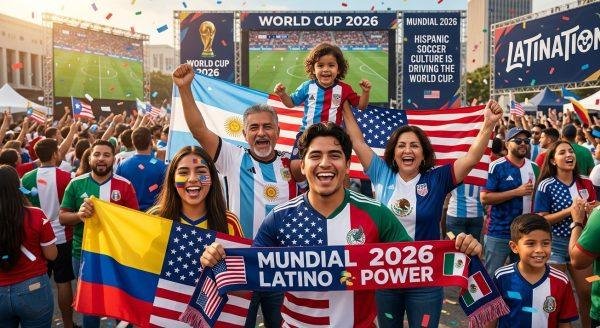
The countdown to the opening whistle of the World Cup reflects an unquestionable reality within the U.S. sports market, where citizens do not share enthusiasm for this tournament evenly.
On the contrary, specific communities heavily concentrate this passion as they assume leadership of the event on digital platforms and at the box office, while the average consumer prioritizes other traditional disciplines.
Loading video…
Loading Video
In fact, a new report from the Pew Research Center confirms this phenomenon with compelling data obtained just days before the opening match, demonstrating that interest in the championship responds to highly defined cultural identity factors.
Therefore, to understand the true scope of the tournament in North American territory, it is essential to observe the behavior of minorities, who are reshaping the current consumption map.
World Cup 2026 Latino fans make a difference in the surveys
The study’s numbers reflect a stark gap in attention among different sectors of the population, as barely 28% of U.S. adults plan to follow the matches on television or platforms.
In contrast, an overwhelming 66% state they will ignore the competition entirely, which evidences that the landscape changes radically when analyzing segments by origin and heritage.
In this way, 54% of immigrants assert they will pay attention to the world championship, a figure that vastly outperforms the modest 23% registered among fans born in the country.
Within this audience ecosystem, World Cup 2026 Latino fans consolidate themselves as the primary driver of expectations with a 42% declared interest, transforming the commercial dynamics of the tournament.
Likewise, this Latino population surpasses the general average of mass participation by a wide margin and, alongside the Asian community which registers 44%, converts an international event into an experience with deep local roots.
World Cup 2026 infographic highlighting Latino fan impact.
Latino soccer culture challenges the dominance of traditional sports
This marked disparity in following the matches is explained through the country’s history and consumption habits, where American football retains an undisputed leadership with 53% of national preference.
On the contrary, traditional soccer captures only 3% of mentions in that top category, a cold statistic that Latino soccer culture constantly challenges thanks to inherited loyalties toward Latin American teams.
Additionally, the presence of global figures and the consolidation of local tournaments like Major League Soccer contribute to sustaining the visibility of this sport throughout the year, paving the way for the audience surge that occurs during the World Cup.
For this reason, cultural influence determines that the World Cup functions as a meeting point for millions of people seeking to maintain a living connection with their roots.
Divided predictions and digital audience projections
On the other hand, the Pew Research Center report explores opinions regarding the favorite teams to lift the trophy in the grand final, highlighting Spain leading the projections with 9% of total support.
In turn, the national teams of Argentina and Brazil follow closely with 8% each, while France and the United States team tie at 7% in the preferences of those surveyed.
Finally, Mexico and Germany complete the main mentions in a dispersion that confirms the enormous diversity of the audience that will consume multiplatform content in the coming weeks.
Consequently, these supporters will position content with a broad approach, driving the commercial success of the tournament through a digital engagement that brands are already looking to capitalize on.