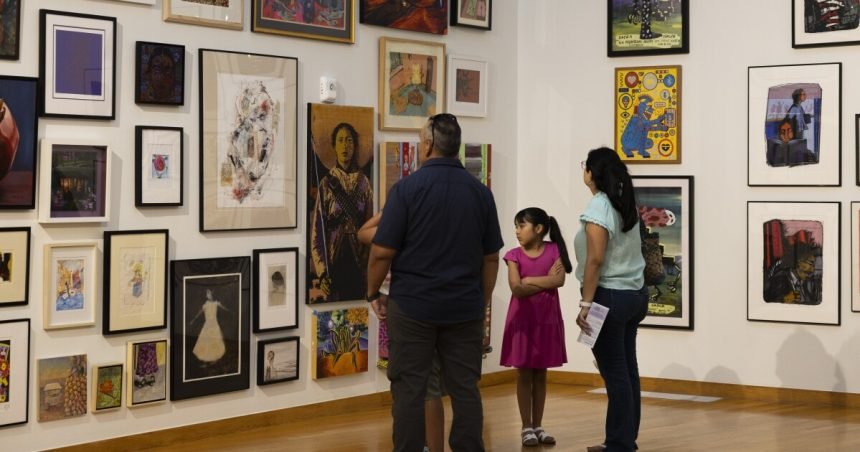
After three and a half years, the Emma S. Barrientos Mexican American Cultural Center reopened Saturday after undergoing major renovations, including the addition of new galleries, a teaching kitchen, green spaces and classrooms.
“I just can’t wait to see people walking around and enjoying, pointing and laughing, dancing and singing because the MACC is just sitting here waiting to be filled up with people again,” said Olivia Tamzarian, the marketing representative for the MACC, ahead of the reopening. “The community really deserves the space back.”
Artwork from local Chicano and Latino artists is displayed in different galleries, including pieces by Courtney Enriquez, an Austin artist who creates work inspired by Mexican lotería. Enriquez said it is important for local Latino artists to have a place they can call home.
“I remember when there was absolutely nothing here but barns, and the city used it to park their trucks and stuff, and just seeing it all come to fruition, and being an artist that’s exhibiting my artwork is a wonderful thing with all the people coming in,” Enriquez said.
Lorianne Willett
/
KUT News
The MACC is shaped like a half circle, with its inner plaza overlooking downtown and the Ann and Roy Butler Hike-and-Bike Trail. At the center is the Perez-Ramos Plaza, a space designed to function as a zócalo, the central public plaza or main square found in many Mexican cities. On Saturday, the plaza featured performances from mariachi bands, ballet folklórico dancers, and danza azteca performers.
The renovations also added a shaded structure above the plaza, which casts shadows that mimic the patterns of papel picado. The colorful paper banners are a form of Mexican art that involve cutting intricate patterns into the paper that is typically used for decorations.
The center received $27 million for Phase 2 renovations from a 2018 bond from the city, according to Austin Parks and Recreation. Tamzarian said the MACC, since its founding, has been intended to be built in phases, with future additions still possible.
The MACC opened in 2007 after more than three decades of activism by Austin’s Latino community and University of Texas at Austin students. The center sits in the Rainey Street Historic District, which Tamzarian said was once a stronghold for working-class Mexican American families. Before becoming the MACC, the building served as a warehouse and an informal gathering space where families could come together and walk to Lady Bird Lake.
Tamzarian said one of the biggest challenges for the MACC has been gentrification that forced families to move farther out of the city and away from the center.

Lorianne Willett
/
KUT News
“When this area was considered for the location of the cultural center, it was still a place where families could walk to the center, and so it was ideal for the Mexican American Cultural Center to be built in the middle of Rainey Street,” Tamzarian said. “Now, I don’t see a lot of families, working families residing in this area.”
Brooke Ornelas, who has lived in Austin for 34 years, attended the grand reopening and said she was excited to return for cooking classes and to check out future Chicano art galleries. Ornelas said it is important for places like the MACC to exist and for all communities to visit it, especially as Austin evolves.
“The city has grown beautifully in some ways, but we have also sort of become so homogenized here,” Ornelas said. “So it’s really nice to remember, and to dive into one culture, and to… talk about it, celebrate it, experience it in all its different facets, from art to food to visual to the architecture, it’s important for everyone, not just the Hispanic community.”