Dallas didn’t lose its downtown. It got a blank slate. And in a city with some of the most creative, entrepreneurial, and well-capitalized real estate minds in the country, a blank slate is not a problem. It is an opportunity.
The departures are well documented: AT&T’s exit, Neiman Marcus signaling the closure of its historic flagship, the Stars headed to Plano, the Mavs bound for Valley View, and Comerica in flux. Each has landed like a verdict. Together they have forced a genuine identity question.
Dallas has long defined itself through its skyline, its sports teams, its destination retail. That identity was real. It was also built for a different era, one in which people lived in the suburbs, drove downtown for a purpose, and drove back out. That era is over.
What’s replacing it is more interesting. Downtown Dallas is becoming a place where people actually want to live. Residential population is growing faster than most peer cities. Young professionals are choosing the urban core.
With the recent turn of events, downtown does not have to organize itself around event-day vehicular traffic and suburban commuter patterns. Office towers can become homes. Blocks once reserved for game-day parking can become neighborhoods. That is not a consolation prize. That is the best possible version of what a downtown can be.
But it will not happen on its own. Here is what we need: a meaningful incentive structure, a single coordinating authority with real independence and real power, and a permitting environment that stops punishing the people willing to take the risk. Get those three things right and the private sector will do the rest.
Dallas has never lacked for people ready to build something extraordinary. It has lacked the framework that lets them.
I grew up in Dallas and have spent my career building its urban fabric as an urban planner and developer. Over the last five years, I have built 400 homes and 64 hotel rooms in downtown Dallas, and I show up to work there every morning. I don’t own downtown real estate. My stake is the city, not the square footage.
Prioritize Incentives First
The good news is that Dallas already knows how to do this. It has done it before.
Facing a shortage of workforce housing, the city created the Dallas Public Facilities Corp. (PFC), a framework backed by state legislation that provided a property tax exemption in exchange for restricting half of all units to essential workers at 60 to 80 percent of area median income.
The terms were set. Developers then got creative. The result was housing that would not otherwise exist, built by private capital that would not otherwise have moved.
My firm used this framework to develop nearly 600 homes just across the Trinity River from downtown, communities that would not pencil without the PFC and are now fully occupied by the teachers, hospital workers, and restaurant managers who keep this city running.
That is the model. Define what downtown needs. Create a meaningful abatement on net operating income in exchange for delivering it. Then step back and let Dallas developers compete on execution.
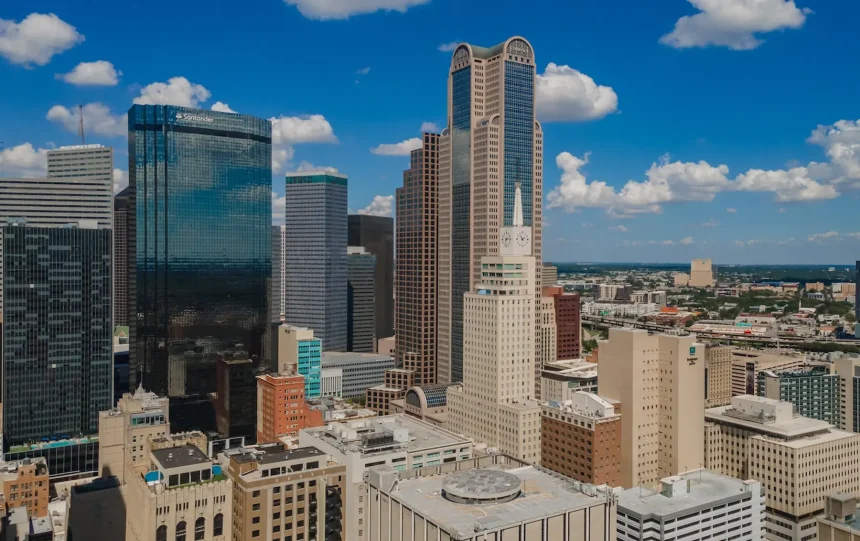
We know the private sector can deliver in downtown when the math works. Our team, in partnership with Pacific Elm Properties, converted part of the 50-story Santander Tower into nearly 400 homes at Peridot Residences, alongside Mint House hotel.
It required extraordinary creativity to solve the floor plate challenges that stop most conversions cold. But it worked in part because the building owner had already made significant investments that most properties downtown have not, and because we shared the same vision.
That is the honest truth about office-to-residential conversion: it is hard, the economics are fragile, and the incentive structure must close the gap that the private market alone cannot.
The Cost of Going Without a Plan
Here is what happens in the absence of that framework: good decisions get lost, and the people trying to build get penalized.
A decade ago, as chair of Uptown Dallas Inc., I helped secure approval and funding for the conversion of McKinney and Cole to two-way streets. It had momentum, cross-departmental and public support, and financing in place.
“It still has not happened. Projects like this are complex and require sustained support throughout the bureaucratic system. Without it, they get pushed aside by competing priorities, new regulations, and uncertainty about the long-term vision.”
This is not a story about bad intentions. It is a story about a system with no one maintaining the long-term vision in the face of competing interests.
The same pattern is playing out in other neighborhoods. A Jefferson Street improvement that would connect Oak Cliff’s retail fabric directly to the downtown core has been studied and supported for years. What is now being rumored, driven by convention center design geometry, is a bridge closure instead—literally limiting downtown access to highways at a time when we need interconnectivity and access options the most.
Fortunately, District 1 Council Member Chad West has taken on the role of advocating for this connection, but it highlights how much continues to be at risk in our downtown if we aren’t watching carefully.
Beyond street-level decisions, the private sector is also enduring challenges from uncoordinated departmental requirements at City Hall. Property owners undertaking downtown conversions are having hundreds of thousands of dollars of new infrastructure costs imposed by city departments after original plans are approved. Departments are operating without coordination or a shared goal.
No one is acting in bad faith. The friction is structural. And it’s burdening the very people Dallas should be encouraging.
The Framework Needed
Every serious conversation about downtown Dallas right now arrives at the same conclusion: the energy is real, the voices are many, and there is no one with the authority or independence to coordinate them. Downtown Dallas Inc. does meaningful work. The Real Estate Council’s Investment and Incentives Working Group, of which I am a member, is beginning to build a framework. The Dallas EDC is engaged. But energy without structure is noise.
Dallas operates under a 14-1 council system that makes a citywide vision nearly impossible to sustain. Downtown is not one council member’s priority. It is everyone’s—and therefore no one’s.
What downtown needs is a single coordinating entity, independent of district politics, insulated from competing property interests, and empowered with real authority to set a vision and hold it. Some will call for charter reform and a stronger mayor. That conversation is overdue. But it takes time that Dallas may not have.
The near-term model is a public-private authority with a narrow mandate, real incentive tools, and accountability to outcomes rather than constituencies. The PFC logic applies: Establish clear terms, align incentives with the vision of an interconnected, livable downtown—and get out of the way.
The Clock Is Ticking
On June 10, the Dallas City Council will meet to address the future of City Hall. The world is watching. World Cup visitors are already arriving. This is the moment to lead, not debate. Councilmembers have an opportunity to signal that Dallas is not a city that argues at the horseshoe when history is calling.
The path forward is not complicated. Create the authority. Build the incentive structure. Clear the friction. Dallas spent decades trying to solve workforce housing and couldn’t crack it until a simple framework let private capital figure out the rest. Downtown’s revival is a similar challenge. Keep it simple, make the incentives real, and trust this city’s extraordinary private sector to compete on execution.
I have watched this city build the impossible before, and many of us have been part of turning the impossible into a reality. We have a large pool of real estate talent exactly when we need it the most. Dallas does not need a savior. It needs a framework and the discipline to step back once it is in place.
It’s time to get back on the horse. Other cities would spend a decade mourning what we lost. Dallas will spend the next one building something they wish they’d thought of first.
Katy Slade is the founder and principal of Mintwood Real Estate, a Dallas-based development firm.