Getting your audio player ready…
A recent archaeological salvage project in the state of Veracruz, Mexico, has revealed the remains of a pre-Hispanic ceremonial complex and a significant monolithic stone sculpture. Conducted by Mexico’s National Institute of Anthropology and History (INAH), the excavations in the San Lucas residential development of Coatepec have uncovered architectural features and decorative elements previously undocumented in the region. The findings, which date to the Early Classic period (AD 200–600), offer a fascinating glimpse into a local culture that thrived along the Gulf Coast of Mexico more than 1,400 years ago.
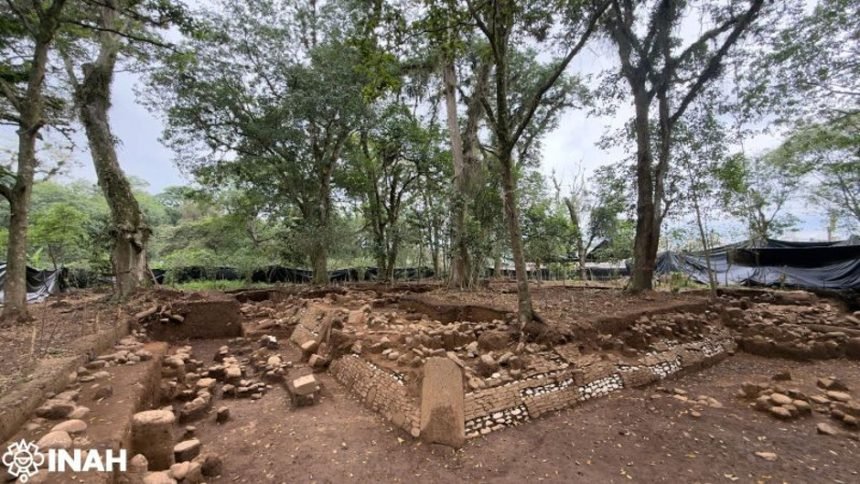
Wide view of the pre-Hispanic ceremonial platform excavated in Coatepec, Veracruz. (INAH)
The centerpiece of the discovery is a rectangular platform measuring 30 meters (98 feet) long and 12 meters (39 feet) wide. Built using flagstones and white limestone with a plaster-like texture, the structure was likely treated with an induced firing process to decorate its walls. What makes the platform truly unique are its ornamental features, which include engraved geometric motifs resembling squares and circular stones embedded along two of its sides. According to INAH researchers, these specific architectural traits have never been recorded in this part of Veracruz, suggesting a distinct local building tradition.
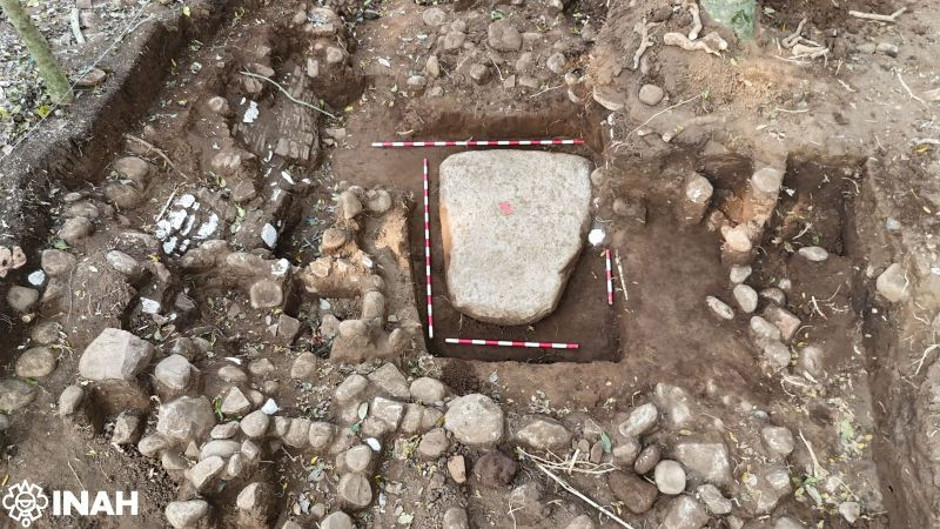
Appearance of the stela at the site of its discovery. (INAH)
A Symbolic Scene Set in Stone
Associated with the ceremonial platform, archaeologists discovered a large monolithic sculpture standing 1.88 meters (6.1 feet) tall. The carved stela depicts a deeply symbolic event involving two seated elite figures dressed in elaborate attire. The engraving shows these individuals receiving a sacred fluid in a vessel from a divine entity positioned above them. Interestingly, researchers noted that one of the figures appears to exhibit Maya-like characteristics, hinting at cultural exchange or influence from other parts of Mesoamerica.
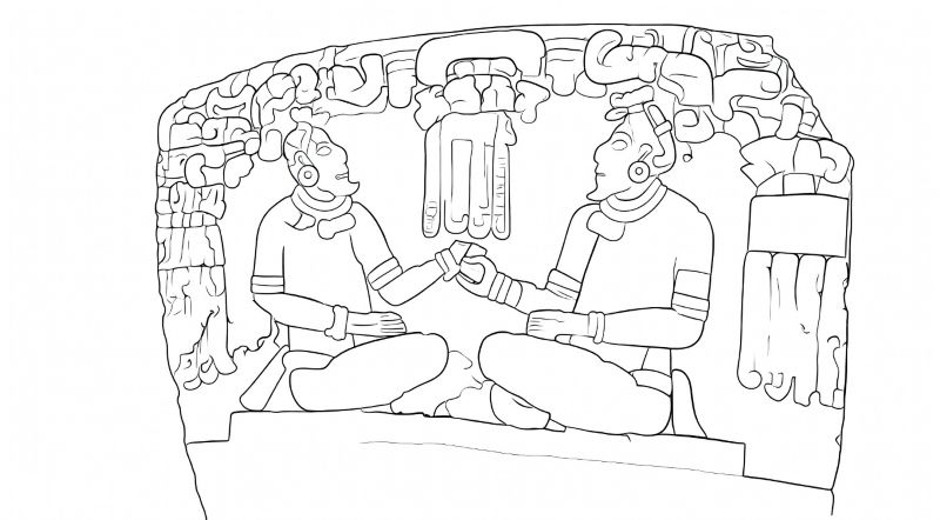
Preliminary drawing of Stela 2. (Courtesy of Lino Espinoza/INAH)
The sculpture and the platform were found in remarkably good condition. Conservation efforts are already underway, with specialists applying consolidants to the stone monument and planning the restoration and stabilization of the architectural remains.
During the excavations, the archaeological team also uncovered various ceremonial offerings. These included buried pottery vessels, the remains of charred maize, and a greenstone bead that had been broken into four pieces. Such ritual offerings provide valuable insights into the religious practices of the people who built the complex. The artifacts have been transferred to a laboratory for further analysis by an interdisciplinary team led by INAH Veracruz Centre archaeologists Alberto Vázquez Domínguez and Lino Espinoza García.
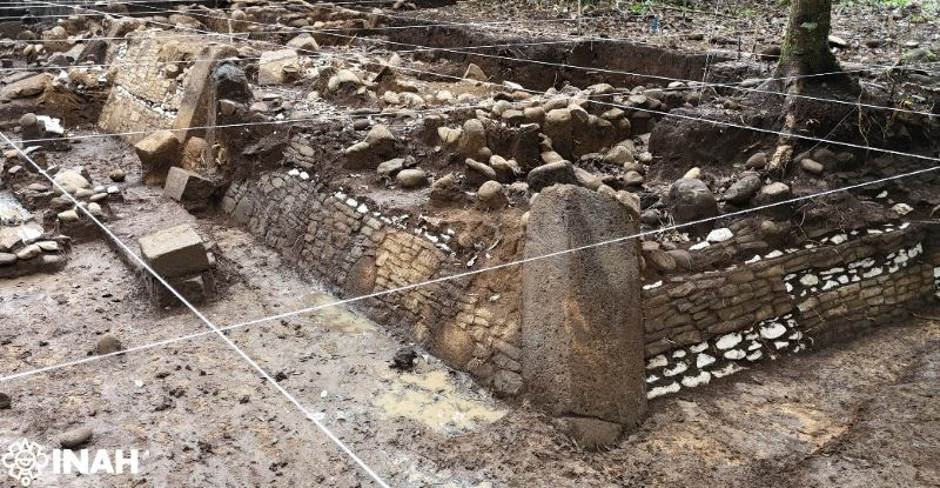
The flanks of the platform have circular stones. (Courtesy of Lino Espinoza/INAH)
Identifying a Distinct Local Culture
While the region of central Veracruz is often associated with the Totonac civilization, researchers currently see no direct evidence linking this newly discovered site to that specific culture. Instead, specialists propose that the ceremonial complex belonged to a distinct local population that developed its own unique traditions while incorporating broader Gulf Coast attributes.
The discovery occurred on a privately owned 12-hectare plot that has been under archaeological investigation since late 2025, following a request to change the land use for residential development. The fieldwork is expected to continue until August 2026, with the analysis of the recovered materials projected to conclude in early 2027. This project is part of a broader, long-term research program conducted by the INAH Veracruz Centre around the nearby Campo Viejo archaeological site.
Mexico’s Secretary of Culture, Claudia Curiel de Icaza, emphasized the significance of the find, stating, “Every structure, object and symbol that emerges from archaeological research reminds us that Mexico possesses one of the deepest and most diverse cultural heritages in the world. This discovery provides new knowledge about our past and reaffirms the importance of protecting heritage as a common good.”
Top image: A large carved monolithic sculpture slab in an excavation trench. Source: INAH
By Gary Manners
References
Curiel de Icaza, C. 2026. En Veracruz, el INAH descubre estructura y escultura prehispánicas con características únicas. INAH. Available at: https://www.inah.gob.mx/boletines/en-veracruz-el-inah-descubre-estructura-y-escultura-prehispanicas-con-caracteristicas-unicas
Heritage Daily. 2026. Ancient ceremonial complex and rare sculpture uncovered in Veracruz. Heritage Daily. Available at: https://www.heritagedaily.com/2026/06/ancient-ceremonial-complex-and-rare-sculpture-uncovered-in-veracruz/158396
La Brújula Verde. 2026. A strange monolithic sculpture with two figures receiving a fluid from a divine entity discovered in Veracruz. La Brújula Verde. Available at: https://www.labrujulaverde.com/en/2026/06/a-strange-monolithic-sculpture-with-two-figures-receiving-a-fluid-from-a-divine-entity-discovered-in-veracruz/