Red Wing’s 121-year-old legacy isn’t stopping the work boot company from advancing its product for the modern consumer.
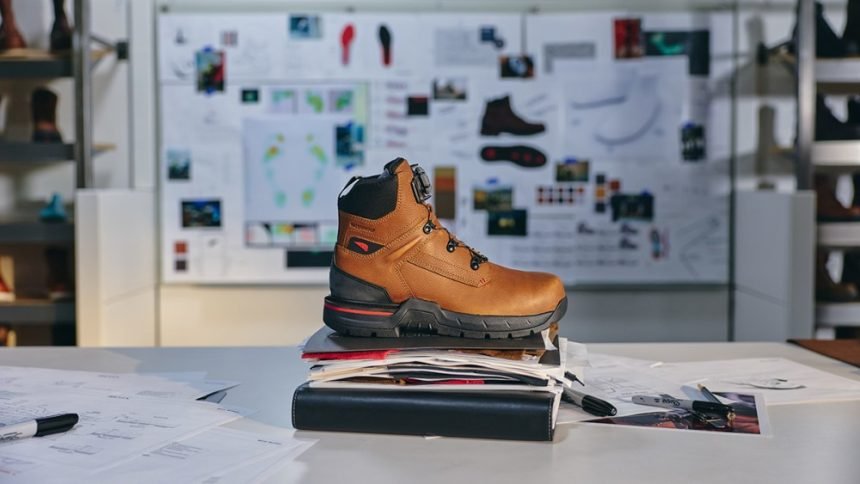
Recently, the Minnesota-based footwear brand unveiled its IronFlex boot. The company noted that the model was designed using insights from the brand’s Ultimate Fit Experience (UFX), a foot-scanning technology from Volumental that has collected and analyzed over 3 million individual scans across 321 styles.
That data informed every dimension of the IronFlex, from the roomier forefoot and toe box to the torsional heel stability built in through Red Wing’s FlexForce cement-to-welt construction, the company said.
For Mike VanGoethem, chief product and services officer at Red Wing Shoe Co., the new technology is the future of the company. “We can now aggregate large scale anonymized consumer fit data, and we can use that information to engineer anatomically accurate last and fit profiles,” VanGoethem told FN in an exclusive interview. “I can slice and segment our consumer data to specifically design products that are customized for that particular end use, so as opposed to relying on historical assumptions around sizing and shape, we can design products around actual consumer foot geometry, but at scale, which is important.”
The executive added that some of the “magic” of this new technology is being able to use the brand’s history of craftsmanship with data from a scientific standpoint. “IronFlex is kind of a badge of honor for me because it’s really threading the needle between satisfying our core consumers’ want of better products that are durable, functional, comfortable, fit well, but also introducing a relevant product family for that next generation of consumers that are entering the trades,” VanGoethem explained. “And there’s millions and millions of them entering the workforce every year, and we wanted to build something that’s exciting to them.”
As for how the company is approaching more innovations like IronFlex, VanGoethem said that product creation starts with spending an “enormous amount of time studying people” and “how they actually move, how they work, their repetitive motions, when fatigue occurs, how environments impact wear patterns, and what consumers are asking for, explicitly or implicitly.”
“For us, the R&D process really takes place in our robust fit and wear testing process,” VanGoethem said. “We have extensive consumer fit testing for comfort. We will literally just put boots on people for weeks to understand how it wears, how it feels out of the box, and what comfort looks like after a period of duration. Then we flip it out into the field and do extensive fit and wear testing, sometimes in very extreme working conditions, so that we can understand how that product will perform in very tough conditions. And then we finish in the lab, which sometimes, for my merchants and designers, is an anguishing process, because we want to make sure that all materials and the finished footwear can perform and meet the certifications and safety standards of employers and different countries around the world.”
Mike VanGoethem.
Courtesy of Red Wing
These new innovations come at a time when the work boot market is seen an influx in new brands, technology and consumer interest. For VanGoethem he is keeping a close eye on consumer behavior in the segment.
“Overall, the growth within work footwear is really coming from a few different areas, I think one is we’re seeing continued investment in the trades, whether it’s infrastructure, construction, manufacturing, everywhere you look, there’s a new fulfillment center or warehouse opening, growth in the energy sector,” he noted. “We track all of these industry verticals, and you can see real-time growth from an employee standpoint, and the necessity or the mandate from employers that they need to wear safety footwear, which is great news for us.”
VanGoethem added that there is also a generational shift happening where more young workers are entering the trades. “They want differentiated product from what their mom or dad wore, or from what their grandfather wore on the job site, and I think that complements our business,” the executive explained.
He added that there is also an increase in women enter the trades, a category that is important for Red Wing’s growth in the future. “Currently, our women’s sales are significantly under-indexed compared to men’s, but we’re seeing more women’s scans than sales in our Ultimate Fit Experience data,” VanGoethem said. “This indicates unmet sales demand which is why we’ve increased our women’s assortment by over 40 percent in the past two years.”
Looking ahead, VanGoethem noted that the company is aiming for its total women’s assortment and sales to be much greater and expect that to grow to a third of its business in the next 10 years. “Current labor statistics show that for several key job groups, women’s composition of the workforce is 50 percent or greater,” he said. “At Red Wing, we’d like to be a destination for her, her footwear preferences, and a leading innovator in optimized fit for her.”
And don’t expect future women’s product from Red Wing to follow the “shrink it and pink it” model that some brand’s use, VanGoethem said. “We’re investing in women’s design, women’s fit architecture and women’s specific shoe lasts,” he said. “I want her to feel comfortable with our brand and in our ecosystem from a DTC standpoint, and I want to make sure that we’re creating loyalty with her in equal measure to him.”