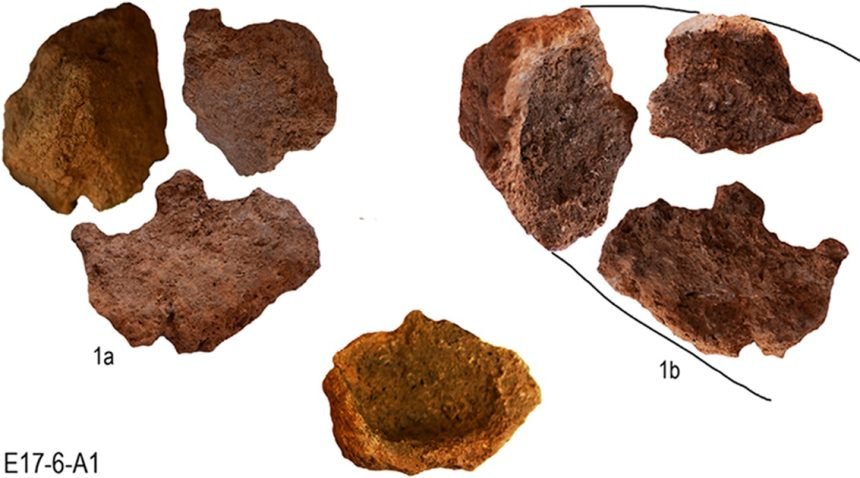
ÇEMKA HÖYÜK, Tur Abdin — Fragments of 46 low-temperature fired clay vessels discovered at the Çemka Höyük archaeological site in Tur Abdin are reshaping archaeologists’ long-held assumptions about the inception of pottery in Beth Nahrin. The findings reveal that ceramic technology did not appear suddenly in the seventh millennium BC, but instead evolved through earlier local experiments involving clay, fire, architectural structures, and daily life practices, Arkeonews reports based on a study by researchers Ergül Kodaş, Natalia Petrova, Maria Daghmehchi, and Rana Özbal. The study was published in the archaeology journal Antiquity and points to a foundational phase of ceramic innovation dating back some 12,000 years, long before pottery became widespread across the Beth Nahrin.
An Early Neolithic Settlement
The Çemka Höyük archeological site is located in Tur Abdin, a region encompassing Mardin Province and parts of surrounding provinces, in Upper Beth Nahrin. Excavations at the site have revealed two main levels: a Proto-Neolithic (or Late Epipaleolithic) level dated to 10,800–9600 BC, and a Pre-Pottery Neolithic A level dated to 9600–8700 BC. Within these layers, the researchers identified eight distinct building or architectural structural levels.
This architectural sequence elevates the Çemka Höyük settlement beyond a mere repository for unusual clay fragments; it serves as a record of transformation for a community transitioning “from simple round huts [tent-like structures] to pit shelters, and finally to surface-level structures” and increasingly complex utilization of material culture. The architectural evolution at Çemka Höyük demonstrates a gradual transformation in sedentary life.
The 46 low-fired clay fragments from 9 different vessels were found at the second level (ca. 9350 BC). Çemka Höyük does not present a mature, fully developed pottery tradition like those seen in the later phases of the Neolithic period; instead, it demonstrates a process of experimentation where clay was already integrated into the architectural world of the settlement. The community did not discover clay from scratch; the residents were already familiar with how the material behaved as a building resource before experimenting with it as a technology for making vessels.
The study argues that the data gathered strongly supports the hypothesis of intentional firing at low temperatures (generally around 600–700 degrees Celsius), i.e. they were testing various forms, different mixtures (plants, dung spherulites) and alternative methods of utilizing clay.

Bridging Old Materials and New Technology
Researchers Kodaş, Petrova, Daghmehchi, and Özbal identify 3 potential functional groups in their analysis of the clay items: fragments of clay coating for organic objects, a fragment of a clay additive intended to be attached to a vessel made of another material, and fragments of clay vessels.
The clay additive is most interesting in that it is thought to have been attached to a container made of a different material. Featuring holes presumably drilled to thread a cord through or to fasten it, this piece may have served to increase the capacity of a stone or organic vessel. This detail is deemed highly valuable for the history of pottery. Before manufacturing entirely autonomous ceramic vessels, humans may have modified existing, older technologies using clay. A stone container, a wooden object, or an organic vessel was thus transformed with the aid of a fired clay component. The same principle applies to the clay linings found on organic objects. Rather than emerging suddenly as a fully matured invention, pottery likely emerged from these types of practical experiments.

Conclusion
The study does not claim that Çemka Höyük produced the world’s first pottery, as East Asia possesses much older pottery traditions. Also, the settlement of Çemka Höyük was part of a broader regional network. Early clay and earthen vessels were already known from settlements such as Çayönü, Nevalı Çori, Boncuklu Höyük, Demirköy, Ganj Dareh, Jericho, Mureybet, and Beidha. However, Çemka Höyük adds a significant, early example from Tur Abdin to this map by providing clear evidence of low-temperature fired and experimentally produced vessels.
While pottery became widespread in Beth Nahrin around the seventh millennium BC, the evidence from Çemka Höyük archeological site points to much earlier times. The researchers position the clay pottery finds among the earliest known examples of pottery or fired clay vessel technology in Beth Nahrin. The conclusion of the study is subtle yet important: pottery was not born in a single moment. It evolved through repeated experimentation across different communities, shaped by local needs, available materials, and sedentary habits.