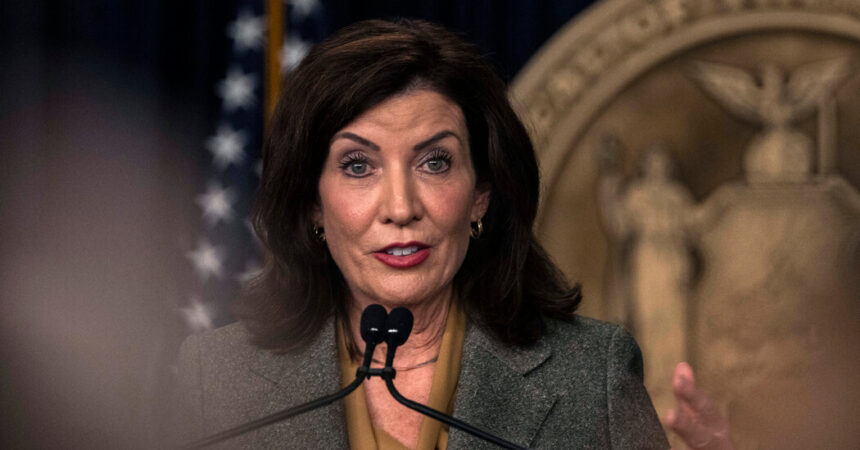
In the last few months, Gov. Kathy Hochul has privately exchanged anxieties about moving forward on congestion pricing with business leaders, political advisers and, in her telling, a great number of ordinary New Yorkers in diners.
But she never shared them with the group that would be most affected by the program: the public at large, which had every reason to believe that the new tolling structure would be in place in Manhattan later this month.
The move to abandon a plan that was decades in the making jolted lawmakers, real estate leaders, transit advocates and other stakeholders. The governor said she was reluctant to deter people from driving to New York City when its economic recovery was still fragile; critics called it an election year ploy to help Democrats in suburban districts where congestion pricing is notably unpopular.
Ms. Hochul’s announcement was particularly jarring given her past championing of the plan. Indeed, as recently as this year, the governor stressed the need to get vehicles off the road — a dissonance that has fed a sense of duplicity and a feeling of betrayal among those who considered her an ally.
On Friday, Jon Orcutt, a longtime congestion pricing proponent and a consultant for Reinvent Albany, described Ms. Hochul’s about-face as “a fundamental sense of betrayal, like, inner-core rock bottom.”
“It would be one thing if she inherited the thing and said, ‘This isn’t my priority,’” he added. “But we got to, not the 11th hour, but 10 seconds before midnight.”
The effects of Ms. Hochul’s decision were immediate. New York City was left without a plan to address the crippling gridlock that has long choked its streets and polluted its air.
The Metropolitan Transportation Authority, the state agency that would have received funding from the congestion pricing program, suddenly had a $15 billion hole in its budget, likely forcing it to mothball long-planned capital projects like signal upgrades to focus on bare-bones operating needs.
And in a searing rebuke to the governor, the State Legislature left Albany for the year without heeding her call to put some sort of temporary funding structure in place for the transportation authority.
On Friday, Ms. Hochul again raised concerns about the city’s pandemic recovery. She told reporters that even more than any particular data point or study, her certainty came from interactions with business owners and diner patrons that gave her “a real pulse on what New Yorkers are thinking.”
“I encourage you to go to the next diner with me, I’ll probably be there in the morning,” she said. “Sit with me and watch the people come over and thank me.”
Polls support her observations: A Siena College survey in April found that New York City residents opposed congestion pricing, 64 percent to 33 percent, with suburban respondents disliking it even more.
But public sentiment has improved following the implementation of congestion pricing in other cities. And even this attempt to underscore her ties to everyday New Yorkers seemed to be rooted in a bygone city where diners still reigned, fueling a perception that her western New York roots had shaped a political outlook anchored in the past.
Indeed, the governor’s seeming empathy for motorists has some history. Twenty-six years ago, as a city councilwoman in the Buffalo suburb of Hamburg, Ms. Hochul gained notoriety for her opposition to commuter tolls on the New York State Thruway.
“While walking a mile in my shoes is said to create empathy, I hope that in this case driving a mile in my minivan will create action,” she wrote in a 1998 opinion piece in The Buffalo News.
As governor, Ms. Hochul’s position toward motorists seemed more nuanced. People closest to her, as well as officials who were informed of her plans for congestion pricing in advance, insisted in interviews that the governor believed in the mission of cutting gridlock, improving air quality and generating billions for the city’s public transit system.
In December, for example, Ms. Hochul headlined a rally to champion the tolling program, telling supporters that she was proud of the transformative policy.
“From time to time, leaders are called upon to envision a better future, be bold in the implementation and execution, and be undaunted by the opposition,” she crowed, adding: “This is when we demonstrate leadership.”
But by then, some of her allies said she was already having misgivings that the timing of the program might be off and could undermine New York City’s economic recovery. Her main concern was data that showed that many New Yorkers had still not returned to city offices, they said.
For a while, it appeared as though Ms. Hochul might not need to intervene to halt congestion pricing: There are currently eight lawsuits seeking to delay its implementation. But as April turned into May, and May to June, that possibility dimmed.
By the time Ms. Hochul took off for Europe last month on a trip that aimed to cement her role as a climate leader, she had begun to avoid the phrase “congestion pricing.”
At a conference for climate leaders in Italy, Ms. Hochul made a previously unreported decision to veer from her prepared remarks. She omitted a section in which she was to explicitly trumpet New York’s nation-leading congestion pricing plan.
Ms. Hochul did still make reference to the need to take cars off the roads and improve public transportation, but she argued that those improvements could not come at the expense of those struggling to pay their bills. She echoed that argument on Wednesday, when she announced her decision to delay the program.
The state Democratic Party chair, Jay Jacobs, defended Ms. Hochul’s decision, saying that congestion pricing was the “right policy” but the “wrong time.” As for why the governor had waited so long to announce her reservations, Mr. Jacobs noted: “It was due to go into effect June 30, right? Can’t wait much longer.”
Still, the timing of Ms. Hochul’s decision, five months before a pivotal general election and right after a visit to the White House, has also sparked suspicion that political concerns had outweighed policy objectives.
The teams of both Ms. Hochul and the House minority leader, Hakeem Jeffries, who is leading the effort to retake the chamber for Democrats, have vehemently denied that there was any political collusion ahead of the decision. But it is hardly a secret that Ms. Hochul’s sclerotic performance atop the ticket during the 2022 midterm election coincided with the party’s loss of four House seats, costing it control of the chamber and earning the governor a mortifying rebuke from Nancy Pelosi, the House speaker at the time.
Since that election, Ms. Hochul has been focused on the issues that Republicans deployed against her, chief among them crime and affordability, which consistently poll among New Yorkers’ top concerns.
Those same polls show that congestion pricing is unpopular with a majority of voters of both parties.
It is difficult to estimate the precise costs of turning away from the tolling program, which would have charged E-ZPass drivers as much as $15 to drive into Manhattan’s central business district. The city’s Independent Budget Office described as “unquantifiable” the amount of time, money and other resources already spent preparing for its implementation.
Some of the more defined costs include the $427 million that the Metropolitan Transportation Authority has already allocated for physical infrastructure, including cameras now mounted above Manhattan streets.
The decision to shelve the program also left the authority, which oversees the city’s subways, buses, bridges, tunnels and two commuter railroads, without the $1 billion in yearly toll revenue from congestion pricing that was to finance $15 billion for capital projects. Those include the expansion of the Second Avenue subway, new subway cars and new subway elevators to make the system accessible to people in wheelchairs.
There are also the legal costs of defending the M.T.A. from the eight lawsuits brought by plaintiffs ranging from truck drivers to the governor of New Jersey.
The financial effects of the loss of congestion pricing also include the environmental costs that communities will bear from the ongoing presence of combustion engine gridlock, as well as the economic harm caused by transportation delays: The Independent Budget Office estimates that rush-hour subway holdups cost riders as much as $390 million a year.
Ms. Hochul’s decision is sure to please car commuters, who are far outnumbered by transit commuters into Manhattan and are generally wealthier than those who take the subway or bus. It also pleased roughly two dozen lawmakers, many from Queens and Long Island, who issued statements of support.
From a political perspective, that might not be the worst thing, said Stu Loeser, who was the chief spokesman for Michael R. Bloomberg when he tried as mayor to push through a congestion pricing plan 17 years ago.
“For all of the great work that’s gone into congestion pricing since then, one hard reality hasn’t budged: It’s just really unpopular among people who live in Nassau, Suffolk, Westchester, Rockland, Orange, Putnam, Dutchess, Orange and Ulster Counties and drive into the city a few times a year or more,” he said.
“These are the same New York counties whose voters could decide whether the House of Representatives keeps its meager MAGA majority.”