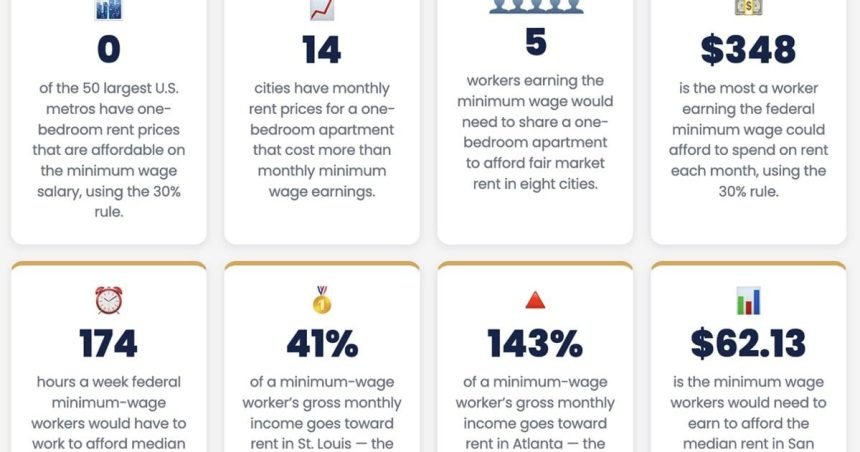
None of the 50 most populous U.S. metros are affordable for renting a one-bedroom apartment on a minimum-wage salary, according to a new report from Best Interest Financial and Clever Real Estate, a St. Louis-based real estate company.
The study measured affordability using the 30% rule, which holds that a household should spend no more than 30% of its gross monthly income on housing.
In 14 of the 50 metros, the monthly rent for a one-bedroom apartment costs more than a minimum-wage worker earns in an entire month. In 12 metros, four minimum-wage workers would need to share a one-bedroom apartment to afford rent under the 30% rule.
Even more, five minimum-wage workers would need to share a one-bedroom apartment to afford monthly rent in eight metros: Atlanta, Dallas, Raleigh, Nashville, Austin, Charlotte, Philadelphia and Salt Lake City.
Atlanta is the most expensive metro for minimum-wage workers, who would spend 143% of their gross monthly income on typical rent. A minimum-wage worker in Atlanta brings home about $1,160 a month, roughly $500 short of the $1,660 needed to cover rent.
Conversely, Missouri is home to the most affordable metros. St. Louis and Kansas City rank as the two cheapest cities for renting on a minimum wage. In St. Louis, the most affordable metro, workers earn $15 an hour and pay $995 for a one-bedroom apartment, with rent consuming about 41% of gross monthly income, still above the recommended 30%.
Even if every metro raised its minimum wage by $10 an hour, only St. Louis, Kansas City and Detroit would become affordable for renters.
Although minimum wages vary across the country, 17 of the 50 most-populous metros still pay the federal minimum of $7.25 an hour. Federal minimum-wage workers would have to work an impossible 174 hours a week to afford the median one-bedroom rent in the 50 largest metro areas.
Read the full report at https://bestinterest.com/research/rent-to-income-ratio.