At last, the Margaritaville mixed-use development, slowly taking shape on Galveston’s East Beach, is beginning to resemble a real development. In the past few days, cranes have lifted sections of two of the modular cottages that make up the 95-acre resort’s initial phase into their proper positions. (Only 276 more to go.)
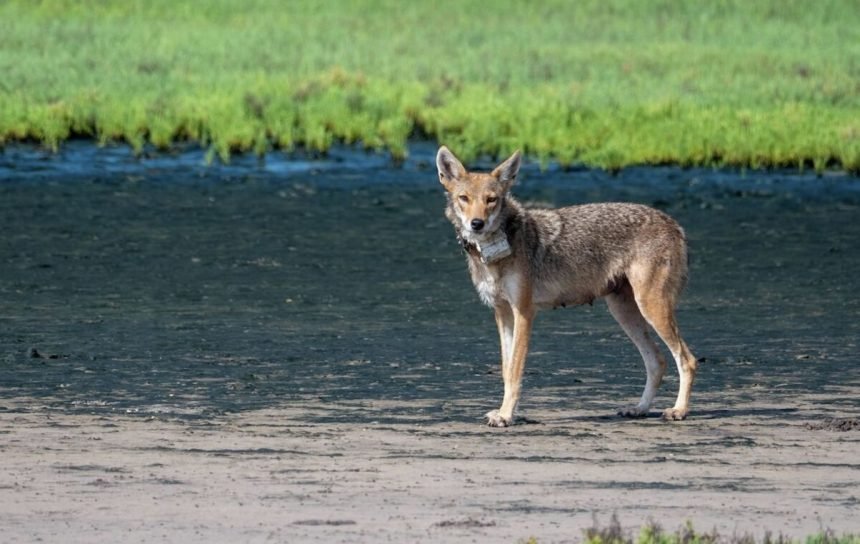
However, the controversial $700-$800 million project’s developer, Dallas’ RREAF Holdings, seems to be making less progress in winning over the public. As their popularity has grown, the island’s genetically unique coyotes—colloquially called “ghost wolves” because they share an unusually high amount of DNA with the eastern red wolf, which is all but extinct in North America—have emerged as a potent symbol of the struggle between local conservationists and the deep pockets behind large-scale developments such as Margaritaville and Discovery Sands on the Island’s West End.
Historically, the East Beach area has been among the coyotes’ principal habitats on the island. But speaking to the Houston Business Journal earlier this week, RREAF President Carl Schwab noted that, genetically unique or not, the State of Texas still considers any coyotes to be “nuisance animals.” The exact wording was the Journal reporter’s, not Schwab’s, based on a Texas Parks and Wildlife regulation that lists urban coyotes as nuisance animals along with alligators, cowbirds, wild pigs, and overabundant deer.
Schwab said that the developers were not intentionally trying to harm the coyotes, and have “paid close attention to what the regulatory agencies that are empowered to protect our environments are asking us to do, and that’s where our focus is.” The company has also spent half a million dollars on environmental consultants, Schwab added, in addition to reserving an unspecified number of acres for wildlife and conducting a study of the bird habitat along the beach.
Still, Schwab’s comments struck some as tone-deaf, especially coming so soon after the Galveston City Council voted to approve Discovery Sands developer Blackard’s requested zoning variances at its June 25 meeting, thereby allowing that project to proceed on another pivotal habitat area for the coyotes.
Princeton University evolutionary biology professor Dr. Bridgett vonHoldt, whose research with Michigan Tech colleague Dr. Kristin Brzeski first brought national attention to Galveston’s ghost wolves, said unhelpful terms like “nuisance animals” do not properly convey the animals’ importance as a “rare reservoir of genetic diversity from one of the world’s most endangered canids.”
“From a scientific perspective, these animals are not simply coyotes, nor are they pests,” vonHoldt told Chron Thursday. “They are part of an evolving conservation story that has attracted the attention of researchers, state and federal wildlife agencies, zoological institutions, and conservation organizations because of their potential to contribute to the long-term recovery of the red wolf. Development and wildlife conservation do not have to be mutually exclusive.”
Some developers have shown that similar projects can successfully balance economic benefits with the conservation of sensitive species, vonHoldt added, but “this development project has chosen not to.” (RREAF has not responded to Chron’s request for comment.)
“We had hoped they would take the first step of recognizing the biological value of the wildlife already present on Galveston Island, on the very land they planned to build,” vonHoldt said. “We had hoped they would work collaboratively with us and the larger Galveston community to minimize unnecessary impacts. As development proceeds at East Beach, I remain hopeful that they will choose to have their decisions guided by the best available science.”