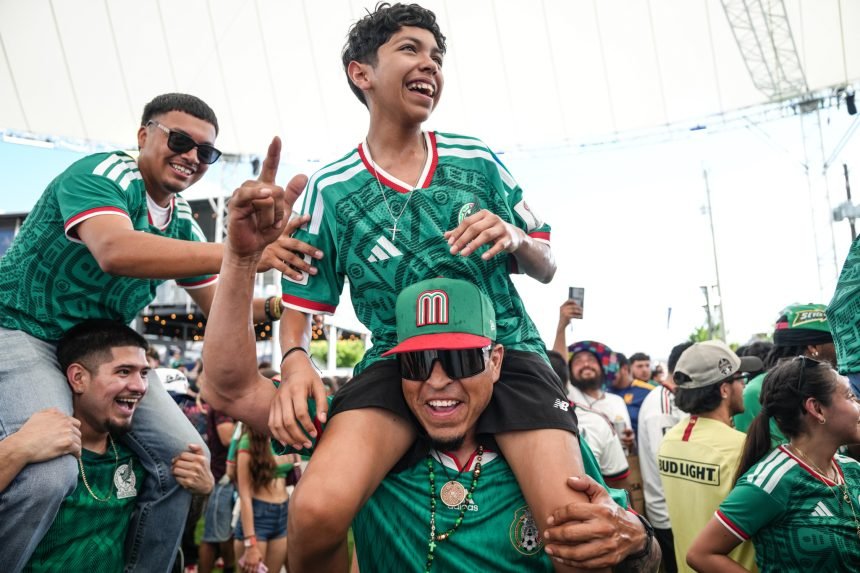
Mexico national team fans sit on each others shoulders and dance after Mexico defeated South Africa 2-0 during the first round of the during the FIFA World Cup 2026 which was streamed at the FIFA Fan Festival in Houston, Thursday, June 11, 2026.


When Raul Jacobo learned that Houston would be one of the cities hosting this year’s World Cup, he hoped that his restaurant, Cobo’s, would see the kind of big crowds–and revenue–typical during Houston Astros playoff games at nearby Daikin Park.
While FIFA’s Fan Festival attracted hundreds of thousands of people just a few blocks from the restaurant, Jacobo said revenue fell far from the $50,000 a day baseball playoffs often drew.
“We’ve only had maybe six really, really good days for the World Cup: every time Mexico played,” said Jacobo, sitting in a mostly empty restaurant on the dreary afternoon Spain defeated France in a semifinal match last week.
Article continues below this ad
But the numbers don’t tell the whole story, he said. When the Netherlands defeated Sweden in June, one of seven matches played in Houston’s Reliant Stadium, Cobo’s became a sea of orange and yellow, overtaken by fans of those two nations: “They would not leave. They had the time of their lives.”
“Whenever I don’t think about the financial side, it’s been really, really fun,” Jacobo said.
Ahead of this year’s tournament, which was co-hosted by Canada and Mexico, FIFA projected that hosting the games would boost the U.S. economy by $30 billion, including $1.5 billion in Houston.
WORLD CUP:
Article continues below this ad
So far, the data is mixed and some government figures won’t be available for months. The number of international travelers to the city increased, and thousands of people attended games and fan events. Yet some restaurant owners say the World Cup didn’t provide the financial boost they were hoping for, and hotel occupancy rates were flat. Still, in the long term, city business and civic leaders said, the tournament may help Houston attract more visitors in the future by showcasing the city to an international audience.
“The simple answer is: hell yeah, it was worth it. Anybody who was in this city for those 39 days and experienced any part of this can testify to that,” Chris Canetti, president of Houston’s World Cup host committee, said Wednesday. “When you look at the energy, the excitement, the joy, the memories that were made for so many people–that, in itself, tells you it was worth it.”
International air travel grew 2% during the games with about 439,000 international people going through customs between June 12 and July 3, according to Houston Airports. More than 480,000 tickets were sold to the seven matches played at Houston Stadium, according to data released Wednesday by the host committee. Forty-four percent of the tickets were purchased by international visitors from more than 200 countries.
The tournament drew more than one million visitors to EaDo, the neighborhood east of US 59 and the George R. Brown Convention Center, a 225% increase compared with the same period last summer, according to the East Downtown Management District. More than half a million people visited Fan Fest and the Houston Dynamo Soccer Celebration at nearby Shell Stadium, both of which were free to attend, and nearby bars and restaurants saw foot traffic soar, according to the host committee.
The picture was mixed for hotels. Hotel occupancy across the Houston region was relatively flat during the three-week period games were held in the city, according to Houston First, the local government corporation responsible for the city’s marketing. But hotels still saw revenue increase about 20% percent after raising their daily rates 21% compared to the same period last year. Bookings at Airbnbs and other short-term rentals increased around match days, according to data provider AirDNA, spiking 40% in the days around Portugal’s two group-stage matches in Houston, against the Democratic Republic of Congo and Uzbekistan.
Article continues below this ad
Sales tax data from the Texas comptroller’s office for June, when Houston hosted most of its matches, won’t be available until later this summer. According to Bank of America, Houstonians – those with ZIP codes tied to the Houston region – spent 2% more during the first few weeks of the World Cup compared with the same period last year, while those from outside the region spent 9% more.
Republic Boot Co. in the Heights sold hundreds of cowboy hats during the course of the tournament—about as many as it typically sells during the Houston Livestock Show & Rodeo, and way more than usual for the middle of summer, said Chris Conrad, owner and founder.
“It was just great exposure for our city,” he said. “People were like: wow, I didn’t know Houston was so cool.”
The mayor’s office did not respond to requests for comment on how much the city spent to host the tournament. However, Canetti, of the host committee, said private sponsorships, support from the state’s major events fund, and federal grants totaling more than $60 million helped cover costs.
Article continues below this ad
The tournament was a chance to burnish Houston’s reputation on the national and international stage, said Michael Heckman, president and CEO of Houston First.
“We have long believed that the real value of this was that when people come to Houston–convention attendees, business travelers, the media, or fans, like this–they leave with a better impression than when they got here,” Heckman said. “And that, for us, has a really great value because it’s better than any advertising you can do.”
Space Center Houston saw a significant increase in visitors compared with last summer, said Keesha Bullock, chief operating and strategy officer, adding that tourists often appeared awed by the experience: “Their eyes get bigger. They start pointing at everything. You can tell that this is the first time that they’ve experienced the scale of human spaceflight.”
Sara Gore of The Red Lion, a British pub in Montrose, endured some disappointment during the tournament: namely, England’s loss to Argentina in the semifinal. “But there we are, that’s the nature of the game,” she said.
Article continues below this ad
But the World Cup had a good impact on her business, she said. “There seem to have been a lot of friendships made through it, friends going to matches together,” Gore said. “I think it’s just been brilliant for Houston.”
On Wednesday, the Fan Fest site was dismantled, leaving only vacant lots and memories, at least for the time being. Canetti said he expects Houston’s experience as a host city this summer to have a legacy that will last decades.
“This was the greatest sporting event in the history of the world,” he said. “It was magical.”
Adriana Rezal contributed reporting.