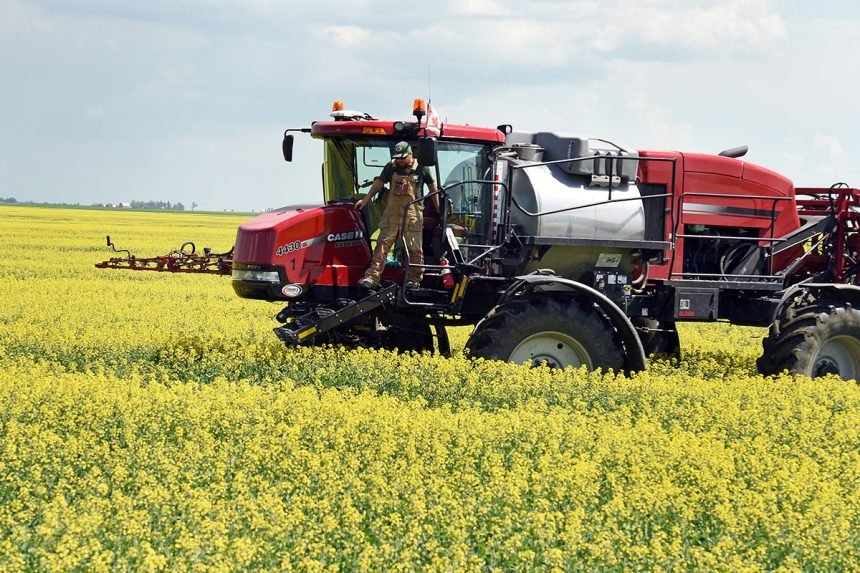
A newly expanded processor in Saskatchewan is now one of the largest canola crushers in Canada — capable of churning a massive two million tonnes a year into cooking oils and biofuels.
The plant, operated by the Dutch agri-food giant Louis Dreyfus Comp. B.V., is also able to capitalize off a consumer market obsessed with high-protein diets with a new line that can process yellow peas into plant-based proteins.
“This facility is one of the new first facilities in pulse crops that Canada has built at scale,” said Tyler Groeneveld, chief executive of Protein Industries Canada.
Louis Dreyfus Comp. recently completed construction at its facility in Yorkton in eastern Saskatchewan, doubling its canola crush capacity and adding a line to process up to 75,000 tonnes of yellow peas annually.
“The province’s highly capable agricultural producers and favourable business environment made the decision to expand our operations here an easy one,” Brian Conn, president of the Canadian subsidiary, said in a statement.
The facility uses a technique that can extract up to 90 per cent of protein content from yellow peas, according to Rex Newkirk, an associate professor at the University of Saskatchewan’s College of Agriculture and Bioresources. Other facilities would have more fibre content and only around 55 per cent protein.
As the provincial research chair in feed processing technology, Newkirk supports businesses such as Louis Dreyfus Comp. with finding markets for crop by-products.
“They need something really concentrated,” said Newkirk. “It allows you more flexibility on how you incorporate that protein into food.”
Food and beverage industries have been marketing higher protein content in everything from lattes to Cheerios cereal and pastas. Newkirk said the processed peas from Yorkton can also feed shrimp and rainbow trout, which require high-protein diets.
The upgrades to the canola plant, established in 2009, were announced by the company in 2023.
At the time several canola crush projects were proposed across Saskatchewan but few made it to completion due to policy or financial challenges with the downstream biofuel market or based on consolidation in the agri-food industry.
Cargill Ltd. recently unveiled its Regina canola facility where it processes one million tonnes of canola seed into oil and meal per year.
REad more
The seeds are pressed for oil, which can either be sold on grocery store shelves for cooking or refined into a low carbon-intensity fuel. The fastest-growing market for canola — by far Canada’s most valuable crop — is not in cooking, but in biofuels.
There were decades of work to create that tailwind for canola, says Tyler McCann, the managing director of the Canadian Agri-Food Policy Institute.
“Canola wasn’t something that was an overnight success. There was a lot of energy and work that went into building that, and I think that we’re seeing that in peas,” he said.
New outlets for peas could bring more value to the crop, and ultimately give farmers stronger crop rotations that provide returns near the levels of canola..
“That’s really the ideal outcome,” said McCann. “We reduce our dependence on any one particular crop.”