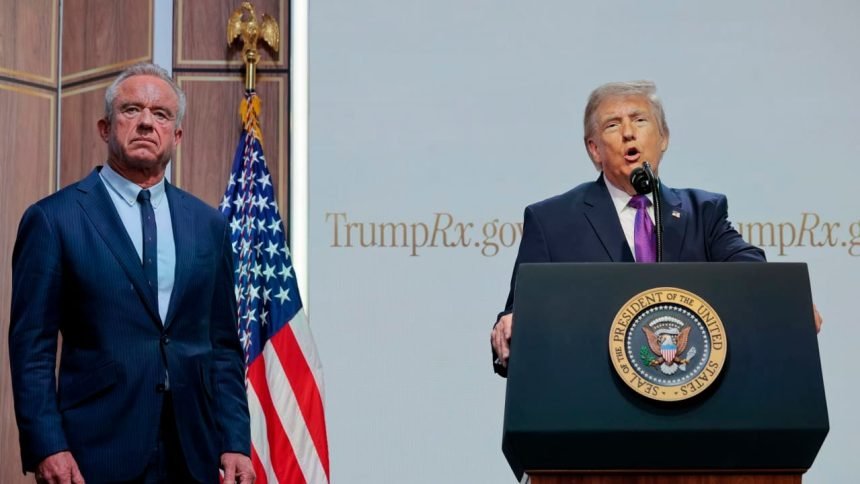
US President Donald Trump has shifted course on his administration’s vaccine policy, pressing Health and Human Services Secretary Robert F. Kennedy Jr. to intensify investigations into a possible link between childhood vaccines and autism, The Wall Street Journal reported Thursday.
Kennedy, who has long advocated scaling back childhood vaccination recommendations, had initially been urged by White House political advisers to tone down his vaccine messaging ahead of the midterm elections, according to the report.
That strategy changed in May, when Trump signed an executive order directing HHS to reduce the number of vaccines recommended for children. The move reportedly surprised senior health officials, who had been following earlier instructions to deemphasize the issue.
Trump has since pressed Kennedy to make autism research a central priority and reduce the number of shots recommended under federal guidelines. The president hoped that cutting the number of vaccinations would lead to lower autism rates, despite the scientific consensus that vaccines do not cause autism, WSJ wrote.
Scientists have not identified a definitive cause for the increase in autism diagnoses, a trend that researchers have attributed to a range of possible factors, including genetics, parental age, and improved screening.
Trump dissatisfied with Kennedy’s progress
Tensions became apparent during a mid-June Oval Office meeting, when Trump told Kennedy that he was not doing enough, people familiar with the matter told WSJ.
The president reportedly believes Kennedy has had sufficient time to advance his agenda and is disappointed by his limited progress.
The pressure marks a reversal from the political strategy promoted by White House advisers. Polling commissioned by longtime Trump adviser Tony Fabrizio found that vaccine skepticism was unpopular with voters, while Kennedy’s food and agriculture policies drew broader support.
White House and HHS officials subsequently urged Kennedy to focus on issues such as removing artificial dyes from food and promoting new dietary guidelines. His staff reportedly classified nutrition as a “green light” topic and vaccines as a “red light” issue, and Kennedy largely avoided discussing vaccines in public, WSJ wrote.
Trump’s renewed emphasis on vaccines and autism has now placed him at odds with that strategy, leaving HHS officials scrambling to expand autism research while Kennedy faces growing pressure to deliver results, according to the report.
Kennedy’s earlier efforts have also faced legal setbacks. A federal judge blocked his January proposal to reduce the number of diseases covered by the childhood vaccination schedule from 17 to 11, ruling that the administration appeared to have bypassed the federal vaccine advisory panel.
White House expands control over HHS
Trump has continued to praise Kennedy publicly, saying in February, “Who would’ve thought a Kennedy, we love a Kennedy, in the Republican Party?”
Behind the scenes, however, White House aides ordered a broad review of HHS amid internal disputes and concerns over Kennedy’s management. Senior officials were reassigned, his advisory team was restructured, and Medicare chief Chris Klomp assumed control of daily operations, according to WSJ.
Trump has also increasingly sought advice from Dr. Mehmet Oz, fueling speculation that Oz could eventually replace Kennedy.
“There’s frustration there,” Kennedy associate Dr. Jeffrey Klausner told WSJ. “It’s one of those situations where you have to accept some things so you can still pursue activities for the greater good.”