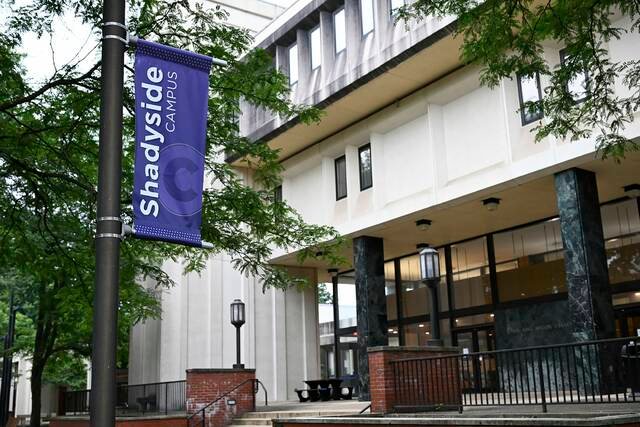
The merger of two schools at Chatham University, school leaders believe, will create stronger, interdisciplinary opportunities for graduates pursuing careers in business and environmental sustainability.
Chatham announced earlier this month the formation of the Falk College of Environment, Leadership and Management — a merger of the School of Business and Enterprise and the Falk School of Sustainability and Environment.
Emily Heffernan, dean of the new college, said the merger addresses employers’ need for graduates who can pair business expertise with environmental responsibility and leadership.
The merged college, for example, would benefit students who are studying Food Science and want to start a restaurant, or a student interested in beekeeping pursuing a small business.
“We hold firm with traditional majors but they will have something new and different, and that’s what the careers of tomorrow demand,” Heffernan said. “We can provide them with skills that are directly transferable. The job market can be a challenging thing and we’re trying to equip students with skills they need now and in the future.”
The merged college will have departments in Business Systems, and Sustainability and Environment. It includes undergraduate and graduate programs in business, data science, environmental science, sustainability and food studies.
Students will study issues like supply chain resilience, data analytics, geographic information systems, environmental decision science, food systems and sustainable agriculture.
Heffernan does not anticipate any programs being discontinued because of the merger.
“The American public has a challenging relationship with higher education,” said Heffernan. “We’re trying to improve confidence in that college degrees are valuable, and we’re working to adapt and change with the times and that we have a great return on our investments.”
Heffernan, a biologist, joined Chatham last year. She spent more than a decade at the New College of Florida in Sarasota, where she was director of the Environmental Studies Program.
Chatham is not immune to the enrollment and financial pressures facing higher education nationwide. Earlier this summer, the university was issued an accreditation warning although university leaders say there is a plan in place to improve finances and planning. It is reducing its budget deficit by selling property and taking other measures.
This fall, Chatham reversed dips in enrollment, reporting its largest incoming undergraduate class — 548 students — in the university’s 157-year history. Chatham also enrolled 306 new graduate students this fall.
“We’ll continue to push the envelope with what markets and employers need when students graduate,” Heffernan said. “It’s about the sum of its parts. By combining them and adding new courses, it’s really going to be wonderful.”
Total enrollment this fall is nearly 2,200 students. The Environment, Leadership and Management College will have 289 total undergraduates, 103 of whom are new students. Top majors include Management and Environmental Science, Heffernan said.
At the graduate level, there are 82 total students in the Environment, Leadership and Management College, 36 of whom are new.
Heffernan said the merger “signals stability” at Chatham.
“This is an opportunity to be at the leading edge of what students want,” Heffernan said. “By combining programs, we’re able to become a leader in sustainable businesses, supply chain management, environmental science and data analytics, and work at the nexus of where these fields overlap.”