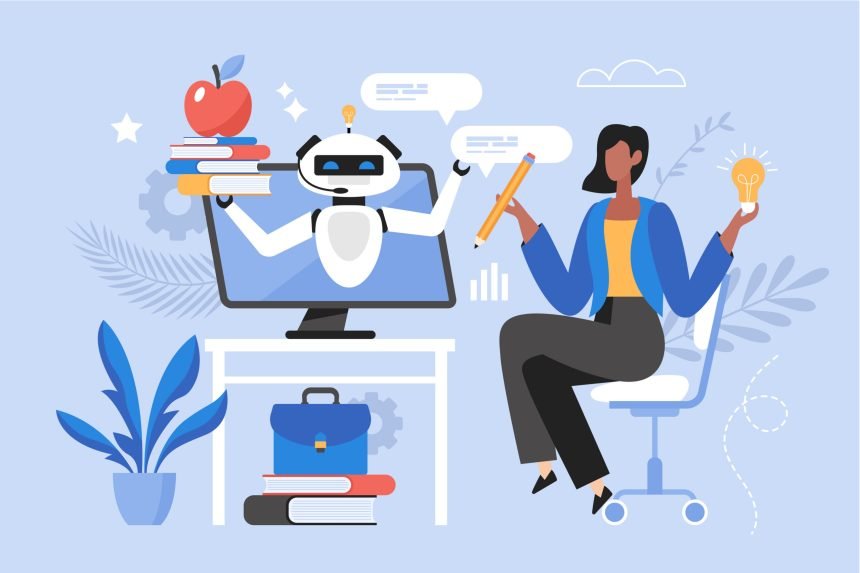
The integration of artificial intelligence (AI) in higher education has generated both enthusiasm and apprehension among educators. This article argues that AI can serve as an adaptive pedagogical partner, enhancing formative assessment, reflection, and metacognitive learning. Through illustrative examples, the study demonstrates how AI can provide individualized feedback and foster deeper conceptual understanding. The discussion emphasizes the ethical and pedagogical implications of AI integration, positioning it as a catalyst for reflective and responsible learning practices. The article concludes that AI, when employed intentionally, can amplify human instruction and promote the development of digitally literate, critically engaged learners.
The integration of artificial intelligence (AI) into higher education pedagogy is often less formidable than it may initially appear. When educators reconceptualize AI not as a disruptive force but as an adaptive, resource-rich instructional tool, the possibilities for enhancing student learning and engagement expand considerably.
Post-Examination Analysis
Post-Examination Analysis is a reflective instructional strategy designed to deepen learning by helping students identify, understand, and correct their misconceptions after an assessment. By revisiting their errors and engaging with targeted feedback, students develop metacognitive awareness, strengthen conceptual understanding, and build greater ownership of their learning. This process encourages critical thinking, self-assessment, and purposeful revision.
To implement Post-Examination Analysis, instructors return graded multiple-choice assessments and direct students to review each incorrect item. Students then input their missed questions into an AI platform, which provides explanations clarifying the conceptual, procedural, or reasoning errors behind their misconceptions. After examining these explanations, students compose written reflections describing why their original answer was incorrect and how the correct answer aligns with the underlying concept or skill. This structured cycle supports deeper understanding and long-term retention.
Prompt Example
“After reviewing the AI feedback, I now realize that… I misunderstood the concept of… I still need to work on…”
Design Phase
Educators determine that the goal extends beyond scoring performance; the intent is to guide students toward recognizing and correcting their misconceptions. AI is selected to support this deeper, individualized learning process by offering consistent, detailed explanations.
Collaboration
As students analyze their incorrect responses, AI serves as an interactive learning partner—providing hints, examples, and clear explanations in real time. This support keeps students engaged in active problem-solving rather than passive review, allowing them to confront errors with confidence.
Reflection and Synthesis
After reviewing AI-generated explanations, students synthesize what they have learned by writing reflections that articulate their corrected understanding. AI may also summarize patterns in student errors, highlight related concepts, or offer targeted follow-up questions, enabling learners to integrate new insights into their existing knowledge.
By integrating AI, Post-Examination Analysis transforms a traditional test-review routine into a reflective, metacognitive learning experience—one that guides students in diagnosing misconceptions, engaging with targeted feedback, and constructing deeper, more accurate understanding through purposeful revision and self-assessment.
Reflective Questioning at the End of a Lecture
Reflective Questioning at the End of a Lecture is an instructional strategy designed to deepen understanding, promote metacognitive awareness, and support active engagement with course concepts. By pausing at the close of a lesson to generate reflective questions, students interact with content in thoughtful and analytical ways. This approach encourages critical thinking, synthesis, and self-directed learning while fostering student agency in meaning-making process.
To implement this activity, instructors dedicate several minutes at the end of a lecture for students to write one or two reflective questions about the day’s topic. These questions may address areas of confusion, patterns noticed during the lesson, or connections to prior knowledge. Students then use AI tools to explore potential explanations or perspectives and synthesize the insights into their own words. After class, they submit short written responses. The instructor reviews these reflections to identify common misconceptions and uses them to structure targeted review in the next session.
Prompt Example
“After exploring my question with the help of AI, I now understand… I realized my earlier thinking was based on… I still wonder about…”
Design Phase
AI can help educators generate reflective question stems aligned with learning goals or differentiated by readiness level. AI tools can model misconceptions or alternate explanations to support purposeful prompt and rubric design. Students can input questions or intentionally flawed reasoning into an AI system to examine explanations and deepen conceptual understanding.
Collaboration
As students work individually or in pairs, they may consult AI platforms to clarify ideas, check reasoning, or explore multiple explanations (Xie et al,.2023). AI tools provide adaptive feedback that highlights misconceptions, enabling students to refine their questions and improve the accuracy and depth of their responses. AI-generated analytics help instructors identify shared learning gaps and prepare responsive instruction for the next class.
Reflection and Synthesis
AI prompts students to explain why their initial reasoning may have been flawed. AI follow-up questions support deeper analysis and connections to prior learning (Zhai et al., 2023). Students may receive AI feedback on reflections, supporting continued clarification and growth.
By integrating AI, Reflective Questioning at the End of a Lecture becomes a powerful formative assessment tool—one that blends student inquiry, metacognitive reflection, and adaptive digital feedback to promote conceptual clarity, critical thinking, and deeper engagement with the learning process.
Guided Notes and Multimodal AI Support
Guided Notes and Multimodal AI Support is an instructional strategy designed to promote organization, metacognition, and deeper content comprehension. Students first take detailed notes, then convert them into guided prompts for peers. After exchanging and answering guided notes, students may use AI tools to reorganize content into multiple formats, such as charts, visual organizers, or concept maps.
Prompt Example
“After reviewing my peer’s responses and creating new formats with AI, I now understand… I noticed that key concepts connect through… I still need help understanding…”
Design Phase
AI can help students transform their written notes into high-quality guided questions aligned with learning objectives or differentiated by readiness. AI tools can also generate multimodal representations (e.g., charts, diagrams, mind maps) that support comprehension and appeal to a range of learning preferences.
Collaboration
As students exchange guided notes, they may consult AI to clarify confusing ideas, check accuracy, or summarize peer responses. AI-powered visual and text-based formatting tools can support accessibility and help students compare, contrast, and refine their understanding.
Reflection and Synthesis
After the activity, AI can assist students in organizing key ideas, generating visual summaries, or drafting reflective statements about their learning. Educators can use AI to analyze student products, identify common themes or misconceptions, and develop follow-up questions or feedback.
By integrating AI, the Guided Notes activity evolves into a dynamic and multimodal learning experience—one that blends peer interaction, metacognitive reflection, and digital support to strengthen comprehension, communication, and conceptual connections.
Gallery Walk
A Gallery Walk is an interactive instructional strategy designed to promote engagement, critical thinking, and collaborative learning. By moving around the room and engaging with content at various stations, students interact with ideas, peers, and the learning environment in dynamic ways. This approach encourages analysis, synthesis, and academic dialogue while fostering student agency and active participation.
To implement a Gallery Walk, prepare 4–6 open-ended prompts related to your current unit. These can be displayed on chart paper, whiteboards, or digital screens around the classroom and may include supporting materials such as images, graphs, quotes, or short texts. Students rotate through stations in small groups, reading, discussing, and responding to each prompt. At each stop, one group member records the team’s thoughts while others contribute ideas. After visiting all stations, students return to their original starting point to review and reflect on the collective input.
Prompt Example
“After reading the group responses at each station, I now understand… I noticed a common theme in… I still wonder about…”
Design Phase
Educators can use AI to generate high-level, open-ended prompts aligned with Bloom’s Taxonomy or differentiated by readiness level. AI tools can curate multimedia materials (e.g., images, charts) to support each prompt.
Collaboration
Students may consult AI tools to clarify unfamiliar concepts or summarize previous group responses. AI-powered speech-to-text and summarization tools can support accessibility and deepen understanding.
Reflection and Synthesis
After the activity, students can use AI to organize their thinking, summarize key insights, or draft reflection pieces. Educators can leverage AI to analyze student responses, identify patterns, and generate follow-up discussion questions or feedback.
By integrating AI, the traditional Gallery Walk evolves into a forward-thinking learning experience—one that blends movement, peer dialogue, and digital support to cultivate critical thinking, metacognition, and deeper content engagement.
Two Minute Talks
Two Minute Talks is an interactive strategy that activates prior knowledge and strengthens communication. Students speak for two minutes on a topic, switch roles, and then reflect individually., and promote active listening. By engaging in brief, focused conversations, students practice articulating ideas clearly while learning from their peers’ perspectives. This strategy builds confidence, collaboration, and metacognitive awareness in an energetic, time-efficient format.
To implement the strategy, students work in pairs. One student begins by speaking for two minutes, sharing everything they know about a given topic or question. The listening partner focuses on understanding and may take brief notes. After time is called, roles switch. The second student may repeat some ideas but should aim to add new insights or examples that deepen the conversation. Following the exchange, students reflect individually to consolidate learning and identify next steps for inquiry.
Prompt Example
“Based on what I already knew and what I learned from my partner, I now understand… I still have questions about…”
Design Phase
Teachers can use AI to generate open-ended prompts aligned with lesson goals or differentiated by readiness level. Students may practice with AI chatbots to refine questioning and speaking skills before pairing up.
Collaboration
Students can use AI tools to clarify key terms, summarize shared ideas, or check for accuracy. Speech-to-text technology can support accessibility and help capture key points from each discussion.
Reflection and Synthesis
After conversations, students can use AI to organize reflections, expand on new insights, or refine writing for clarity. Educators can analyze AI-assisted summaries to identify common themes or misconceptions and plan follow-up lessons.
By integrating AI, Two Minute Talks becomes a more dynamic and reflective experience. Technology enhances—not replaces—the personal interaction at the heart of this strategy, helping students connect ideas, strengthen communication, and engage deeply with learning.
Three-Step Interview
Three-Step Interview fosters structured dialogue and perspective-taking. Students interview one another, switch roles, and then synthesize insights in groups of four. Designed to deepen understanding through interpersonal communication, this method helps students articulate their thinking while engaging empathetically with the ideas of others.
To implement the strategy, students begin in pairs. One student interviews the other by asking open-ended questions, listening closely, and paraphrasing their partner’s responses. After a set time, roles reverse. Finally, each pair joins another to form a group of four. In this synthesis phase, students introduce their interview partner and summarize their key ideas, helping to reinforce comprehension and encourage diverse perspectives.
Prompt Example
“During our interview, I learned that my partner believes… One idea that surprised me was… I now see the topic from a new perspective because…”
Design Phase
Students can rehearse interviews using AI-powered chatbots to improve questioning techniques and paraphrasing skills. Teachers can use AI to generate differentiated interview questions aligned with student needs and lesson objectives.
Collaboration
AI speech-to-text tools can provide real-time feedback on questioning clarity and tone, or help students refine responses for accuracy and empathy. Prompt generators can suggest thoughtful follow-up questions to deepen dialogue.
Reflection and Synthesis
Students can use AI tools to help summarize peer ideas, generate visual maps of perspectives (e.g., word clouds or mind maps), or write reflective responses based on the group discussion. Teachers can analyze AI-generated transcripts or student summaries to assess understanding, identify misconceptions, and plan next steps.
By integrating AI, the Three-Step Interview becomes a more dynamic, inclusive, and reflective experience. Technology supports—not replaces—the essential human connection that this strategy is built upon. Through guided conversation and thoughtful reflection, students grow in both their content knowledge and their interpersonal skills.
Conclusion
Collectively, this framework conceptualizes learning as a socially mediated, metacognitive process in which understanding emerges through iterative cycles of inquiry, feedback, and reflection. Peer interaction and guided dialogue function as mechanisms for conceptual negotiation, while metacognitive self-assessment supports the identification and revision of misconceptions. Digital tools operate as adaptive cognitive supports, extending learners’ capacity to monitor thinking and engage with targeted feedback without displacing the relational foundations of learning. Through this integration, students develop increasingly coherent mental models, enhanced conceptual clarity, and deeper engagement, positioning learning as an active, reflective, and meaning-making process.
Emerging scholarship positions AI as both a cognitive partner and a formative assessment tool. Although many instructors remain apprehensive, AI’s educational value becomes clear when it is used to complement human judgment and enhance learner-centered pedagogy.
Nancy Marsh’s expertise is in elementary education. She was a university supervisor, professor, assessment coordinator, and dean of an educator preparation program.
Nan Flickinger’s expertise is in middle-grades education. She was a university supervisor, a professor, and the director of clinical experience.
Together, Nancy and Nan have 60 years of teaching experience between them. They trained future educators to design detailed lesson plans, reviewed their submissions, and monitored their implementation in the classroom. However, their university has not adopted the position that AI offers significant instructional benefits. As a result, they chose to jointly develop an article outlining practical and collaborative applications of AI in educational practice.
References
Xie, K., S. Liu, Y. Cheng, and J. H. H. Leung. 2023. “Effects of Teacher Collaboration on Teaching Practices in China and England: A Structural Equation Model with TAILS2018 Data.” Teaching and Teacher Education 121: 103921. https://journals.sagepub.com/doi/10.1177/21582440231177908
Zhai, X., Chu, X., Chai, C. S., Jong, M. S. Y., Istenic, A., Spector, M., Liu, J.-B., Yuan, J., & Li, Y. (2021). A review of artificial intelligence (AI) in education from 2010 to 2020. Complexity, 2021, Article 8812542. https://doi.org/10.1155/2021/8812542