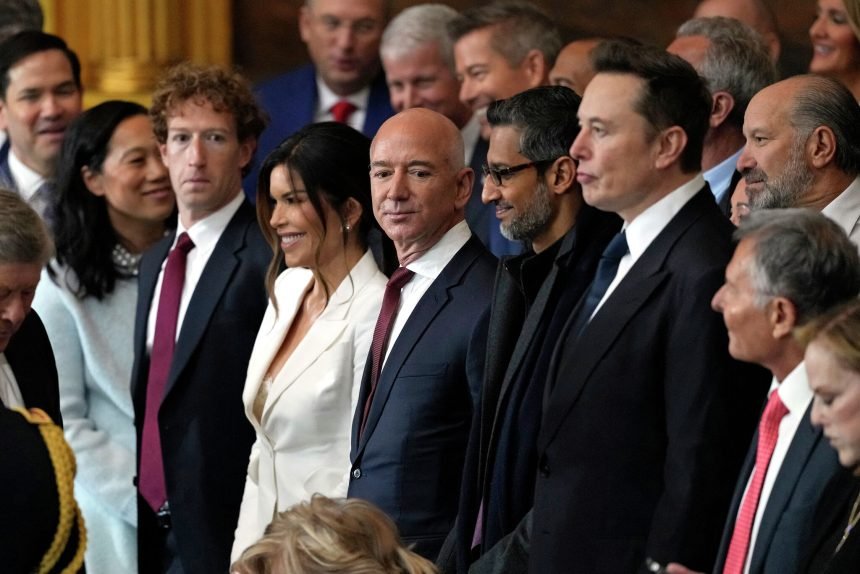
(L-R) CEO of Meta Mark Zuckerberg, Lauren Sanchez, US businessman Jeff Bezos, CEO of Alphabet Inc and Google Sundar Pichai and Teska and SpaceX CEO Elon Musk attend the inauguration ceremony where Donald Trump will sworn in as the 47th US President in the US Capitol Rotunda in Washington, DC, on January 20, 2025. (Photo by Julia Demaree Nikhinson / POOL / AFP via Getty Images)
By the time the likes of Mark Zuckerberg, Sundar Pichai, Jeff Bezos, Elon Musk and Tim Cook lined up for photo ops with Donald Trump at his second inauguration, a narrative had taken hold: Tech had moved firmly right.
That narrative is wrong, a Chronicle analysis of federal political giving shows — except at the very pinnacle of tech’s power pyramid.
It’s impossible to know which voters changed their allegiance from Democratic or independent to Republican in 2024: The ballot in the U.S. is secret, after all. But tens of thousands of Bay Area residents donate to political causes each year, and those records are public. They show that when it comes to voting with their wallets, tech workers are still overwhelmingly Democratic.
Article continues below this ad
Some 93% of software developers and other tech workers donated solely or primarily to Democratic committees in 2024 — a share that’s been consistent in the Trump era and actually up since the 2012 election cycle.
That isn’t to say there hasn’t been a rightward shift in recent years. But it’s mostly confined to the ultra-wealthy and ultra-influential. Some CEOs, upper-level executives, crypto workers and venture capitalists are the only workers to have transitioned much of their giving to Republicans.
To make that determination, the Chronicle analyzed 16 years of donations to federal campaigns made by residents of the nine-county Bay Area — including in the ongoing 2026 midterms. We counted “tech workers” as anyone reporting working as a software engineer, web developer, IT specialist and the like. Many work for tech companies, but the definition also encompasses people in tech roles at other firms. We deliberately limit the definition to the rank-and-file: Tech executives, managers and financiers are counted separately.
Some people donate to candidates from both major parties; we assigned partisanship based on the party a donor gave more to in a given cycle. We grouped partisan super PACs with the parties they support — but industry-specific committees that support candidates of both parties weren’t assigned any partisanship.
Article continues below this ad
Tech workers donate at the same rate as other workers — and overwhelmingly to Democrats
When the DotCom and Web 2.0 booms created swaths of tech jobs in the Bay Area, chatter began to emerge about how these workers would fit into the region’s free-wheeling, progressive culture, including its politics.
In cultural and economic terms, there have been plenty of clashes. But in partisan political terms, tech workers have become reliable supporters of the Bay Area’s reigning liberal consensus. In fact, a Chronicle analysis of 2024 election results at the voting precinct level shows that wealthy, tech-heavy areas like the Peninsula displayed some of the state’s weakest shifts in favor of Trump in a year where California lurched right.
Moreover, contrary to complaints about their political disengagement, tech workers have been roughly as likely as other workers to donate to political causes, with about 1.4% donating in the average cycle over the last decade and a half, compared to 1.6% of workers overall. (In recent years, nearly half of Bay Area federal donors have been retired or listed their occupation as unemployed.)
Article continues below this ad
That these tech donors’ partisan loyalty is lopsided is no surprise to Bruce Cain, a political science professor at Stanford University. Like other college-educated professionals, Cain said, tech workers have overwhelmingly become Democrats. And even more so than other professions, he added, workers in the tech industry tend to congregate in left-leaning urban areas, like San Francisco.
“Even when you go into red states, it’s Austin, it’s the urban areas that get the clustering of the tech workers, and so these clusters reinforce the kind of liberal culture,” Cain said.
In other words, Cain suggested, it’s not just that tech workers spread liberal values. It’s that liberal places influence techies’ values.
Techies at some companies lean more Republican than others
Tech workers’ Democratic lean transcends sub-industries and company sizes. But some companies do have a higher — even rising — share of Republican donors compared with others.
Article continues below this ad
In the 2024 election, for example, Tesla had one of the highest shares of employees donating to Republican committees out of top Bay Area technology companies. Some 22% of Tesla employees who gave to partisan causes that year bolstered committees such as Trump’s Make America Great Again PAC and his joint fundraising committee with the RNC. (In 2020, just 7% of Tesla donors did.)
The trend is even more pronounced for some smaller companies, at which a handful of employees can have an outsized impact.
For instance, only a few dozen employees of Coinbase, the crypto platform, contribute money each cycle. But as the crypto industry has become more politically engaged, those contributions have ballooned — and started flowing to Republicans. In 2020, just 3% of the $34,000 given by Coinbase employees went to Republicans. In 2024, 23% of the $1.6 million given by Coinbase employees did.
Likewise, only a handful of employees of Palantir, the defense software company, give each year — only 26 in 2024, and 16 so far this year. Most of their money has gone to Democrats. But as giving from Palantir employees has ramped up in 2026, the share of those dollars going to Republicans surged to 48%.
Article continues below this ad
Tech workers support the same kinds of Democrats others do — mostly
Even if techies are mostly Democrats, it might be supposed that they don’t support the same kinds of Democrats that donors from other professions might. Studies show that tech employees have a more libertarian worldview than other left-of-center voters.
That divide is beginning to emerge in local contests. In the ongoing race to succeed Speaker Emerita Nancy Pelosi in Congress, state Sen. Scott Wiener’s donor base is made up of far more tech donors than those of his opponent, S.F. Board of Supervisors member Connie Chan. (Wiener has also drawn support from tech industry giants like Y Combinator CEO Garry Tan and crypto billionaire Chris Larsen, both of whom have poured money into a super PAC boosting Wiener’s campaign.)
But that contest remains an exception. On the national stage, donation data mostly shows that techies support the same sorts of Democrats other educated professionals do.
In fact, along with major nationwide causes like Democratic presidential campaigns, the list of most popular targets for tech donations includes some notably progressive — and even tech-skeptical — politicians like Vermont Sen. Bernie Sanders and New York Rep. Alexandria Ocasio-Cortez.
In contrast, many of the Bay Area’s most famous Democratic politicians have actually drawn relatively little support from tech workers. Notably, only about 3% of Bay Area donors to the principal committee supporting Rep. Ro Khanna, who won office in 2016 by running on his relationships with the tech industry, were tech workers.
Other local luminaries like Pelosi, former Rep. and current Oakland mayor Barbara Lee and Rep. Sam Liccardo, the former mayor of tech-heavy San Jose, also received only a small share of their political donations from tech workers.
Jason Overman, a political consultant and co-founder of Bay Area-based Progress Public Affairs, said that pattern says something about what rank-and-file Democratic donors actually care about: winning competitive elections. Because the region leans so heavily Democratic, tech workers and other politically active, educated Californians might spend their money on Democrats gunning for a competitive seat or running in swing states.
Jon Ossoff’s and Raphael Warnock’s 2020 Senate campaigns, for example, are among the causes with the highest shares of donations from Bay Area tech workers. Same with Beto O’Rourke’s 2018 Texas Senate run.
“California is often seen as a national ATM for Democratic candidates at all levels,” Overman said. “If you are a Democratic candidate for governor of Texas or New York or Georgia, you’re probably coming to San Francisco and Los Angeles to raise money.”
The wealthiest are throwing more weight around. But only some swung right
A small group of wealthy donors with tech-industry ties account for a rising share of Bay Area political giving. In the 2024 election, half of all Bay Area political money came from just 100 donors, about two-fifths of whom currently work for tech companies or have in the past.
Some of these big donors swung right. Others didn’t.
Much of the change has to do with who the ultra-wealthy are: Some are tech leaders, but others are investors like venture capitalists. More than before, these financiers see politics as a way to protect their investments.
They “know that (Congress) can make decisions about taxes, about regulation, and so they’re like, ‘We got to talk to the people who actually have power,’” said Ray La Raja, a political scientist at University of Massachusetts Amherst who studies campaign finance. Lately, these leaders have courted Republicans to clear the regulatory environment for profitable hot-button industries like crypto, AI and surveillance technology.
Among those are billionaire venture capitalists like Marc Andreessen and Ben Horowitz, who have poured millions into right-leaning super PACs like Trump’s Make America Great Again Inc. and Defend American Jobs, the Republican arm of pro-crypto super PAC Fairshake.
That’s a change from prior decades, when the biggest Bay Area Republican donors tended to come from the more traditional finance sector, along with energy, agriculture and construction. By contrast, venture stayed more distant from politics, and individual venture capitalists often supported Democrats.
“The flip to more Republican contributions… after Trump won the election shows tech recognizing that they need to have a relationship with both parties, that they can’t be seen as captured by the Democratic party,” said Thad Kousser, a UC San Diego political scientist.
Even as late as 2024, though, the vast majority of money from major venture firms’ employees went to Democrats.
And over the same period, some tycoons have actively become heavy hitters on the left. Former hedge fund manager Tom Steyer, who ran unsuccessfully for governor in California’s June primary, has emerged as the state’s leading Democratic donor. Since 2010, he’s donated more than $300 million to progressive groups like his own Nextgen Climate Action Committee and to super PACs backing Democrats like Joe Biden and Kamala Harris.
Even among Silicon Valley capitalists in the Trump era, liberalism looks dominant.
The Chronicle analyzed individual political contributions reported to the Federal Election Commission from 2010 through the first part of 2026, although election cycles are reported starting from 2012 to account for two-year campaign seasons.
The FEC does not require committees to itemize donation amounts under $200, but WinRed and ActBlue, two of the biggest fundraising platforms for Republicans and Democrats respectively, itemize all items regardless of amount. That means the universe of donors includes everyone who gave more than $200 at a time — or less than that through one of those platforms. It does not include any dark-money groups that aren’t required to publicly disclose their individual donors.
Unique donors were identified by the combination of first name, last name and ZIP code of residence. This method works well for most people, but wealthier or more frequent donors are often recorded with many name variations and even addresses, so we used “fuzzy” matching to attempt to align donor names, as well as a manual review of the top 100 donors.
To narrow our analysis to Bay Area donors, we considered only donors in ZIP codes coterminous with the nine Bay Area counties.
The analysis relies on grouping donors by occupation. To account for variation in self-reported occupations, we standardized job titles using a computerized coding system created by the CDC’s National Institute for Occupational Safety and Health, which uses a machine learning model to give each unique title a standard occupational classification, or SOC code. These codes are a unified system created by government agencies to track employment trends. The same codes were used to measure donations given on a per capita basis. We randomly sampled 100 transactions and found that 93% were labeled accurately.
We only included occupations labeled with a 90% confidence or higher, and excluded retired, unemployed and homemaker donors from occupation analyses, but included them when measuring overall Bay Area donations. Categories were created for philanthropists and campaign managers, because there is no existing SOC category for those groups, despite their significant contributions. Some valid members of certain occupations may be left out if there were significant misspellings, vague information or unintelligible values in their job titles.
The analysis also relies on classifying political committees as Republican- or Democratic-aligned. Individual candidates’ campaign committees are generally identified with the candidate’s party, but many super PACs are not, despite having a clear partisan lean. To account for this, we manually labeled the top 100 unassigned committees in the FEC data based on research and past political contributions. We then excluded the rest, which we estimated only accounted for a small share (roughly 3%) of contributions.
Finally, the analysis relies on attributing donors to individual employers. We prompted the ChatGPT Sol GPT-5.6 model to help standardize employer names, which included combining company misspellings and name variations. The top 100 employers by amount were given additional standardization with a manual review. Donors who listed multiple employers were treated as a separate category. If donors listed two different employers in the same two-year election cycle, we double-counted them in employer-level analyses.
The analysis includes individual contributions and calculates net giving by subtracting refund disbursements. Conduit transfers and special-purpose transaction types are excluded from totals to avoid counting forwarded contributions as additional individual donations.