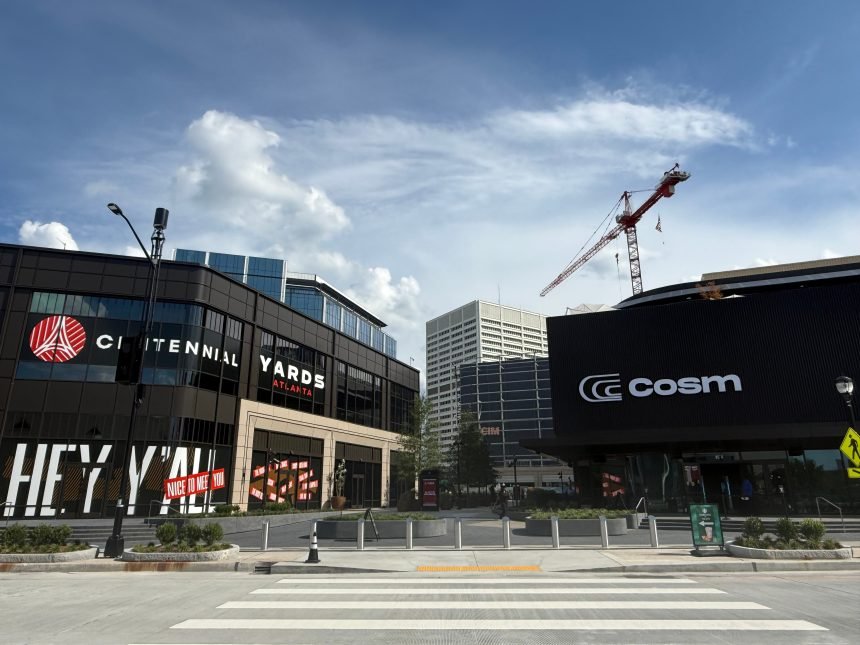
ATLANTA — This might be the land of Waffle House, but sandwiched between a pair of downtown stadiums sits a heavyweight Shake Shack.
The importance of this spot isn’t so much the smash burgers or the black and white shakes themselves, but rather why it exists at all.
The quick-stop restaurant, an Irish pub, and a giant, 70,000-square-foot Cosm — a theater specializing in immersive experiences — are early anchors in the Centennial Yards mixed-use development. Eventually, the 52-acre wedge is slated to be packed with entertainment, hotels and condos.
There’s already one hotel and a condo building open and another hotel and what is expected to be a roughly 5,000-seat venue are under construction just on the other side of a temporary wall.
The ties to Denver here are fairly obvious.
A mixed-use district next to a football stadium and built over — literally in this case — train tracks in what used to essentially be inaccessible industrial land? That sounds like Burnham Yard’s music.
The Broncos, as it turns out, think the same.
Before a preseason game against the Falcons next door at Mercedes-Benz Stadium, Broncos president Damani Leech and other team executives toured Centennial Yards, sources told The Post. The tour has been on the club’s radar for some time. Owner and CEO Greg Penner mentioned Centennial Yards to The Post as an interesting project nearly a year ago when his franchise named Burnham Yard as its preferred site for a stadium and adjoining district.
It is one of two major mixed-use districts in the Atlanta area the Broncos have visited while planning their own, with The Battery, which surrounds the Braves’ baseball stadium in Cobb County, as the more talked-about.
“It used to be called The Gulch,” RCLCO managing director Erin Talkington said of Centennial Yards before the development really ramped up. “It’s been used as parking lots, but it’s several stories below the grade of parking and building entrances and people have been trying to develop it for years
“It’s just been prohibitively expensive.”
Now, though, it’s an ambitious project in the midst of downtown.
Lessons to learn from Atlanta
No two projects are the same, of course, and Penner told The Post last fall that the Broncos “haven’t seen something that’s exactly what we want to do because we’ll create something that’s unique to this market and both what’s interesting to our fans but also what’s interesting to the community on a year-round basis.”
There are things to learn from these spots in Atlanta, however — especially since the Broncos recently released a new round of renderings about their own plans for Burnham Yard and this summer have put a somewhat finer point on the time horizon for various stages of development around a stadium they hope to have open by the 2031 NFL season.
At Centennial Yards, it’s impossible to miss that the place is a work in progress, but it’s also possible to walk through the existing part without feeling as though it’s a construction site. That will be important for the Broncos as they move through Phase 1 of construction and toward the stadium’s opening — assuming the myriad processes with community groups and the city of Denver are completed over the coming months.
“We want it to be a place that is connected to the existing neighborhood, a place where people feel connected, where they feel like they can live,” Leech said at a recent small area plan meeting at the La Alma Recreation Center. “A place that remembers and celebrates the history — the great history of this site that goes back hundreds of years. A place where people feel like they can move and gather … and spend time comfortably in the site.
“And then, finally, a place where residents, businesses and guests all feel like they can grow and prosper for the next several generations. That is what’s guided a lot of what you’re going to see.”
The renderings the team has released will change in future iterations, but they won’t be fully realized by 2031. Construction around the district in Phases 2 and 3 will take “many years,” Leech said, meaning it will be a decade or more before the plans are fully realized.
Much of the Phase 1 buildout around the stadium shown in recent renderings and planning documents features work in what the Broncos are calling “Village Center,” which is on the eastern flank of the district between the stadium site and the La Alma and Lincoln Park neighborhoods. In previous filings, the Broncos have proposed zoning in that stretch that will make it the entertainment hub of the district.
Creating connectivity
One interesting factor to watch will be how much residential build-out is completed by the time the stadium opens. The Broncos, of course, play just 10 games a year in the stadium, and even with concerts and other events a stadium will draw, there aren’t a ton of event days over the course of a year.
Even in a place like The Battery, where the Braves play 81 home games a year, the district’s designers prioritized having residential units ready early in the buildout.
“You want your (residential) there pretty much first, right, to get people there,” Lauren Standish, a principal at HGOR in Atlanta that worked on the design of the district, said earlier this year while estimating that 80% of the foot traffic on non-game days in the area comes from people who live right there. “And then that spills off. They’ve got a Whole Foods there now, they’ve got bowling and other corporate offices that have come up.
“That whole ring around the stadium is just going crazy, too.”

Burnham Yard, of course, has the La Alma and Lincoln Park neighborhoods to the east, Baker and Santa Fe to the north, and is closer to downtown, so its foot traffic patterns will differ from those of either of the districts in Atlanta.
What is clear, though, is that these places provide a glimpse at what a long-term project at Burnham Yard will look like in the medium term and much further down the road toward completion.
“As much of the development is built around that daily activation, the sense of place and creating this new node of social activity with direct linkage to the stadium, that became the glue for that mixed-use development,” Todd Powers, another principal at HGOR, said. “How do all the buildings relate to each other? What is the open space connectivity and how do people move through to the stadium?
“Also creating day-to-day programming for vitality — porches and patios and daily events, outdoor activities.”
Want more Broncos news? Sign up for the Broncos Insider to get all our NFL analysis.