Attempting to personally connect with hundreds of students in one large class presents faculty with a unique set of challenges.
“This semester, for example, I have two students named Precious, two students named Bee, and one student with the last name of Connor and another student with the first name of Connor,” said Dr. Aaron Pitluck, a professor of sociology at Illinois State University who teaches nearly 300 students in his Introduction to Sociology course. “Recalling who is who—and providing personalized attention to students reaching out to me, or proactively reaching out to students that I’ve identified, is an enormous undertaking above and beyond the weekly teaching and grading of course content.”
But what if technology could make large classes seem much smaller?
Pitluck, a recipient of the University’s inaugural Adaptive Edge Institute (AEI) Faculty Fellowship, spent last semester exploring ways for generative artificial intelligence (AI) to help scale up personalized communication and accountability strategies that are easily achieved in typical 20-seat classrooms but nearly impossible in classes of 100 or more students.
At the same time, Dr. Sandeep Jagani, an associate professor of operations management and the other inaugural AEI faculty fellow, sought to pair AI automation with student and faculty data to streamline the College of Business accreditation process while enabling departments to more easily observe student progress.
“We’re looking at the meeting place of technology and service and pedagogy research, and where technology can help enable humanity,” said Dr. Roy Magnuson, a professor of music composition who directs AEI. His team includes Pedagogy Lead David Giovagnoli and Development Lead Nathan Stien.
Founded in 2025 within the Office of the Provost, the institute aims to guide faculty, staff, and students in navigating the changes to teaching, learning, and work created by emerging technologies, especially AI. The AEI Faculty Fellowship includes a course release for faculty to review research and develop a project that drives innovation and supports success across the University.
Magnuson, Giovagnoli, and Stien collaborate with the fellows, including Jagani and Pitluck, throughout the semester-long fellowship.
“These two are vastly different projects. It’s a testament to the generalist nature of the technology,” Magnuson said. “AI is kind of like electricity or something that can be applied to anything. Aaron is a sociologist, and Sandeep studies efficiencies in business. So, they have totally different backgrounds, but they’re applying the same technology to their projects, which is remarkable.”
Charting student progress
Of the approximately 16,000 business programs worldwide, less than 6% are accredited by the Association to Advance Collegiate Schools of Business (AACSB). Illinois State’s College of Business is among this elite group.
While prestigious, the annual AACSB accreditation process is arduous and consumes hundreds of hours each year, as faculty manually review syllabi, map course content to learning objectives, score student assignments against those objectives, and compile everything into reports for accreditors.
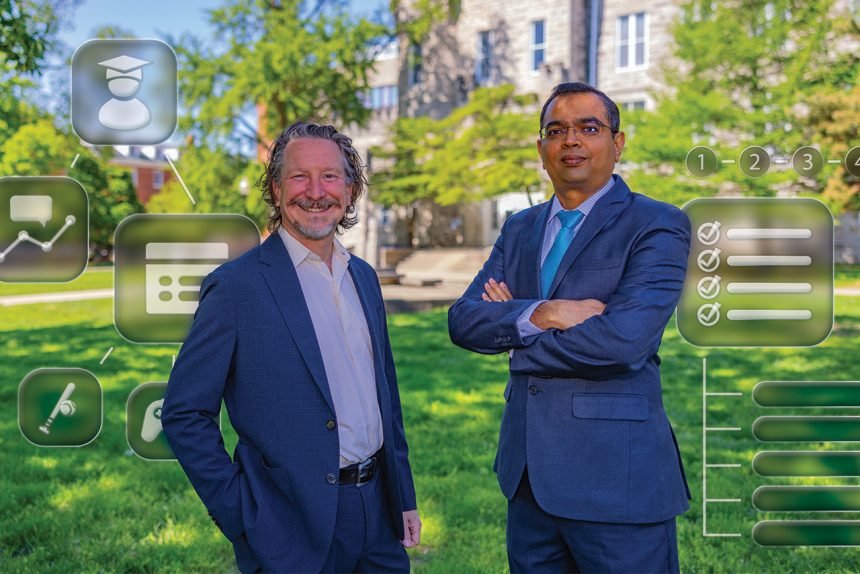
Dr. Sandeep Jagani believes the tools he developed through the fellowship can be applied beyond the College of Business.
Jagani envisioned creating a large language model (LLM)-powered tool to automate the process. LLMs are AI systems capable of understanding and generating human language by processing massive datasets.
“We have data (for the accreditation) at two different places, which don’t currently talk to each other,” Jagani said. “One is Watermark Faculty Success, where we are required to put our syllabus every semester. And the second is Canvas, which has our grade book. I knew if we could match these with the (accreditation) goals using a large language model, I could accomplish my goal.”
He started by asking Google’s AI tool Gemini to develop a process map and workflow diagram for his project. He refined Gemini’s outputs, while discarding occasional misinformation from AI hallucinations.
With his project plans solidified, Jagani asked Gemini to guide the development process. It instructed him to install programming tools such as Python to code the custom program and offered advice on testing, first on Jagani’s computer and later on a university server.
“It told me what to do, and I kept following it,” Jagani said.
The biggest challenge, maintaining data security, was addressed by making student and course data self-destructible and by only using university-approved AI models housed on secure servers.
Jagani, who lacked coding experience, accomplished his fellowship project goals by developing several new AI-powered tools: a single syllabus analyzer for instructors that reads a course syllabus and evaluates how well it aligns with the program’s learning goals and objectives; a batch syllabus analyzer for administrators that processes up to 20 syllabi at once to help identify gaps in goal coverage across multiple courses or sections; a course map generator for instructors and administrators that reads a Canvas course export to automatically produce a structured course map linking course activities and assessments to specific learning objectives; and a grade analyzer that uses the course map generator output and Canvas grade export to automatically calculate student proficiency ratings mapped to the college’s AACSB learning goals.

The syllabus analyzers identify which learning goals are addressed in each course, and the course map generator produces a formatted Word document ready for instructor and student use. Both feed into the grade analyzer, which converts Canvas grade data into proficiency ratings. Together, the outputs support AACSB accreditation reporting and provide data that can be analyzed to track student learning outcomes over time.
“Measuring students from year one onward, you would know how students grew from their first year to the fourth year,” Jagani said.
If data shows a student or class falling behind, faculty can strategize an intervention.
Jagani’s tools developed through the AEI fellowship could also be applied beyond the College of Business.
“If this can be implemented into other courses, someday it could give a live, pictorial demo of every single student and every single year on an aggregate basis if you want to see how students are developing—measuring student success across the University,” Jagani said.
Making a big class feel smaller
Like Jagani, Pitluck is also encouraged by the prospect of using AI tools to document and improve learning outcomes.
Although Illinois State prides itself on a 19-to-1 student-to-faculty ratio resulting in individualized attention, students still encounter a handful of large lecture hall classes such as Pitluck’s Introduction to Sociology course.
“I have challenges in large classes (such as student attendance) that I never have in my small classes,” Pitluck said. “In a small class, if someone misses a class, I send an email to check on them. You can’t do that individually for everyone in a large class.”
Through the AEI fellowship, Pitluck worked on two projects. First, he explored ways to train a data-secure AI tool about individual students in large classes by inputting performance data from Canvas, email exchanges, in-class polling data, and the instructor’s own knowledge of each student.
“I’m trying to put the full picture together so I can build a stronger relationship with each student,” Pitluck said.
His other project investigated how to generate lists of students flagged with similar issues, such as missing consecutive classes, and sending them mass-personal emails.
Pitluck tested this concept by emailing students absent following spring break, with the subject: “Should I be concerned?” He personalized templated messages within an Excel spreadsheet and used Outlook’s mail merge function to send dozens of emails simultaneously.
“Within an hour, I heard from half of them,” Pitluck said. “And there was a big jump in attendance the following week.”
Whereas Jagani developed a new set of AI-powered tools to specifically address his fellowship project, Pitluck is using existing, readily accessible AI systems to achieve his goals.
“I think most faculty of large classes don’t even realize what AI could do for them,” Pitluck said. “So, I developed a menu of things that AI could potentially do.”

Dr. Aaron Pitluck is using technology to connect on a more personal level with students in his large Introduction to Sociology course.
Pitluck continues testing his projects and is refining his menu of effective AI tools for instructors accordingly.
By using AI technology to build stronger connections with students in his large classes, Pitluck hopes to observe a statistically significant increase in attendance, office-hour visits, and test scores.
“I think using these tools can make a really large class of 300 students feel more like a small class of 20,” Pitluck said. “That’s the ultimate goal.”
The Adaptive Edge Institute invites tenure-line faculty from all disciplines to apply for the Faculty Fellowship.