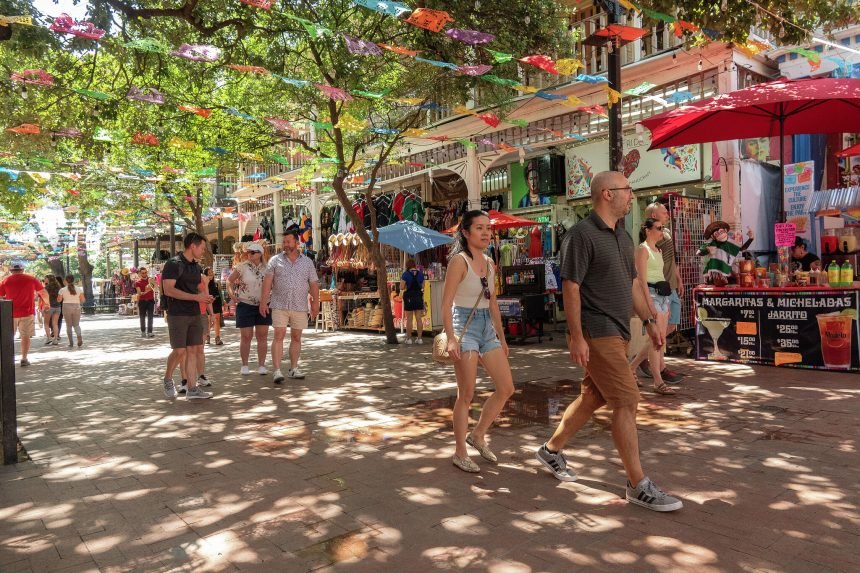
Historic Market Square as we know it today was unveiled 50 years ago this month.
It’s hard to imagine the vibrant Market Square was once an area in decline.

Its rebirth into a place that has received national recognition as a top tourist spot and cultural destination happened largely because a group of merchants and concerned residents wanted to ensure the area’s rich history was preserved.
Article continues below this ad
Besides attracting tourists, the spot’s pop-up vendors and established merchants have drawn locals, too. From live music events to food-focused happenings, to Fiesta and the Christmas holiday season, the three-block site off West Commerce Street is deeply rooted in the city’s history.
San Antonio Explained looks at the origins, development and lasting legacy of Historic Market Square as its revitalization into what we know today commemorates 50 years.
Its origins
Public markets where produce and commodities were sold have been a part of San Antonio’s history since its beginning.
Article continues below this ad
“Market Square is heir to all of the markets of San Antonio’s 300-year past,” historian Mary Ann Noonan Guerra wrote in her 1988 book “The History of San Antonio’s Market Square.”
Market Square sits on land that is part of the original 1730 ejido that was a gift from the King of Spain for settlers in the region to use. An ejido is an area of communal land intended to be used mostly for farming and agriculture.
The city, located about 150 miles from the Mexico border, was considered vital for trade. A marketplace where farmers could sell their products and that could serve as a central spot for trade was necessary to develop the area.
Spain wanted to populate the region with loyal settlers in order to prevent French encroachment from Louisiana and the Matagorda Bay area, according to historians.
Article continues below this ad
Its decline
A big change came to downtown San Antonio in 1951, when a group of about 30 produce wholesalers pooled their resources to build a private, modern $2.5-million Terminal Market on Zarzamora Street.
Dozens of vendors who occupied stalls in the city-owned Farmers Market building off West Commerce Street moved to the new spot. This led to a drop in foot traffic, and ultimately resulted in a decline in “energetic street life” in the area, according to historical accounts.
Also contributing to the decline in business for produce sellers were changes in shopping habits, spurred by the growth in supermarkets where a variety of products could be purchased in one stop.
Article continues below this ad
Many Farmers Market merchants were determined to stay. Some took out an ad in the Sept. 14, 1952 edition of the San Antonio Express that declared their intention to keep “doing business at the same ole stand.” The merchants, many of whom worked in family-run businesses, were committed to continue working where their ancestors had started.
As business continued to decline, the city rented the Farmers Market building and its surrounding space for events, including Cinco de Mayo celebrations, charity rummage sales and wrestling matches.
Its development
By the late 1960s, the merchants who stayed at the Farmers Market, along with local conservationists, persuaded city officials to create a committee that would look at ways to revive the area. This led to voters passing a city bond in 1970 that funded the market’s renovation.
Article continues below this ad
The transition from a produce market into a space that included a refurbished plaza and an enclosed air-conditioned market known today as El Mercado was funded as part of the $50 million Rosa Verde Urban Renewal project, records show. As part of the renovation, three city blocks bounded by Dolorosa, Santa Rosa and West Commerce Streets were turned into pedestrian malls, with stone fountains, ornamental streetlights, trees and benches installed.
The renovated Market Square was dedicated on Sept. 30, 1976, with ceremonies that kicked off four days of festivities, according to San Antonio Public Library archives.
Its current role
The types of activities that started to fill Market Square in the years before its renovation continued, as Fiesta events, holiday tamaladas, music fan fairs and regular weekend events have taken place over the years. And it’s home to a few longtime merchants, notably Mi Tierra Cafe y Panadería, an icon of the city’s downtown landscape.
Article continues below this ad
Though Historic Market Square has been criticized for catering too much to tourists, others recognize that its shops and eateries reflect San Antonio’s history.
“We see it as just a treasured cultural facility,” Mark Jenkins, the Market Square manager for the city of San Antonio, told the Express-News in 2015. “It really gives tourists from all over the country a chance to see some of our great Hispanic, Mexican traditions.”