DePaul University is launching its new Institute for a Sustainable Future and will partner with the Vatican’s Laudato Si’ Center for Higher Education in an effort to build on its ongoing efforts to develop a more sustainable world in which people can thrive.
The university announced both steps Sept. 2, a day after the beginning of Season of Creation, which runs from the beginning of September through the feast of St. Francis of Assisi on Oct. 4.
“This is a success for a multitude of people who have been doing this work without this formal structure over my entire career,” said Christie Klimas, codirector of the new institute. “This is a new form for a lot of the really wonderful work that DePaul has been doing for years, and something we can build on. We’d like this to be a home for integral ecology.”
Klimas chairs DePaul’s department of environmental science and studies in the College of Science. The College of Science and the university’s Driehaus College of Business will house the new institute; Alyssa Westring, professor and chair of management and entrepreneurship in the business school will also serve as a codirector.
The university will continue working on its climate action plan, which is adapted and changes over time, with the facilities operations department, she said, and it will expand academic programming about sustainability as the institute gets up and running.
Among the new efforts will be a cohort of 18 to 20 “sustainability scholars,” drawn from majors across the university, who will participate in a four-year program of classes, service and work with nonprofits and businesses to develop and implement sustainability efforts beginning in the fall of 2027, Klimas said.
The institute also hopes to collaborate with the archdiocese, parishes and other institutions working to bring the vision of “Laudato Si’: On Care for Our Common Home” to life.
Pope Francis’ 2015 encyclical calls on all people to recognize the need to care for the earth and for one another, and explains that the consequences of harm to the environment fall disproportionately on the most marginalized people.
Thus, “Laudato Si’” calls for the development of an “integral ecology,” one that Klimas described as focusing on supporting an environment in which humanity can thrive.
“Ecologists see things as connected,” Klimas said. “If we’re looking at human thriving, we need to look at the systems that we need for human thriving, and it changes the way we see the environment. … It mimics the interconnectedness we have with other people. If we see ourselves in relationship with each other and with the environment and think about what right relationship looks like with other people and with the environment, we are working towards an integral ecology.”
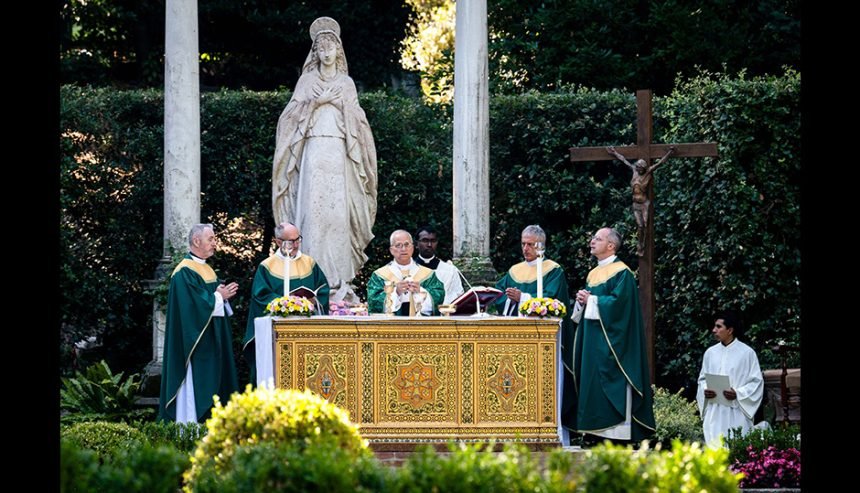
At the same time, DePaul is entering into a partnership with the Vatican’s Laudato Si’ Center for Higher Education, established by Pope Francis in 2023 to carry out education on the economy of sustainability and ecology and housed at Borgo Laudato Si’ at Castel Gandolfo, the papal retreat, in Italy.
“We’re putting the good work in the context of this mission,” Klimas said. “What can we do to better live out our mission?”
“As a Catholic, Vincentian university, DePaul recognizes that caring for our common home is inseparable from caring for one another,” said Robert L. Manuel, DePaul’s president. “The health of our planet directly affects the well-being of people and communities around the world, particularly those most vulnerable to a changing environment.”
DePaul and the center have proposed several joint initiatives, including developing executive education and certification offerings to engage students and working professionals with the principles of “Laudato Si’.” The proposed courses incorporate curriculum on ethical leadership, including the exploration of artificial intelligence for the common good and sustainable business practices, supporting professionals in driving social good across industries.
“Borgo Laudato Si’ was established to offer a model of integral ecology that can be shared and replicated around the world. The Global Alliance, established here in March 2026, gives concrete expression to this vision by bringing together universities and research institutions committed to caring for our common home,” said Cardinal Fabio Baggio, director general of the Laudato Si’ Center for Higher Education.
“DePaul University’s participation strengthens this network and creates new opportunities to equip younger generations to become protagonists of the change our world needs. We look forward to the lasting fruits this collaboration can bring to education, research and the common good.”