The University of Texas at San Antonio is exploring how innovation, research and community collaboration can make downtown streets more comfortable, walkable and connected.
Through the Nueva Nueva initiative, the university is reimagining Nueva Street in Downtown San Antonio. By examining nature-based solutions and innovative active cooling measures, the study seeks to transform Nueva Street into a more inviting and comfortable pedestrian corridor, elevating its role as a key connection between the Downtown Campus, San Pedro I and II, and Hemisfair Park.
Funded through a $1.21 million award from the Alamo Area Metropolitan Planning Organization (AAMPO), the initiative aligns with the agency’s mission to guide regional transportation planning and support the area’s long-term growth and mobility needs.
“The Nueva Nueva initiative reflects UT San Antonio’s commitment to helping shape a vibrant, connected and resilient downtown,” said Joshua Gerken, associate vice president of asset management. “By bringing together research, innovation and community engagement, we’re exploring how our downtown footprint can serve as a catalyst for improving quality of life, strengthening mobility and creating public spaces that better serve students, residents and visitors for generations to come.”
The scope of the initiative includes outdoor comfort and economic impact analysis, transit planning and a feasibility study. Community engagement will help inform and support the project, while faculty and student research will contribute to the study’s eventual recommendations.
A key area of focus is heat resiliency. UT San Antonio faculty with expertise in extreme heat and urban heat island effects will help integrate those considerations into transit planning and project recommendations.
“What is especially exciting is how the project brings research, education and practice together,” said Farzad Hashemi, PhD, assistant professor of architecture and coordinator of the Graduate Certificate in High-Performance Design and Sustainability (HPD&S). “Our faculty and students are combining spatial mapping, thermal and environmental monitoring, traffic analysis and microclimate modeling to understand existing conditions and test where cooling strategies can have the greatest impact. The lessons from Nueva Street can help inform more walkable, healthy and heat-resilient public spaces across San Antonio.”
This research opens opportunities to explore strategies to create more comfortable outdoor environments through cooling technologies, green infrastructure and other climate-responsive design approaches. Together, these strategies could help position Nueva as a model for climate-responsive urban development.
“Projects like Nueva Nueva reflect how an urban-serving university can partner with the community to better understand extreme heat and support informed planning that helps San Antonio prepare for a hotter future,” said Esteban A. López Ochoa, PhD, associate professor and program lead of Urban and Regional Planning and associate director of the Sustainable Pervasive Urban Resilience Center.
Hands-on learning opportunities
Hashemi, López Ochoa and other faculty are incorporating the initiative into the classroom, giving students a unique experiential learning opportunity. Through coursework and capstone projects, students from engineering, urban planning, architecture and related disciplines are contributing research, design concepts and prototype technologies that address urban heat and public-space challenges.
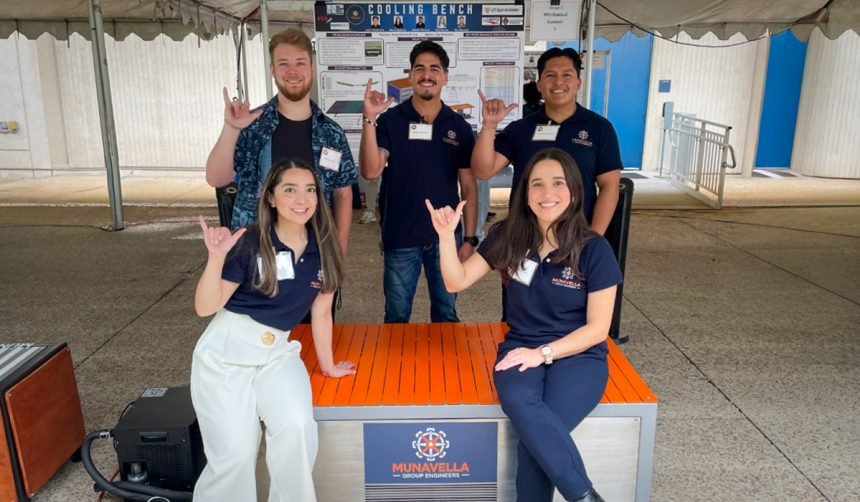
One example of student-driven innovation is a cooling bench designed to reduce surface temperatures through a circulating water system, helping make outdoor spaces more comfortable in extreme heat. Developed by The Munavella Group Engineers team, the project earned first place in the Design I category at the Klesse College Tech Symposium. Although developed separately from the Nueva Nueva initiative, the bench illustrates the type of practical, research-based innovation that can help address urban heat and climate resilience.
“Addressing extreme heat requires solutions that draw from multiple disciplines,” said Lani May, PhD, director of sustainability. “Whether it’s an engineering team creating an active-cooling bench or urban planning students reimagining the corridor’s design, this work demonstrates how academic research can contribute to real-world challenges facing our communities.”

While still in its early stages, Nueva Nueva represents an opportunity to connect research and real-world impact, creating a living laboratory where students, faculty and community partners can collaborate on solutions that support a more sustainable and vibrant downtown San Antonio.
The university anticipates the study to be completed by December 2027. The goal is for the AAMPO to then include the study recommendations in its Transportation Improvement Program, which implements transportation planning initiatives through federal, state and local funding.