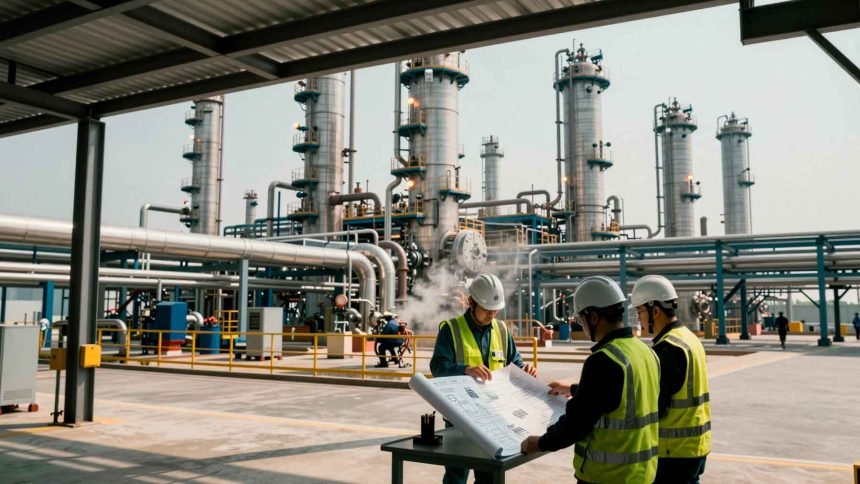
South Korean refiner S-Oil has reached a final investment decision to deploy Axens’ Liquid Phase Isomerization (LPI) technology at its aromatics complex — a move designed to sharpen the facility’s energy performance and expand its paraxylene output.
Under the agreement, Axens will provide a technology license, process design package, and technical services to support project execution and start-up.
S-Oil commits to Axens’ LPI technology with FID
Reaching a final investment decision is a major threshold for any large industrial project. It means feasibility studies are done, contracts are signed, and real money is about to move. For S-Oil, this FID represents a formal, binding commitment to upgrade its aromatics complex using technology that’s already proven itself at facilities around the world.
Global appetite for it has been growing steadily, and producers face real pressure to expand capacity without simply building more energy-intensive infrastructure.
Axens’ scope of work is comprehensive. Beyond the technology license, the French process technology company will deliver a full process design package and provide technical services throughout project execution and start-up — giving S-Oil a single point of accountability as the project moves from engineering into commissioning.
Jungmin Seo, Vice-President of CDU/LUBE/ARO Plant at S-Oil, described the decision as “an important milestone in S-Oil’s strategy to further strengthen its petrochemical competitiveness.” He added that the company is confident LPI technology will enhance both the performance and efficiency of the aromatics complex.
Why S-Oil is investing in liquid-phase isomerization
Paraxylene is a high-demand petrochemical feedstock, used mainly in the production of polyester fibers and PET plastic. Global appetite for it has been growing steadily, and producers face real pressure to expand capacity without simply building more energy-intensive infrastructure.
That’s where liquid-phase isomerization comes in. Most xylenes loops rely on vapor-phase isomerization to convert off-spec xylene isomers back into paraxylene. LPI adds a liquid-phase unit into that loop, and the two work in tandem — letting the facility process more material more efficiently and improving paraxylene yield without a proportional jump in energy consumption.
For S-Oil, this investment fits a broader strategic picture. The company has been working to strengthen its petrochemicals operations, and optimizing the aromatics complex is a direct lever for that. Better efficiency lowers operating costs; higher paraxylene output generates more revenue from the same asset base.
Expected energy and economic benefits of the project
The energy savings case for LPI is one of its strongest selling points. By integrating liquid-phase and vapor-phase isomerization units within the xylenes loop, the technology reduces the overall energy load required to produce paraxylene. Axens describes these savings as “substantial” across the loop as a whole.
Better energy performance doesn’t just cut utility bills — it shifts complex economics in a meaningful way. When a facility uses less energy to produce the same output, margins improve. That matters considerably in a refining and petrochemicals environment where energy costs are a major variable expense.
Reduced emissions are also cited as an expected outcome. Lower energy consumption and fewer emissions tend to go hand in hand, and for a facility operating under increasing environmental scrutiny, that’s a real co-benefit alongside the economic gains. Luc Wolff, Vice-President of the Petrochemistry Product Line at Axens, put it plainly: “By improving overall aromatics complex efficiency, the technology enables significant energy savings while supporting stronger operational and economic performance.”
Background: Axens’ LPI technology and its global deployment
LPI technology has an ownership structure worth understanding. The technology itself belongs to ExxonMobil — one of the world’s largest petrochemicals producers and a major player in xylenes. Axens licenses it commercially, making it available to third-party operators like S-Oil who want to benefit from ExxonMobil’s process innovation without building a proprietary solution from scratch.
That arrangement has produced a solid global footprint. LPI has already been implemented at several aromatics complexes worldwide, and each successive deployment has benefited from continuous improvements in catalyst performance and process optimization. The version S-Oil is licensing today reflects years of accumulated operational learning.
The relationship between S-Oil and Axens also carries some history. Wolff noted the “long-standing relationship” between the two companies in the context of aromatics asset development. That familiarity matters in complex industrial projects — it reduces friction around aligning technical standards, communication protocols, and execution expectations between a technology licensor and an operator.
Substantial energy savings
This FID marks a concrete step forward for S-Oil’s aromatics complex. The company is deploying Axens’ Liquid Phase Isomerization technology — owned by ExxonMobil and commercially licensed by Axens — to improve energy efficiency and expand paraxylene production capacity.
Axens will deliver the technology license, process design package, and full technical services through project execution and start-up. Substantial energy savings across the xylenes loop, improved complex economics, and reduced emissions are all expected outcomes.
The investment reflects S-Oil’s strategy to strengthen petrochemical competitiveness by optimizing existing assets rather than simply adding capacity. LPI has already been deployed at multiple sites globally and continuously refined through successive implementations, so S-Oil is adopting a technology with a genuine track record — and a well-established partner to help bring it online.
Staff Writer
Kelly is an experienced writer with 15 years of experience exploring the big stories that shape our world, from tech breakthroughs and space exploration to climate, energy, and the fascinating quirks of science. She has a talent for turning complex ideas into sharp, memorable insights that stay with readers long after they’ve finished reading.