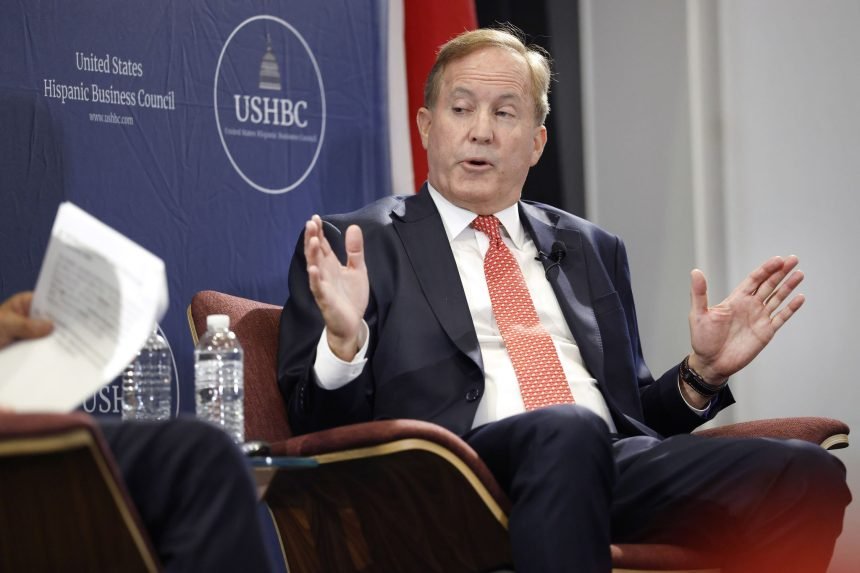
Attorney General Ken Paxton on Monday said there is “plenty of open space in Texas” for data centers, clarifying his stance on a hot-button issue that has divided voters in both parties ahead of the midterm election.
In an interview with the U.S. Hispanic Business Council, the Republican U.S. Senate nominee said the centers offer high-paying jobs, are good for the economy and help the country compete with China.
“This is a yes with conditions,” he told the council’s president, Javier Palomarez, outlining restrictions like preventing data centers from using the electric grid and potentially raising rates for others, along with requiring data centers to recycle their own water so they don’t exacerbate water issues in other areas. “It can’t be a no, because we won’t survive that. China will have a huge advantage over us in artificial intelligence and they will use that to dominate us.”
Paxton said the industry will ultimately be an “economic boom” for both Texas and the rest of the country.
Data centers have become a flashpoint issue this cycle, as candidates try to walk the line between promoting development and alienating communities hesitant to welcome them. That has been especially challenging for Republicans like Paxton, whose base centers on rural voters, many of whom now oppose data centers and the drain they may pose to local energy and water supplies.
Texas now has the second most data centers in the country, according to 2026 data published by Pew Research, behind Virginia. The state currently has 296 data centers operating and 170 more planned, according to that data.
Paxton has not talked much on the campaign trail about the issue, but his campaign released a plan last month to “stop the negative impacts” of data centers.
That plan says Paxton will advocate for legislation to stop technology made in China from being used in data centers, support legislation to create new power systems so centers don’t increase rates and support Gov. Greg Abbott’s plan, which would ban “building AI data centers in rural Texas neighborhoods.”
“I think it’s really important that we go forward, but look, do these things need to be built in a neighborhood?” Paxton said on Monday. “I think there can be some negotiation there about ‘let’s not put it right next to somebody’s house.’ There’s plenty of open space in Texas and in other parts of the country that we can put data centers.”
Abbott, who is in his own competitive reelection battle, recently instituted a pause on data center permits that includes audits of the projects and how they’re using electricity. He has also called on state electricity regulators to ensure that energy costs from the centers don’t get passed on to regular ratepayers.
Paxton recently announced investigations into several data centers that did not respond to a state water use survey, as well as one that may be proposed on public parkland. But his office has so far declined to weigh in on whether counties can block data centers locally, though his campaign proposal expresses support for it. Several counties have asked Paxton to provide guidance on a state law that may prevent them from rejecting data center proposals.
Talarico has joined the chorus of voices in Texas calling for a pause and for tighter restrictions. The plan he released in July mirrors Abbott’s.
The Hispanic Business Council plans to interview Talarico later this week.