



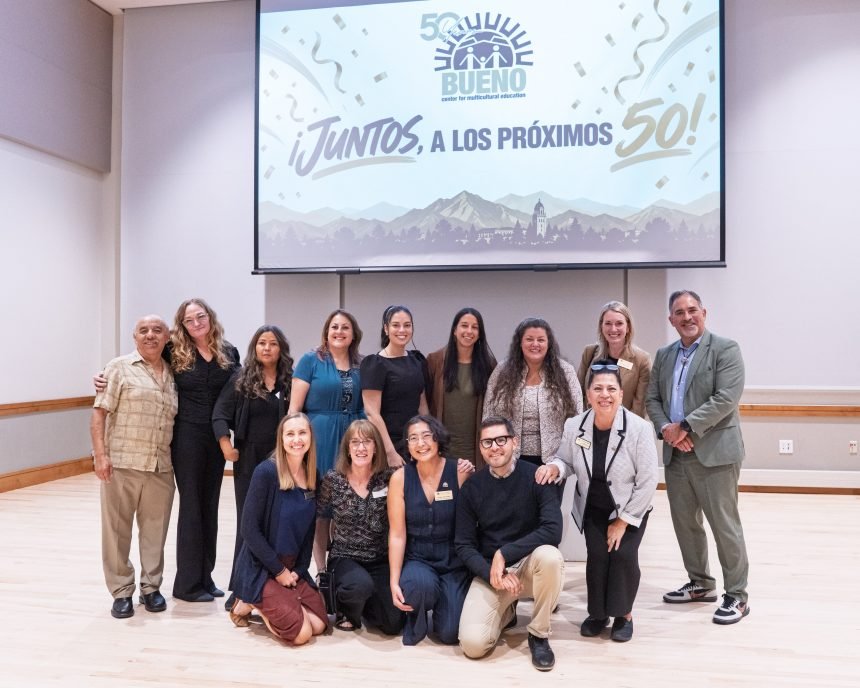
Opening with vibrant folklórico dancers from In Lak’ech Denver Arts and closing with the joyful music of Mariachi Sol de Mi Tierra, CU Boulder’s BUENO Center for Multicultural Education celebrated its historic 50th anniversary with heart, history and community.
The memorable celebration, hosted during Hispanic Heritage Month, honored the cultural roots and visionary leadership that have shaped the BUENO Center since its founding in 1976.
BUENO Center Executive Director Tania Hogan welcomed past and present faculty, staff, students, alumni and supporters with gratitude for the generations who built and sustained the center.
She shared the touching story of BUENO’s beginnings and how it got its name—Bilingües Unidos para Educación y Nuevas Oportunidades, or Bilinguals United for Education and New Opportunities. The center, based in the School of Education, began with a dream of its late founder, Leonard Baca, then an assistant professor of education. Baca hand-delivered his paper-hole-punched proposal to seek federal funding for the new center to the Office of Contracts and Grants in 1976.
Baca’s hands-on approach and vision remain relevant today: bilingualism is an asset and honoring culture in schools helps young people and their communities connect with their learning and share their knowledge.
Baca’s foresight was sparked by the Civil Rights movement and growing attention on educational equity in Colorado in the 1970s, Hogan said.
“Latino communities were asking some fundamental questions about: Who has access to education? Whose language and culture are valued? And who belongs in places like this university?” she said.
“In Colorado schools, Spanish-speaking children were often treated as though their language were the problem. Some were punished for speaking Spanish. Latino students were dramatically underrepresented at universities like CU Boulder, and there were very few bilingual education programs across the state.
“BUENO didn’t begin simply because someone had an idea for a university center. BUENO grew out of a movement for educational opportunity, civil rights and voice.”
At the anniversary celebration, School of Education Dean Amanda Haertling Thein and CU Boulder Chancellor Justin Schwartz highlighted BUENO’s campus, state and national impact—from Baca’s seminal scholarship shaping bilingual special education to serving more than 14,000 migrant students in accessing GEDs and/or higher education through the High School Equivalency (HEP) and College Assistance Migrant or Patitos program.
Over the years, the BUENO Center has secured more than $175 million in research, training and service grants, and it has worked with more than 50 school districts. It has supported more than 1,800 educators in earning college or advanced degrees, including 500+ paraprofessionals and 1,300+ active teachers.
Longtime BUENO program director Tammy Molinar-LeBlanc explained how students and alumni often become part of the “BUENO familia.”
“They came to BUENO as young first year students. We watched them grow up. We knew their names. We knew their families. We celebrated when they graduated. We watched where they went next,” Molinar-LeBlanc said. “And sometimes, years later, they came back—as educators, as colleagues, as partners or bringing another generation with them.”
Hogan shared the current vision for the next generation of BUENO, including stronger educational pathways, deeper community‑driven research, expanded multilingual recognition in education policies and practices and continued connections with partners across Colorado and beyond.
“Fifty years ago, Dr. Baca and the people who built BUENO could not have known exactly what this center would become,” Hogan said. “They could not have predicted every program, every grant, every partnership or every person who would eventually become part of this familia.
“But they knew what they believed in. They believed language was a strength, culture belonged in our schools, and students and families deserved access to opportunity. They believed that a university like CU Boulder had a responsibility not simply to open its doors, but to go out into communities. Those beliefs built our first 50 years and will guide our next 50.”