



Latino entrepreneurs in Greater Philadelphia are launching businesses at a remarkable pace. However, getting those businesses to hire their first employee is another story.
For every Hispanic-owned business with employees in the region, there are about 15 one-person, self-employed operations, according to research from the Economy League of Greater Philadelphia.
For the market as a whole, that ratio is under 5-to-1. Nationally, the Hispanic ratio is 10.8-to-1.
“This is not a story about a community that doesn’t start businesses. Hispanics start businesses in abundance. It’s a story about the wall between self-employment and scale,” said Jeff Hornstein, the Economy League’s executive director.
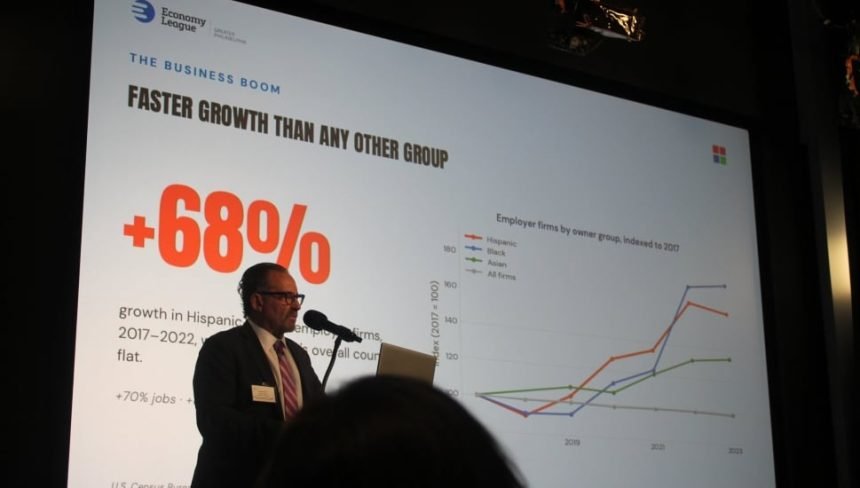
He presented the findings at the Greater Philadelphia Hispanic Chamber of Commerce’s (GPHCC) 2026 State of Hispanic Business Forum on October 22.
The numbers behind that wall start with a community on the rise.
Nearly 450,000 Hispanic residents live across southeastern Pennsylvania’s five counties, and they hold an estimated $13 billion in annual spending power. The region’s Latino population has grown by roughly 100,000 people since 2015, from about 8.5 percent to more than 10.5 percent of all residents.
Hispanic entrepreneurship is surging too.
Hispanic-owned employer firms grew approximately 68 percent from 2017 to 2022, even as the overall number of firms in the region stayed flat.
But self-employed operations are growing even faster, and the firms that do hire tend to stay small. The average Hispanic-owned employer business has about eight employees, compared with 26 for employer firms in the region overall, a gap that hasn’t moved in seven years.
The growth, Hornstein said, “is coming almost entirely from more firms, not bigger firms.”
The result shows up at every rung of the ladder.
Latino residents make up roughly 9 percent to 10 percent of the region’s population, but Latino-owned companies account for just 2 percent of its employer businesses, less than 1 percent of their jobs, and about 0.4 percent of business receipts.
“The community generates enormous demand, but most of those dollars are flowing to businesses the community doesn’t own,” Hornstein said.
‘Not a Pandemic Artifact’
The 15-to-1 ratio has held every year since 2018.
“This is not a one-year number,” Hornstein said. “It’s not a pandemic artifact. This is a structural feature of our regional economy.”
Because the gap is wider here than it is nationally, he argued the problem goes beyond demographics. Adjusted for population, Hispanic residents in the region are less represented among employer-firm owners than Hispanic residents nationwide.
“There’s something specific about our region’s environment we can and should address,” he said.
Black-owned businesses face an even steeper ratio of 15.9-to-1, while Asian-owned businesses sit at 3.2-to-1. Relative to their share of the population, Hispanic and Black residents own businesses at only about a quarter of parity.
Staying small also limits who these businesses can sell to.
Hornstein noted that companies with less than roughly $500,000 to $1 million in annual revenue find it very difficult to win contracts with major institutions like Temple University, CHOP, or Jefferson, and few Latino-owned firms have reached that scale.
Following the Money
The clearest barrier, Hornstein said, is capital.
Only 21 percent of Latino-owned businesses receive the full amount of financing they request, compared with 40 percent of white-owned firms.
When Latino-owned firms are turned down, they’re also far less likely to be told why. Nearly one in three Hispanic households is unbanked or underbanked, which means thinner credit histories when an owner applies for a first business loan.
Hornstein cautioned that the data shows a pattern rather than proving capital is the single cause. Still, he called it the most actionable lever, and it lines up with where entrepreneurs get stuck.
“Startups are abundant. The first hire is the wall,” he said.
The capital gap also starts long before a loan application. Hornstein pointed to the Economy League’s earlier “Know Your Price” report, which tracked about 70 years of Philadelphia property values. It found a $57 billion cumulative gap in home values between Black and brown neighborhoods and majority-white neighborhoods, about half of it in Latino neighborhoods.
“You need the capital to start a business, but you can’t really grow your business and accrue capital without capital to begin with,” he said.
With little family wealth to draw on, many minority-owned businesses start on high-interest credit, which Hornstein called “not a path to growth.”
What It Will Take
Hornstein called for scaling up the city’s Catalyst Fund to $50 million to $100 million, from the roughly $5 million it holds now.
“It’s a good start, but everyone needs to pile on,” he said.
He also laid out three priorities:
“For years, we have celebrated the growth of Latino entrepreneurship, and rightfully so. But today, we want to look beyond business formation and focus on business growth,” she said.
- Close the first-hire financing gap: Loan and technical assistance products built for the leap from self-employed to employer, delivered through CDFIs and banks with Spanish-capable staff.
- Make the growth path navigable: One coordinated, Spanish-capable pathway through the licensing, payroll, and procurement hurdles that pile up as a business grows.
- Commit to measurement: An annual public-data index to track the gap, paired with an owner survey to validate and humanize the findings.

For Jennifer Rodriguez, president and CEO of GPHCC, the findings mark a shift in how the region should think about Latino entrepreneurship.
The first-hire framing struck her as new.
“I don’t think that we talk about small business growth in those terms,” Rodriguez said. “If you don’t hire the first employee, you’re never going to get to the second or the third or the fourth.”
What Comes Next?
The chamber plans to spend the next year asking entrepreneurs what’s keeping them from making that first hire.
The Economy League, meanwhile, is fielding its owner survey with the chamber, and it plans to publish a state of small business report every year, with segments on Latino-owned, African American-owned, and immigrant-owned businesses.
The goal, Hornstein said, is a clear path that turns the Latino community’s entrepreneurial energy into larger businesses, and greater opportunity for the entire region.