



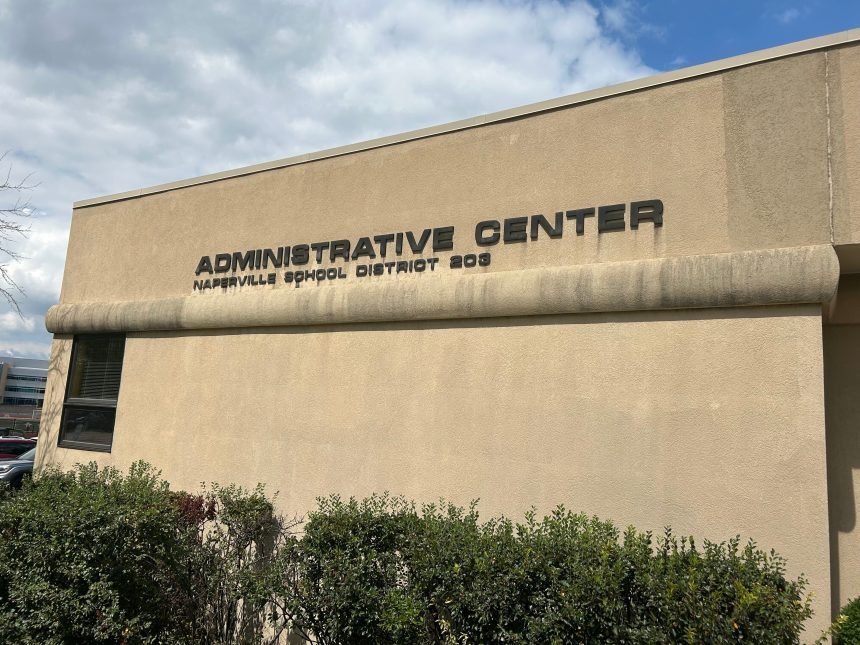
All 21 elementary, junior high and high schools in Naperville District 203 earned the exemplary designation, the highest school performance award issued by the Illinois State Board of Education, according to 2026 Illinois Report Card data released Friday.
The results show the district as high performing and in the top 99% of all unit, or K-12, districts in Illinois, said Patrick Nolten, D203 assistant superintendent for assessment, accountability and information.
The Illinois Report Card data looks at a variety of measures, including academic proficiency, student growth, graduation rates and other indicators related to student engagement and progress.
Exemplary status, which is the state’s highest level of performance, was given to about 28% of schools statewide with the next highest status, approaching exemplary, given to nearly 21% of schools. The next highest ranking of commendable, which is a typical or average performance, was attained by about 30% of state schools.
“This is an achievement we are incredibly proud of, but what makes it most meaningful is the people behind it,” Superintendent Dan Bridges said in a statement. “Our students bring their best efforts and unique strengths to school each day. Our educators and staff work to help every child learn and grow, and our families are essential partners in that work. To see all 21 schools receive this recognition is a tremendous honor, and one our entire community can share.”
District leaders will study the data and look for ways academic performance can continue to improve, Nolten said.
Among the ongoing work is to support the proficiency, growth and success of various subgroups, such as those with economic disadvantages, Black and Hispanic students, and individuals with disabilities, he said.
The data was compiled from various tests taken this past spring by students in 3rd through 11th grades, with about 99% of district students taking the exams.
In March, District 203 administered the Illinois Assessment of Readiness to about 7,300 students in 3rd through 8th grades.
In April about 3,600 high school students in 9th to 11th grades were given the ACT Suite of assessments, Nolten said.
Freshman and sophomore students are given a pre-ACT test while high school juniors take the ACT exam, which also includes an essay. All high school students are required to take the ACT exam to graduate, although some students with significant disabilities are given an alternative test.
All students were tested in English language arts and math. Students in 5th, 8th and 11th grades also take a science test.
On the Illinois Assessment of Readiness test, 82% of district students are proficient in the English language arts category and 71% are proficient in math, which is the exact same as the district’s scores last year.
On the English language arts portion of the ACT, district students rose from 78% proficient last year to 81% this year. In math, proficiency decreased from 72% last year to 70% this year.
Nolten said each percent change, whether up or down, represents about 12 students, so the differences between last year and this year are not statistically significant.
The district’s data also reflects statewide trends with overall proficiency in math decreasing statewide since last year, he said.
By grade level, in English language arts, data shows about 78% of district students proficient in 3rd grade, rising to about 84% proficient in 4th and 5th grades, dipping to 82% proficient in 6th and 7th grades and rising to 84% proficient in 8th grade.
Data shows high school students are about 85% proficient in English language arts in 9th grade and 76% proficient in 11th grade.
In math, 3rd grade students are about 77% proficient. The proficiency decreases to about 69% in 6th grade, then goes up to 72% in 7th grade and dips to 66% in 8th grade.
Data shows high school students are about 74% proficient in math in 9th grade, 65% proficient in 10th grade and 72% proficient in 11th grade.
District officials also looked at various subcategories, including race and if the students have a disability, are learning English or come from low-income families. Some students may fall into more than one subcategory.
When looking at the various subgroups, district students exceed students across the state.
About 90% of district Asian students are proficient in English language arts compared to about 80% of the statewide Asian population on the Illinois Assessment of Readiness exam. Test results show about 85% of district White students are proficient compared to 68% statewide; 68% of district Hispanic students are proficient compared to 44% statewide; and about 52% of district Black students are proficient compared to 35% of students statewide.
In high school English language arts, data shows about 91% Asian, 84% White, 58% Hispanic and 48% Black proficient across the district. Data shows that the district’s Hispanic population showed the biggest jump in English language arts proficiency from 48% proficiency last year to 58% this year.
Statewide data shows about 82% Asian, 67% White, 41% Hispanic and almost 33% Black high school students are proficient in English language arts.
Looking at the math scores, about 87% of district Asian students are proficient compared to almost 72% of the statewide Asian population on the Illinois Assessment of Readiness exam. Test results show about 73% of White students are proficient compared to 52% statewide; 50% of Hispanic students are proficient compared to 26% statewide; and about 27% of district Black students are proficient compared to about 17% of students statewide.
In high school math, data shows about 88% Asian, 72% White, 47% Hispanic and 29% Black proficient across the district.
Statewide data reports that 74% Asian, 51% White, 25% Hispanic and 15% Black students are proficient in high school math.
Nolten said the subgroups that have lower proficiency are still among the best in the state and each subgroup has students performing at a variety of levels.
That said, the district acknowledges that more work needs to be done, he said.
“Despite all these accolades, we still have areas that we need to improve,” he said.
Closing achievement gaps is an ongoing process at the district and building levels, Nolten said. Teachers work on supports and techniques that help each individual student maximize their potential, he said.
Every school creates an improvement plan that looks at how it is doing in math, science, English language arts, social-emotional learning, engagement and other metrics.
The district also ranks at the top of its core subjects compared with peer districts such as Indian Prairie District 204, Barrington Unit District 220, St. Charles Unit District 303, Batavia School District 101 and Elmhurst Unit District 205. Nolten said only Elmhurst edged out District 203 in math scores by about 0.2%.
The district is better than the state average in terms of chronic absenteeism at 13% compared to the state average of 24%, Nolten said. The district’s truancy rate is 2% compared to 19% for Illinois.
About 88% of district students head to post-secondary programs, including two- and four-year colleges and universities, trade schools or beauty and cosmetology schools, Nolten said.
The district also boasts a 94.7% graduation rate compared to the state’s graduation rate of 89.8%.
Michelle Mullins is a freelance reporter for the Naperville Sun.